

Adult ADHD Assessment and Treatment Bundle (2026)
An adult ADHD assessment and treatment bundle: a diagnostic interview, ASRS v1.1 and Wender Utah scoring, executive function measures, a treatment plan and executive function coaching worksheets.
What is in the bundle
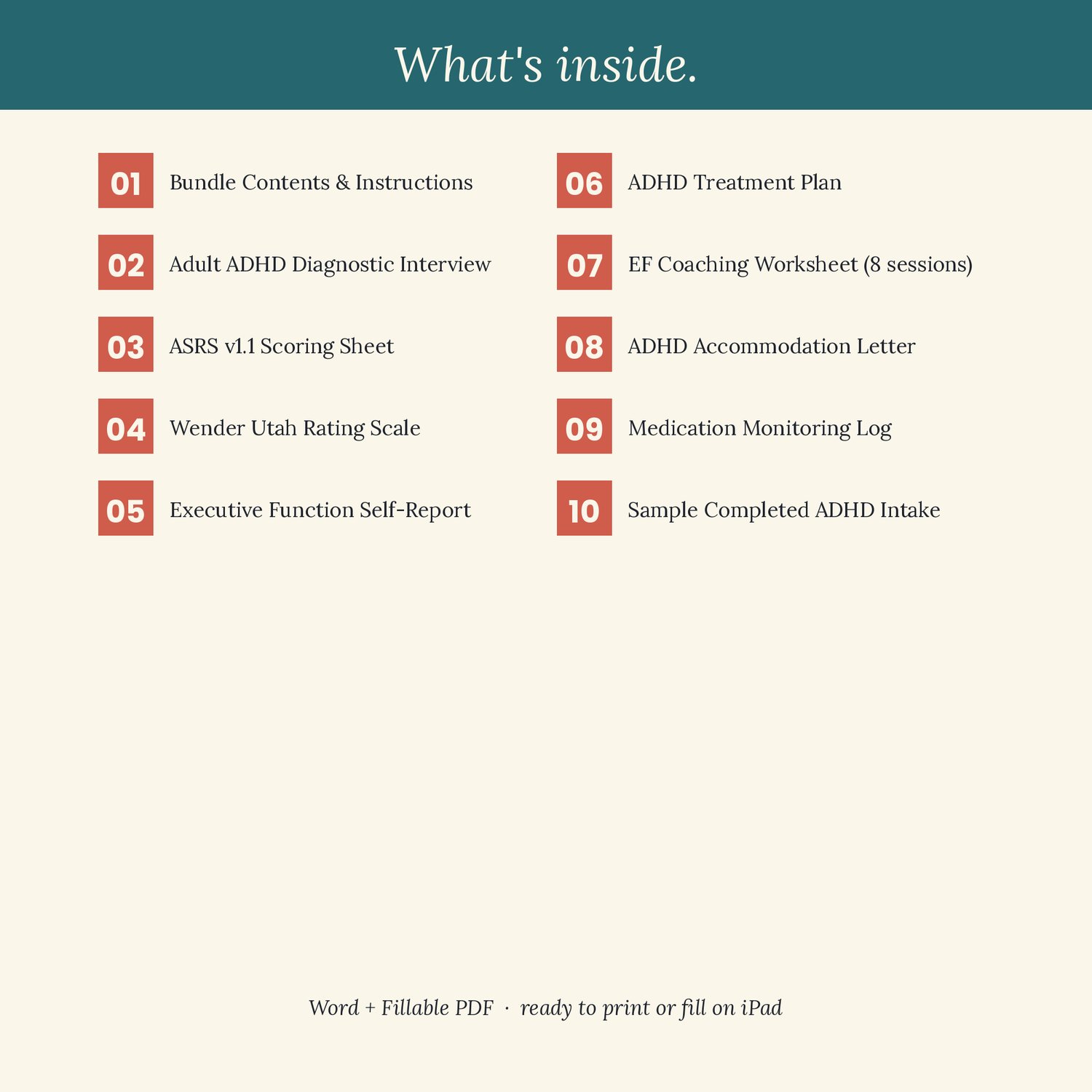
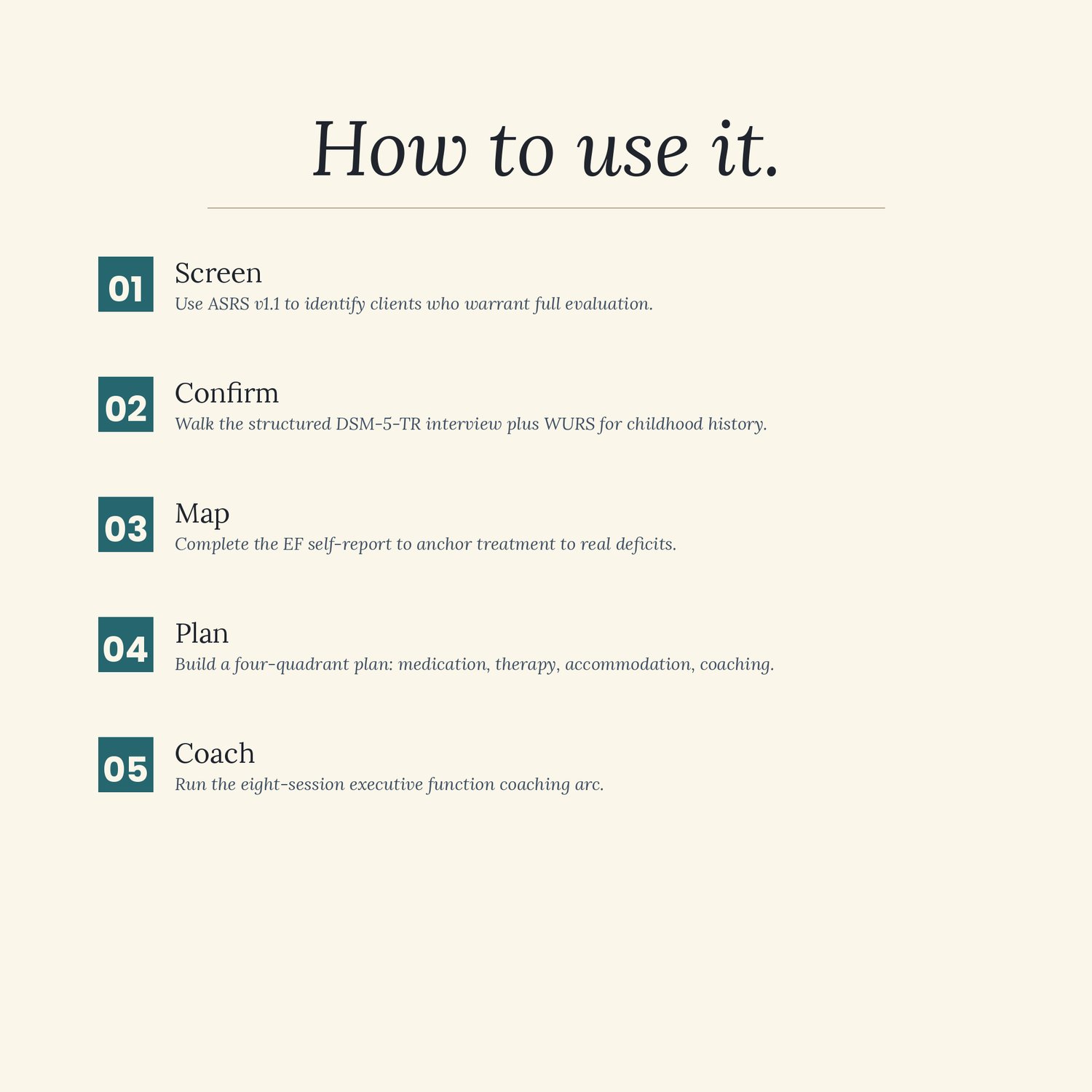
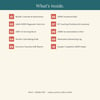
- Section 1: Bundle contents and instructions for use, with the reference list (DSM-5-TR 2022, Kessler et al. 2005 ASRS, Ward, Wender and Reimherr 1993 WURS, Barkley 4th edition 2015, Ramsay 2nd edition 2020, AAP 2019 Clinical Practice Guideline)
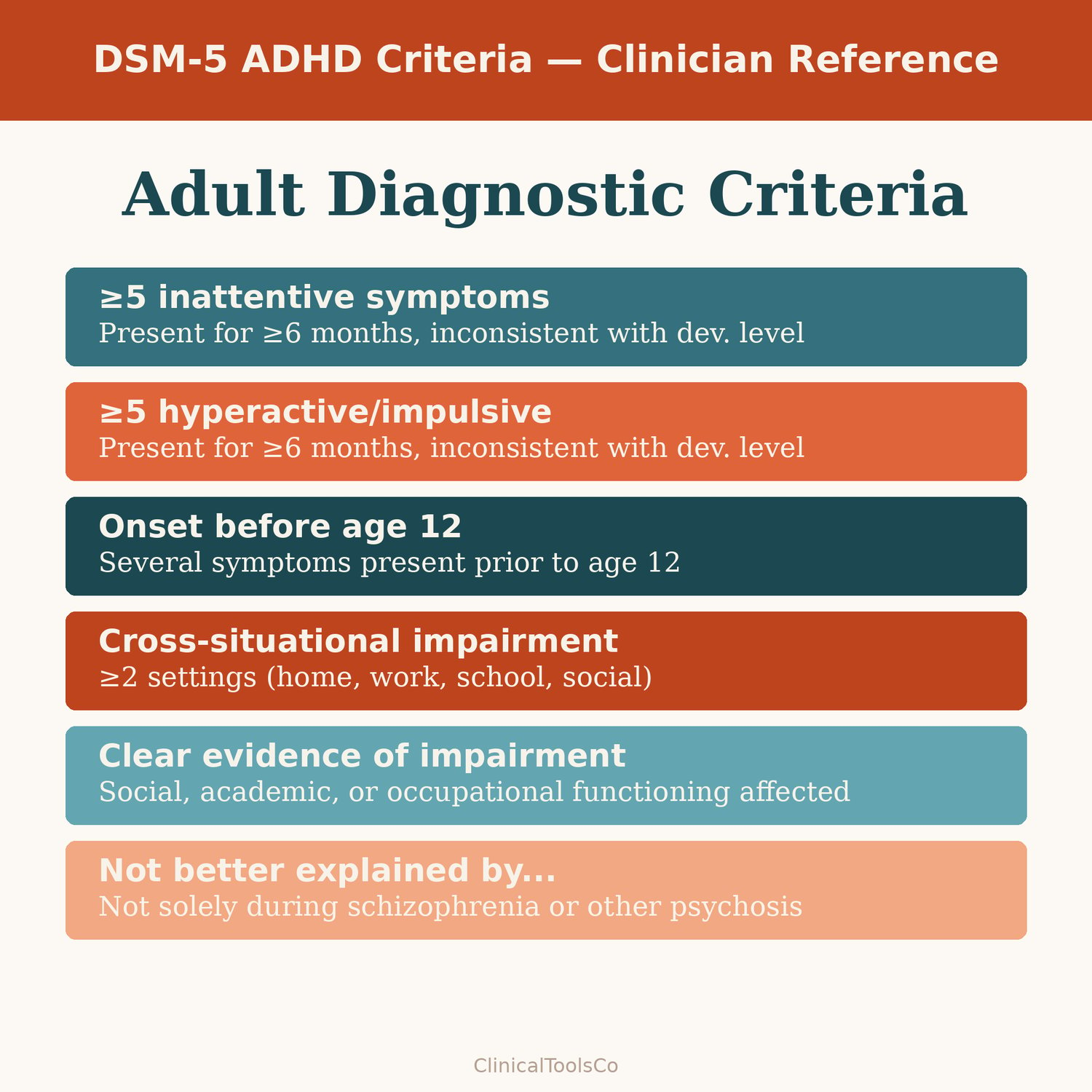
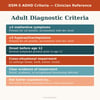
- Section 2: Adult ADHD diagnostic interview. Structured walkthrough of Criterion A (nine inattention plus nine hyperactivity-impulsivity symptoms), Criterion B (age of onset before 12 with collateral source), Criterion C (impairment in two or more settings), Criterion D (functional impairment) and Criterion E (rule-out), with developmental anchoring throughout
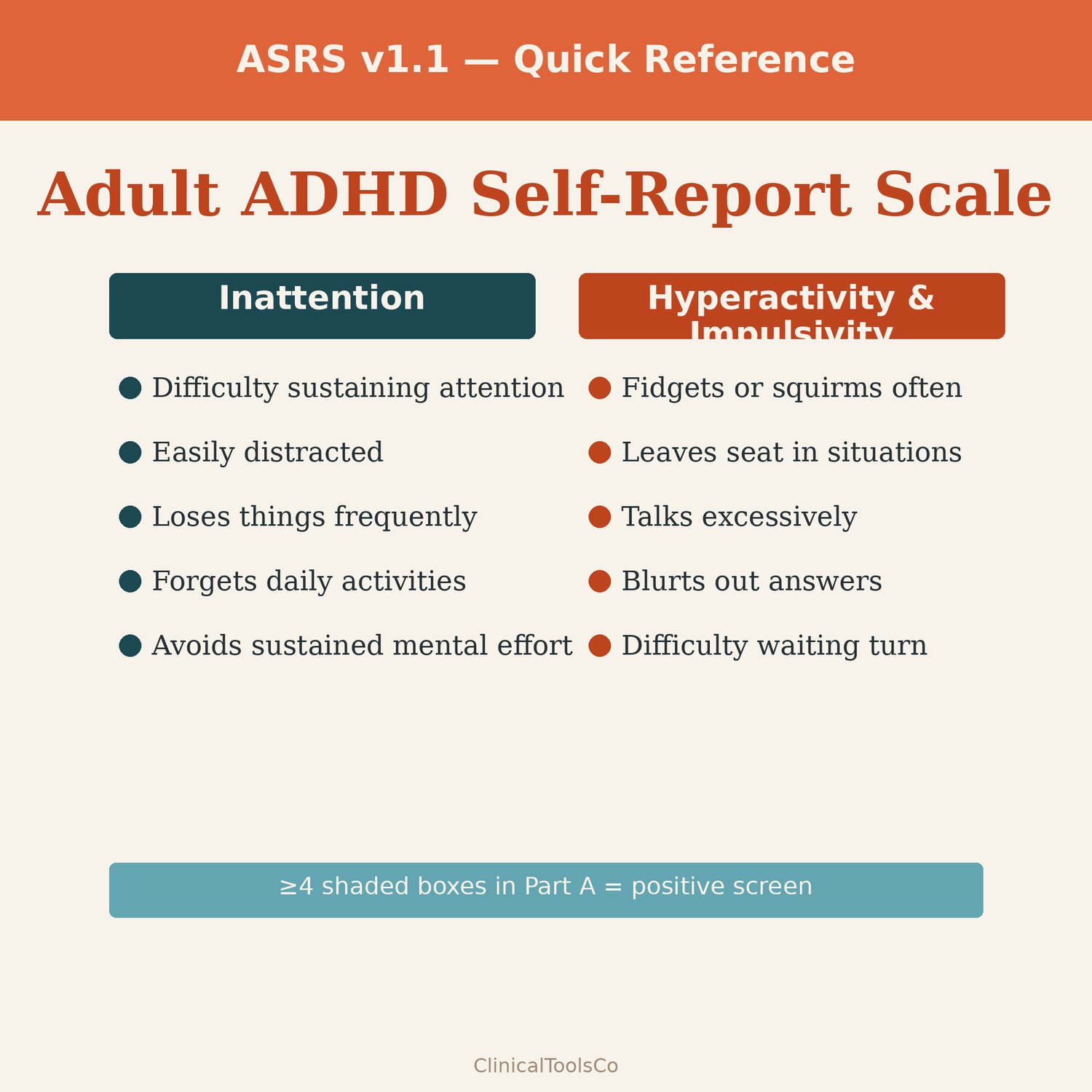
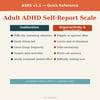
- Section 3: ASRS v1.1 scoring sheet. Six-item Part A screener with WHO-validated cutoffs, twelve-item Part B, full scoring instructions and interpretation
- Section 4: Wender Utah Rating Scale. Retrospective childhood ADHD self-report used for adult diagnostic confirmation when collateral history is limited
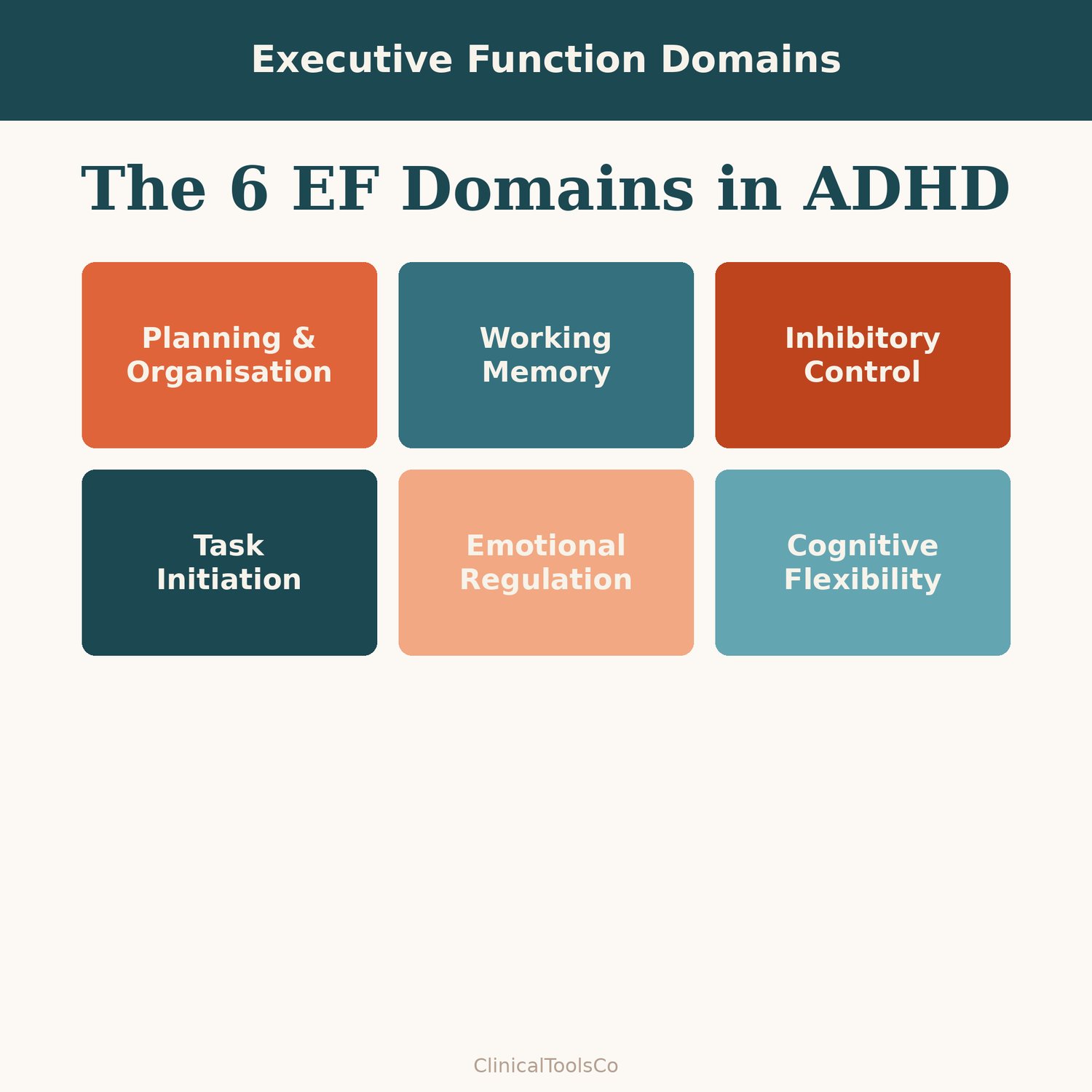
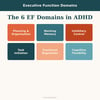
- Section 5: Executive function self-report. Nine-domain rating tied to treatment targets across attention regulation, working memory, planning, task initiation, emotional regulation, response inhibition, organization, time management and sustained effort
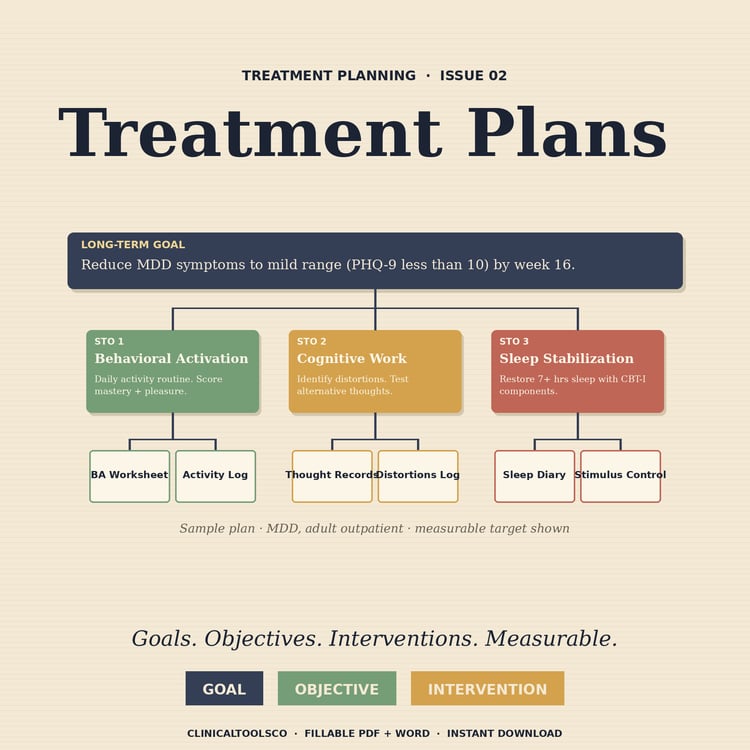
- Section 6: ADHD treatment plan template. Four-quadrant plan covering medication coordination, therapy, accommodation and skill coaching with measurable goals
- Section 7: Executive function coaching worksheet. Eight-session structured template covering goal articulation, planning, time mapping, environmental engineering, accountability, follow-up and generalization
- Section 8: ADHD accommodation letter. Template for school (504, IEP, college disability office), employer (ADA) or testing agency requests
- Section 9: Medication monitoring log. Dose, response, side effects, sleep, appetite, mood and follow-up tracker for coordination with the prescribing PCP or psychiatrist
- Section 10: Sample completed ADHD intake. Clinical exemplar showing criterion-by-criterion documentation, scored ASRS and WURS results, and the treatment plan rationale
Who it is for
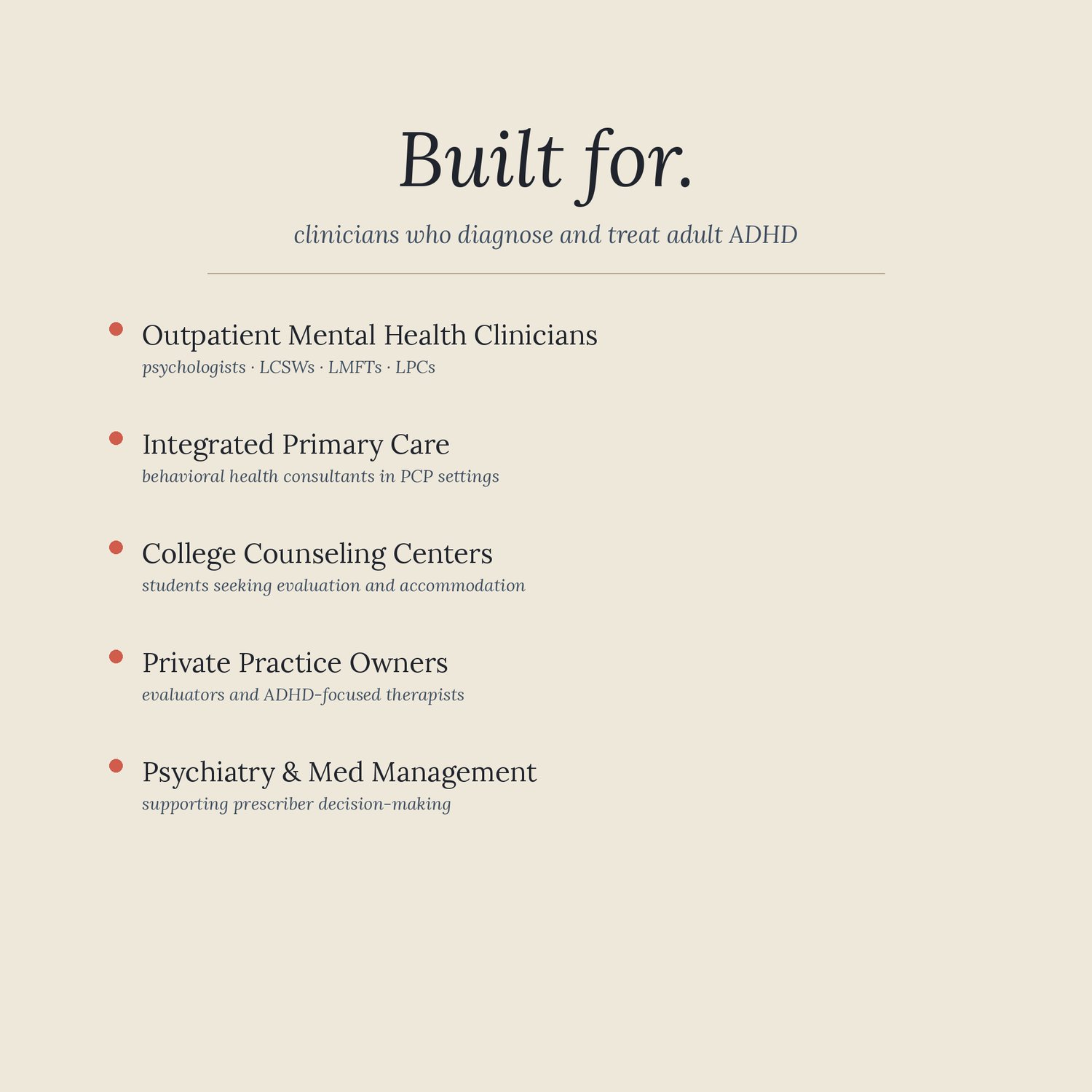
- Licensed clinicians (LCSW, LMFT, LPC, LCMHC, LMHC, PsyD, PhD) doing adult ADHD evaluation and treatment in outpatient practice
- Integrated primary care behavioral health clinicians working alongside the PCP
- College and university counseling center clinicians evaluating students and writing accommodation letters
- Psychiatric nurse practitioners and psychiatrists doing ADHD diagnosis, medication and coordination
- Pre-licensed clinicians and trainees building their first adult ADHD evaluation under supervision
- Clinical supervisors teaching adult ADHD evaluation and coaching
- Group practice owners standardizing ADHD evaluation and treatment plan documentation
- Adult ADHD coaches who want a clinically defensible coaching worksheet structure
Why it exists
The adult client tells you they have always struggled with focus and they think it might be ADHD. You have a generic intake template that does not walk DSM-5-TR Criterion A through E, no validated screener, no retrospective childhood symptom tool, no executive function self-report, and no accommodation letter template for the school or employer they will ask you to write to next week.
This is the ADHD binder I built after my fifth adult ADHD evaluation, when I realized the diagnostic interview that meets DSM-5-TR Criterion A through E with developmental anchoring and the validated screeners (ASRS v1.1, Wender Utah Rating Scale) all live in different places, and the medication monitoring log and accommodation letter the work actually requires are usually missing entirely.
34 pages covering the full evaluation, diagnosis, treatment planning, accommodation and coaching workflow for adolescent and adult ADHD. Built for outpatient mental health, integrated primary care, college counseling and private practice. Written by a practicing clinician for licensed clinicians and supervised pre-licensed staff.
Why this is different
Most adult ADHD intake templates online are a one-page symptom checklist with no DSM-5-TR criterion walkthrough, no validated screener, no retrospective childhood anchor and no executive function dimension. The result is an evaluation that misses Criterion B entirely, and a treatment plan that does not address what the patient actually needs help with on Monday morning.
The structured diagnostic interview matters because Criterion B requires evidence of symptom onset before age 12 and collateral childhood history is often unavailable. This version surfaces the question, prompts for source, and documents the rationale a board reviewer or insurance auditor expects.
The ASRS v1.1 matters because it is the WHO-validated short screener for adult ADHD and the one insurance reviewers, primary care colleagues and disability evaluators recognize.
The Wender Utah Rating Scale matters because in adults presenting without childhood records or living parents, retrospective self-report is often the only way to establish Criterion B.
The executive function self-report matters because medication alone does not address the deficits that drive functional impairment. The nine-domain rating ties directly to coaching targets and accommodation requests.
The accommodation letter template matters because patients diagnosed with adult ADHD will need a letter for a college disability office, an employer ADA process or a testing agency, and most clinicians end up improvising one under time pressure.
Format
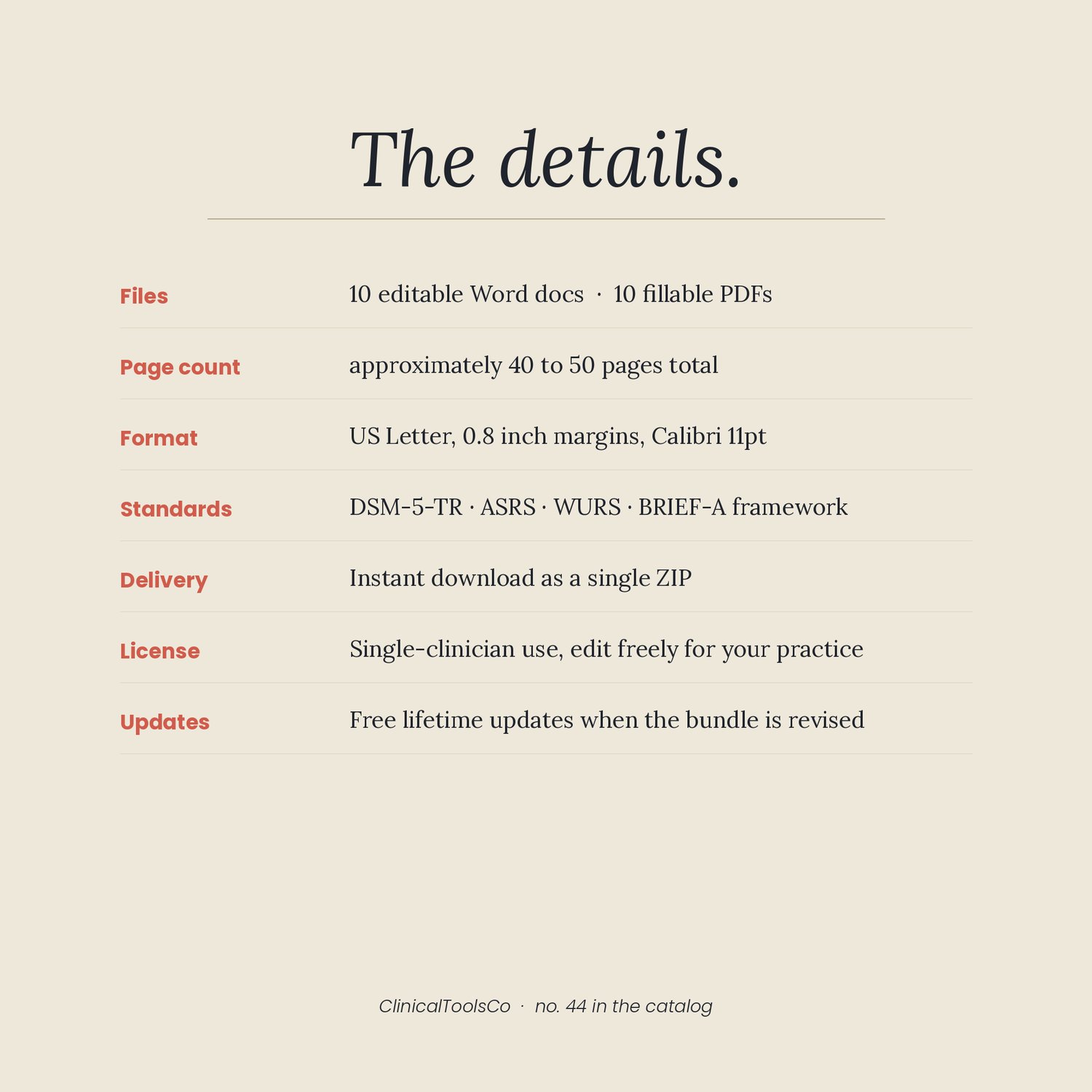
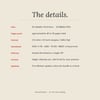
- Fillable PDF and editable Microsoft Word (.docx)
- Diagnostic interview, screeners, treatment plan, coaching worksheet, accommodation letter and medication monitoring log ready to drop into your EHR
- US Letter page size
- Works on Mac, Windows, iPad, GoodNotes, Notability
- Lifetime access, unlimited prints
Updated 2026
References DSM-5-TR (American Psychiatric Association, 2022), Kessler et al. (2005) Adult ADHD Self-Report Scale v1.1, Ward, Wender and Reimherr (1993) Wender Utah Rating Scale, Barkley (2015) fourth edition handbook, Ramsay (2020) Cognitive Behavioral Therapy for Adult ADHD second edition, and the American Academy of Pediatrics (2019) Clinical Practice Guideline. Uses ICD-10-CM F90 codes as used in DSM-5-TR practice.
A note from the designer
I am a practicing clinician. I built this after my fifth adult ADHD evaluation. The section I send every supervisee is the diagnostic interview, because adult ADHD evaluations done without a Criterion B age-of-onset anchor are the ones that get challenged in board reviews and disability appeals.
Good evaluations open doors. Good documentation keeps them open.
Digital download. No physical product ships. Reach out by email if anything does not work or if you have questions.