


Couples and Family Therapy Toolkit (2026)
A couples and family therapy toolkit: couples and family intake assessments, genograms and relationship mapping, and a couples treatment plan, with EFT, Gottman and IBCT documentation language.
What is inside
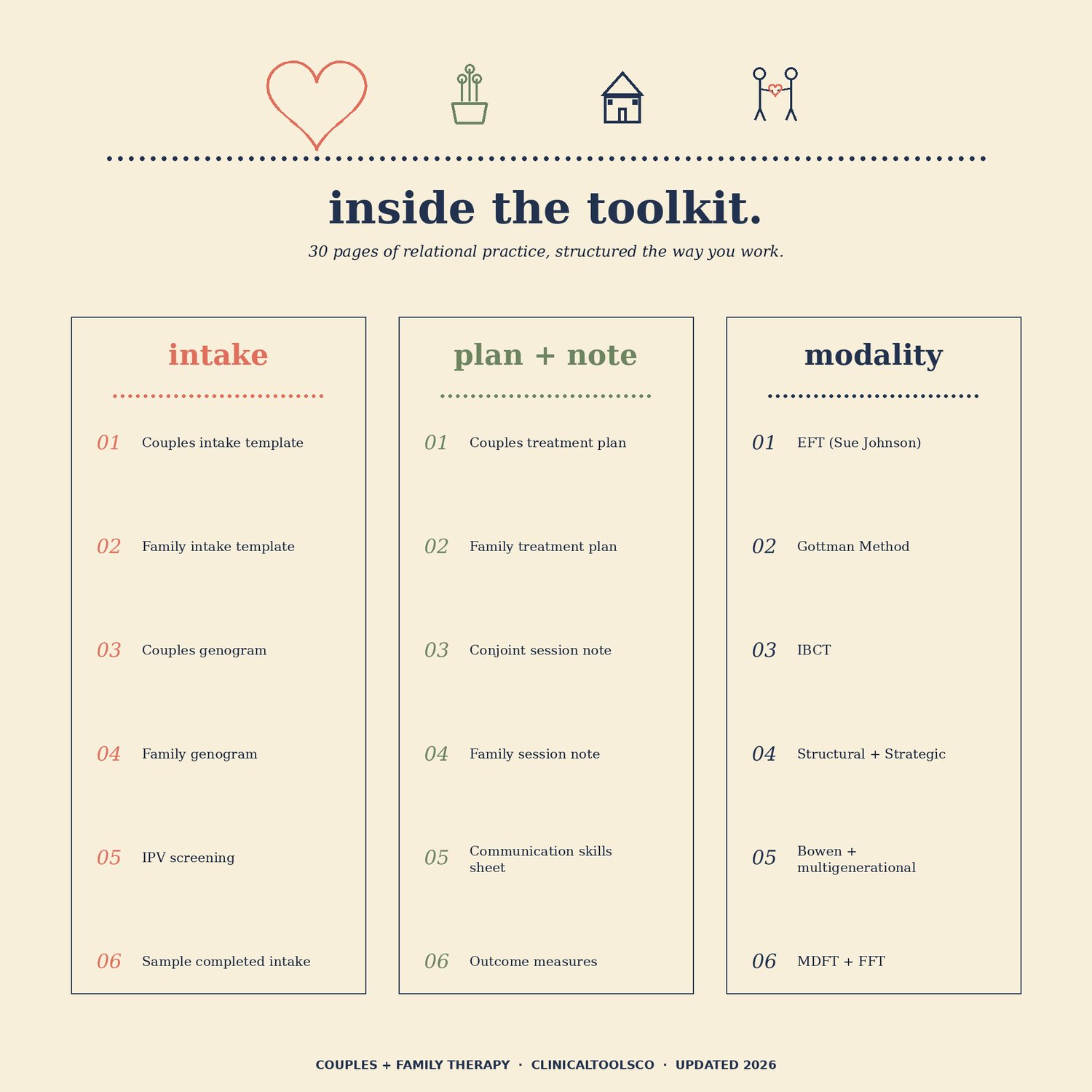
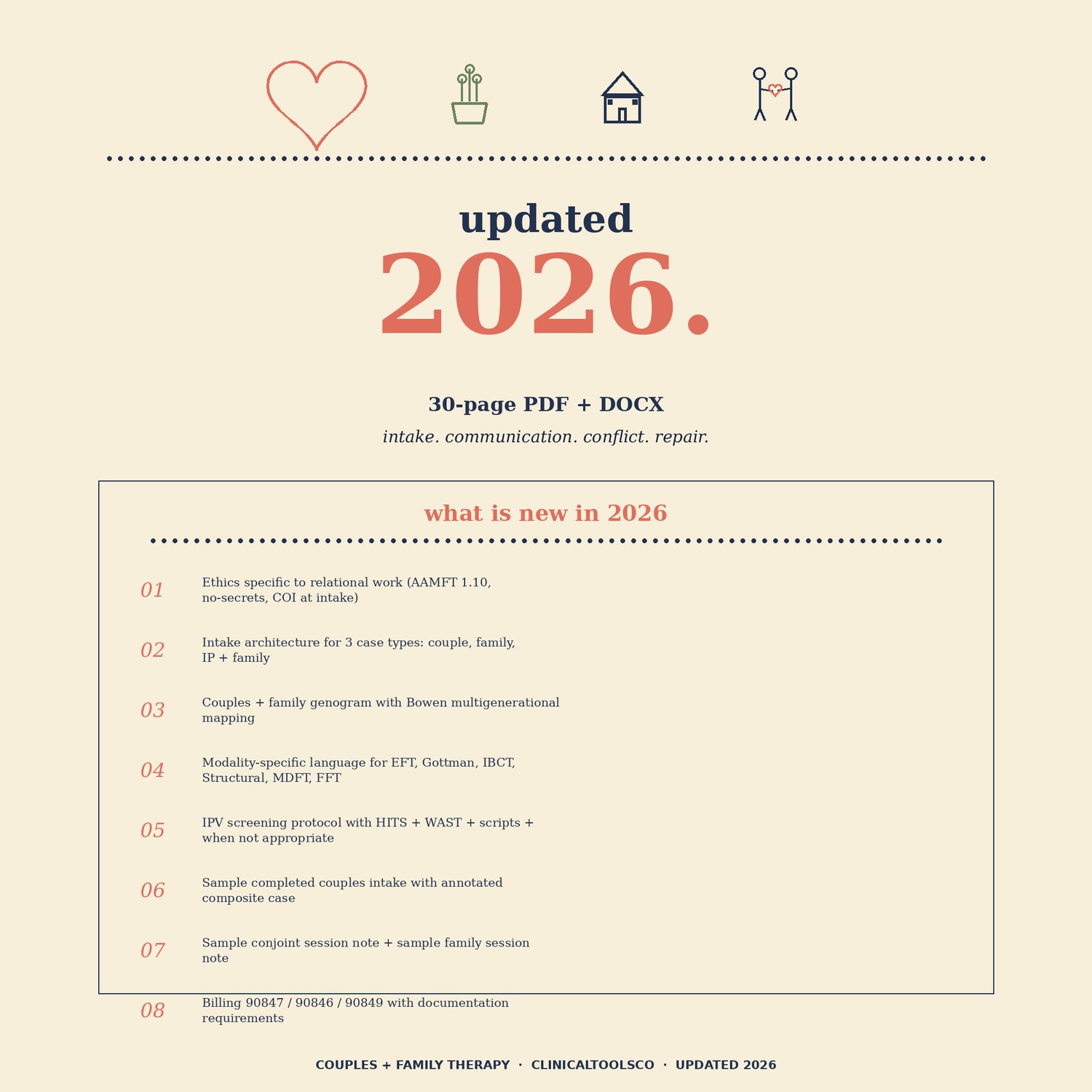
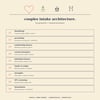
- Setup foundation (Sections 1 to 4): how to use it, five ways relational therapy differs from individual work, ethics specific to relational work (AAMFT Standards 1.10, 2.1, 2.2, 2.4, 3.4) with no-secrets policy and conflict-of-interest sample consent language, and the three intake architectures, couple as patient, family as patient, and identified patient plus family.
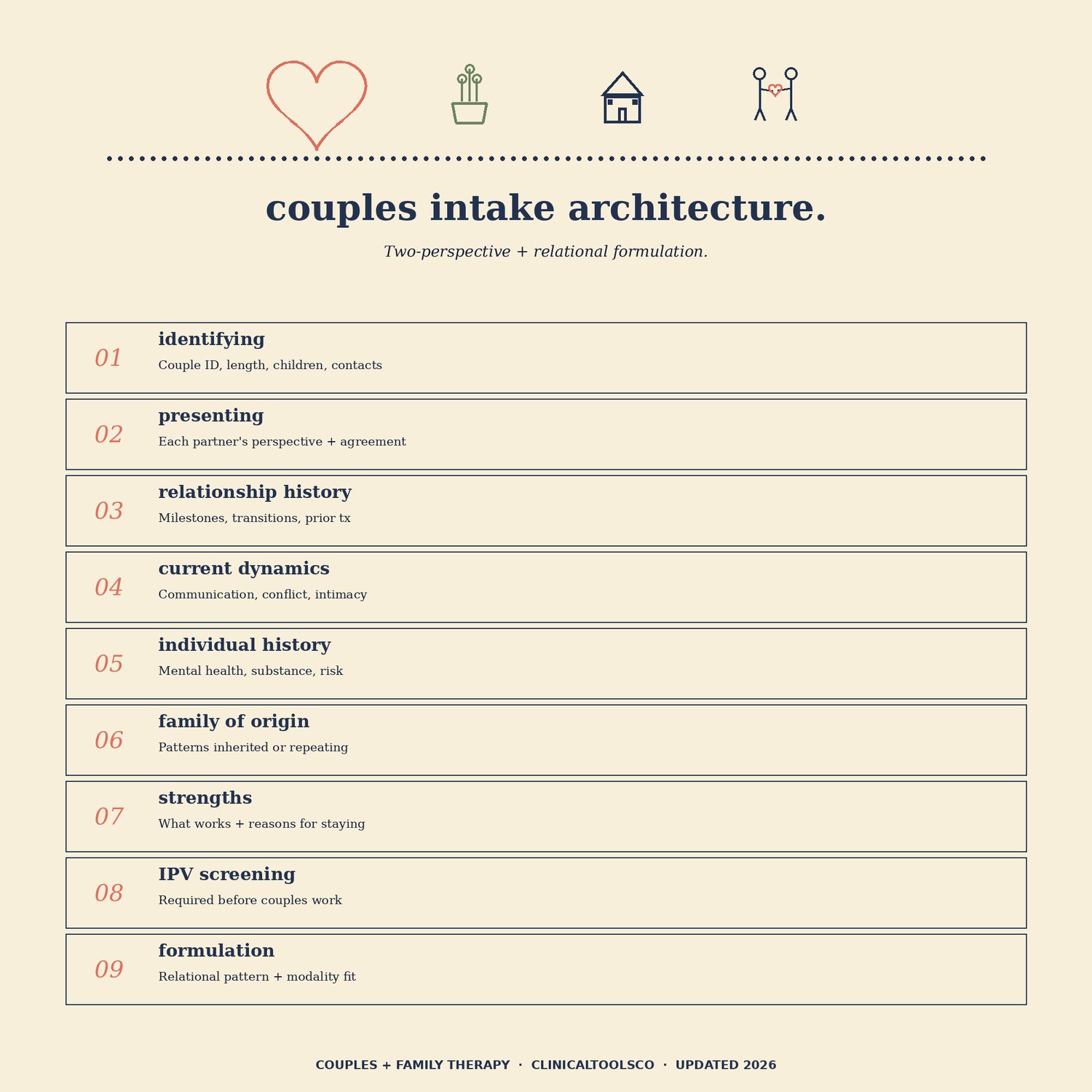
- Two-perspective Couples Intake Assessment (Section 5): each partner's presenting concern, relationship history, current dynamics, individual mental health history and risk, family of origin, strengths, IPV screening placeholder, and clinical formulation.
- Family Intake Assessment (Section 6): family composition, each member's perspective, family history, subsystem and triangulation patterns, individual member history, school and work context, cultural and spiritual context, family-level safety, strengths, and a system-level formulation.
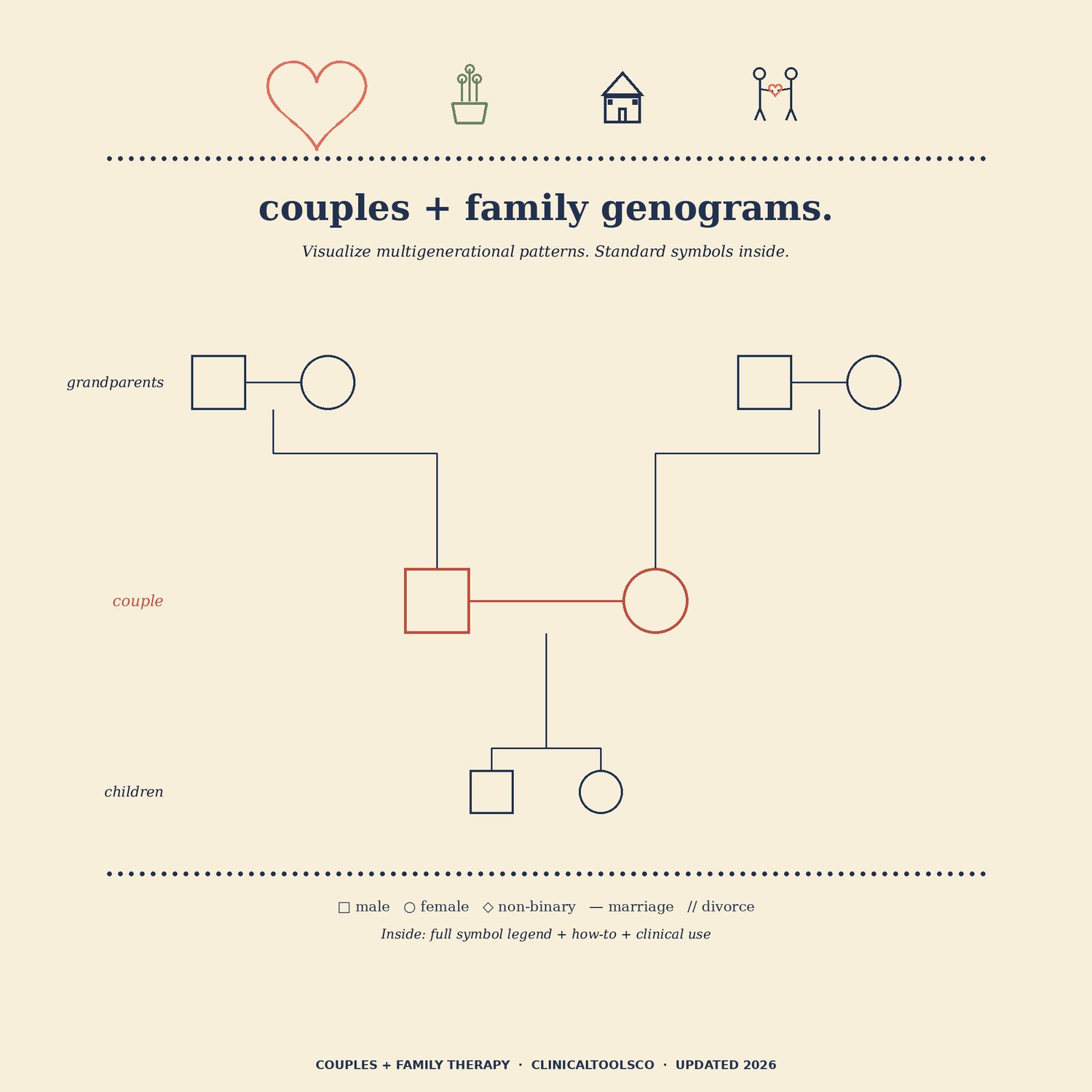
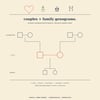
- Couples Genogram and Relationship Mapping (Section 7): standard symbols, a three-generation drawing workflow, and a pattern identification protocol.
- Family Genogram and Multigenerational Mapping (Section 8): a Bowen-informed three-generation workflow covering multigenerational transmission, triangles, fusion versus differentiation, emotional cutoff, sibling position, and family projection process.
- Couples Treatment Plan (Section 9): relational and individual goals at long and short horizons, a sample plan built on Gottman and EFT, and dyadic outcome measures (CSI, ECR-R).
- Family Treatment Plan (Section 10): system-level and IP-specific goals, a sample plan using Structural plus MDFT plus Bowen, and multi-source outcome tracking including FACES-IV.
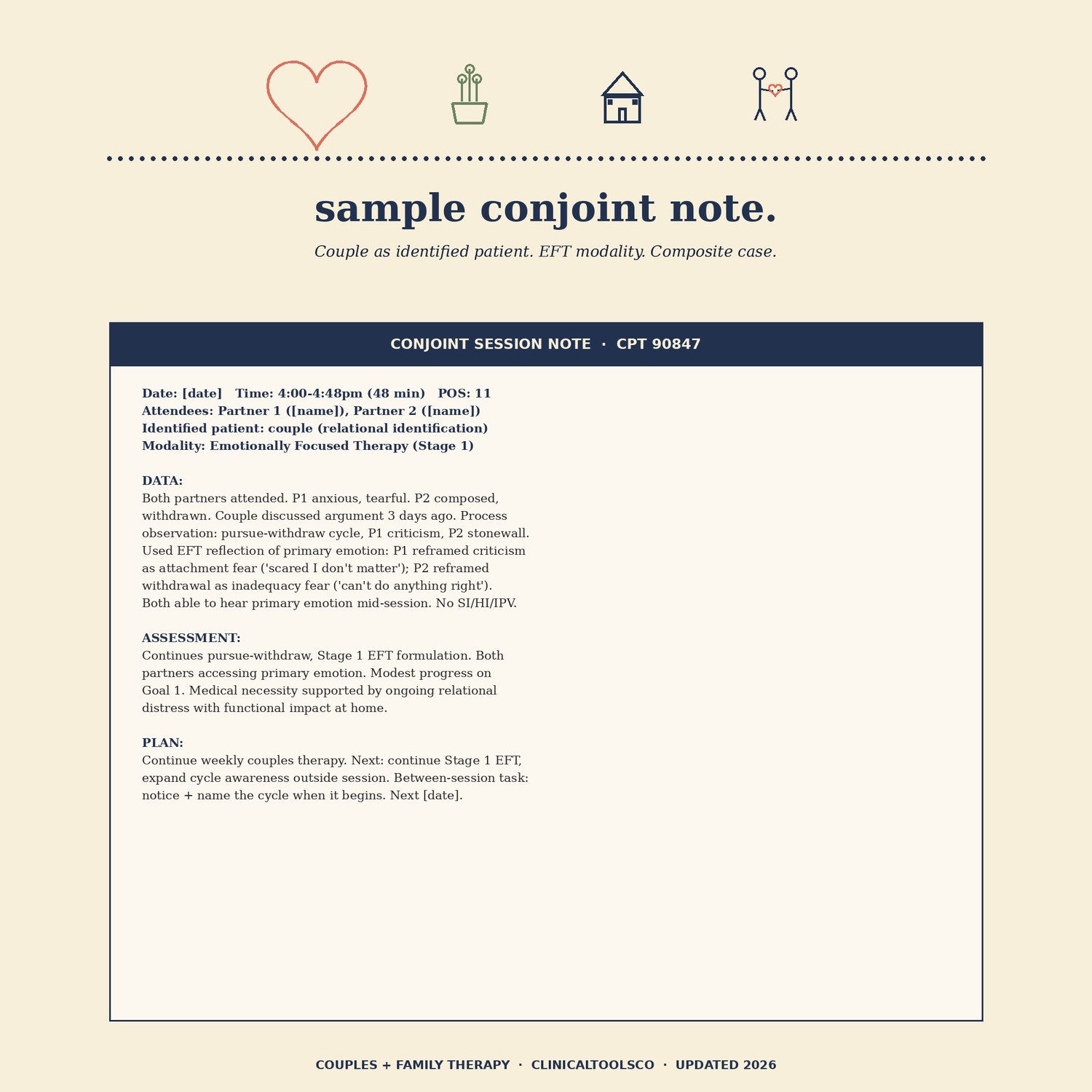
- Conjoint Session Note (Section 11) for CPT 90847, with a full DATA, ASSESSMENT, PLAN sample note written in EFT Stage 1 format.
- Family Session Note (Section 12) for CPT 90847 and 90849, with a full sample note in Structural Family Therapy format.
- Sample completed couples intake (Section 13): an annotated composite case showing presenting concerns, dynamics, IPV screening, formulation, diagnosis, and modality selection.
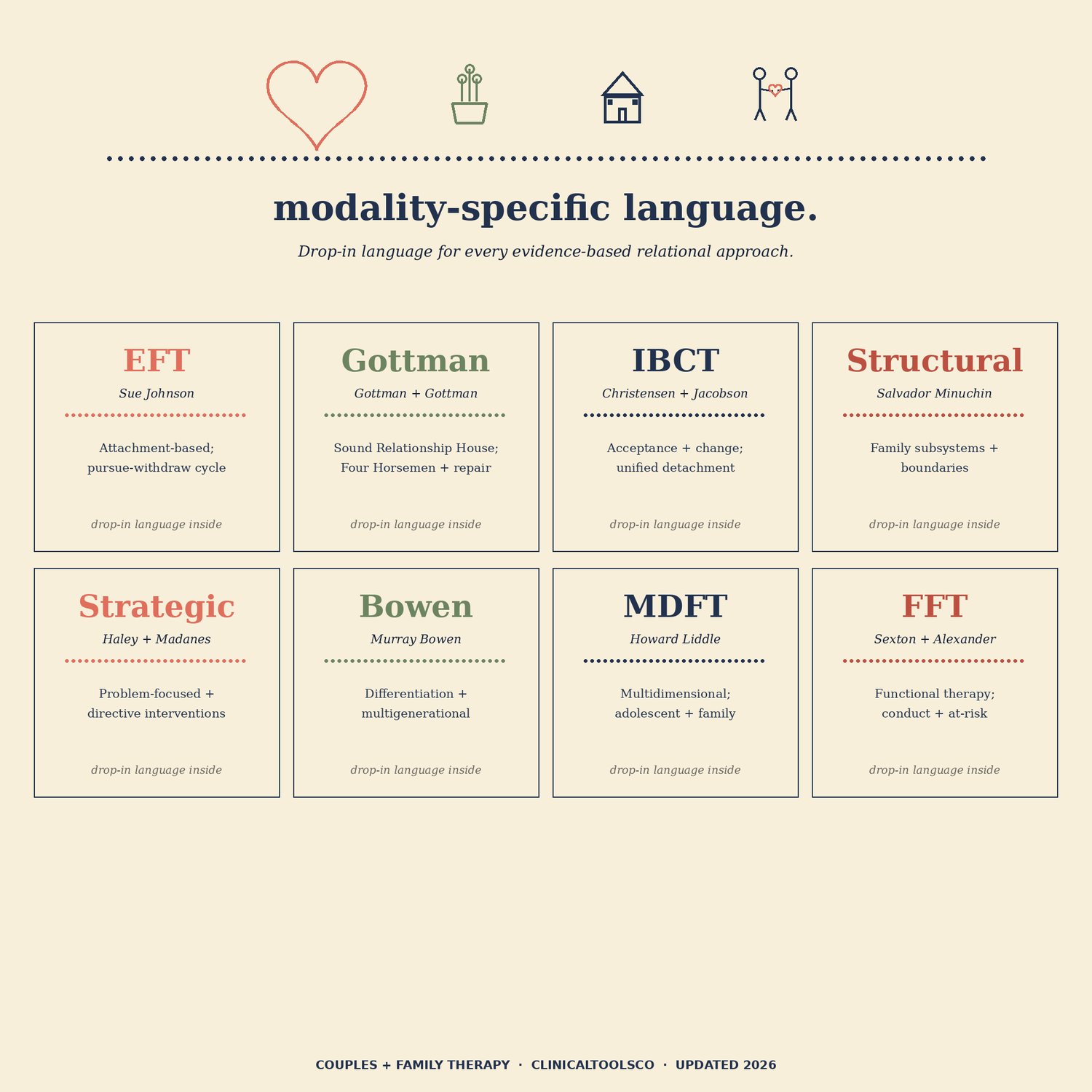
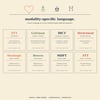
- Modality frameworks (Sections 14 to 18): EFT with its three stages and intervention language bank; Gottman Method with the Four Horsemen and antidotes, soft start-up, repair attempts, accepting influence, flooding, bids for connection, and the Sound Relationship House; IBCT with acceptance, unified detachment, and empathic joining; Structural, Strategic, and Bowen family work; and MDFT and FFT for adolescent and family-of-origin contexts. Each carries the named interventions and the exact documentation phrases that match how the modality is actually delivered.
- Couples Communication Skills worksheet (Section 19): Speaker-Listener, Soft Start-Up, Repair Attempts, the 20-Minute Flooding Break, Daily Check-In, and Weekly State of the Union.
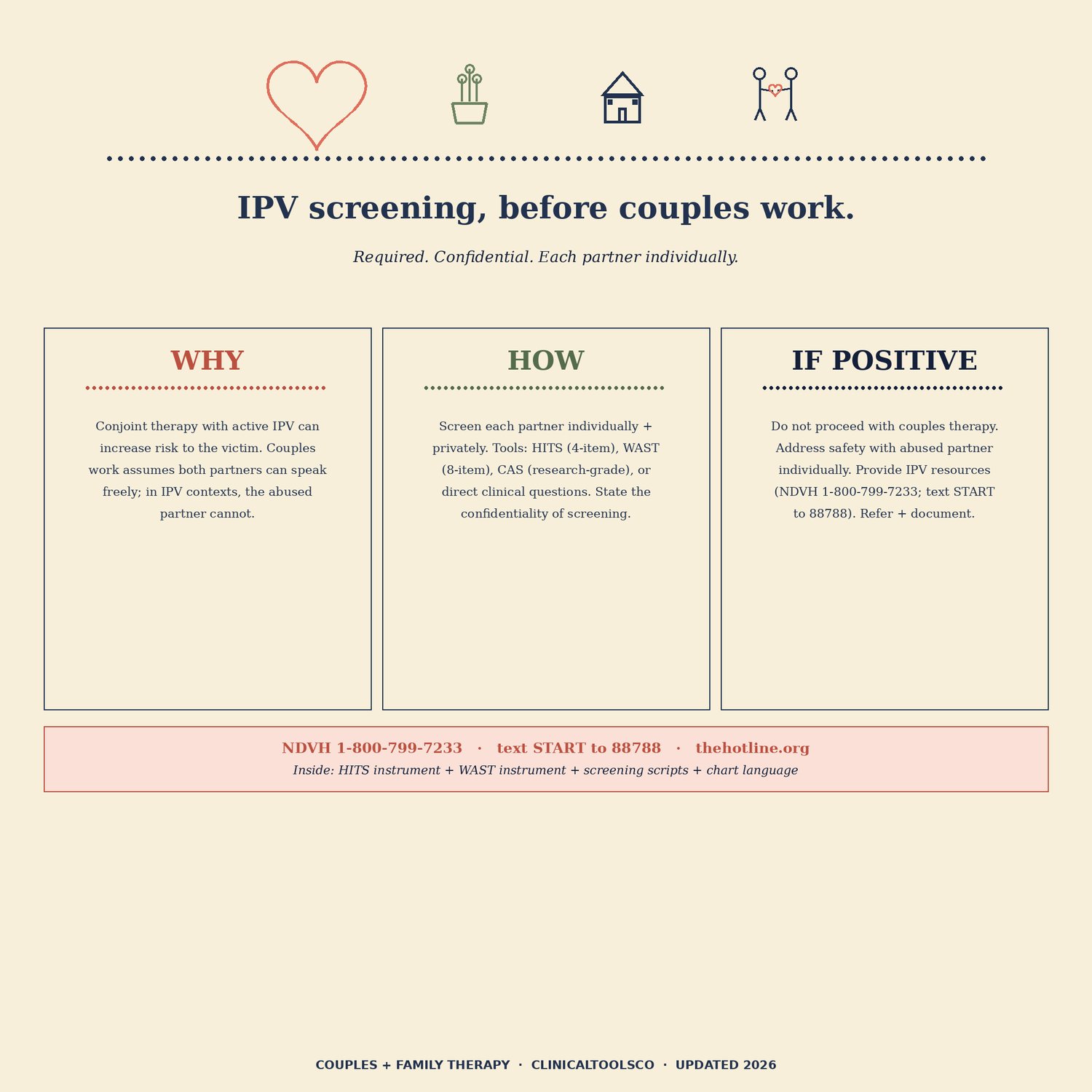
- IPV screening and when conjoint work is contraindicated (Section 20): why to screen, HITS, WAST, the Composite Abuse Scale, direct clinical questions, the individual and private screening protocol, the post-positive-screen workflow with NDVH and Crisis Text Line resources, and the conditions under which historical IPV may still permit conjoint work.
- Billing relational therapy (Section 21): CPT 90847, 90846, 90849, and the +90785 interactive complexity add-on, the documentation required to support each code, and the errors that get these claims denied.
- Twenty relational documentation pitfalls with audit-friendly habits (Section 22), and a quick-reference relational card (Section 23) covering the intake checklist, the conjoint note checklist, and billing reminders.
Who it is for
LMFTs and LMFTAs. LCSWs and LICSWs doing couples or family work. LPCs, LCMHCs, and LCPCs with relational scope. Psychologists adding couples or family work to an individual caseload. MFT interns and supervised trainees building a first relational caseload. Group practice owners standardizing documentation across associates. Clinical supervisors teaching relational work. Psychiatric NPs and psychiatrists working with families around an IP's treatment. School-based and pediatric clinicians using MDFT or FFT.
Why it exists
The session opens with criticism and stonewalling. Forty minutes later you have to write a note that captures process without taking a side, and the no-secrets policy you meant to document at intake is nowhere in the chart.
53 pages, 23 sections. Intakes, treatment plans, conjoint notes, modality language banks, IPV screening, billing, and the relational ethics most individual-therapy training skips.
Why it is built this way
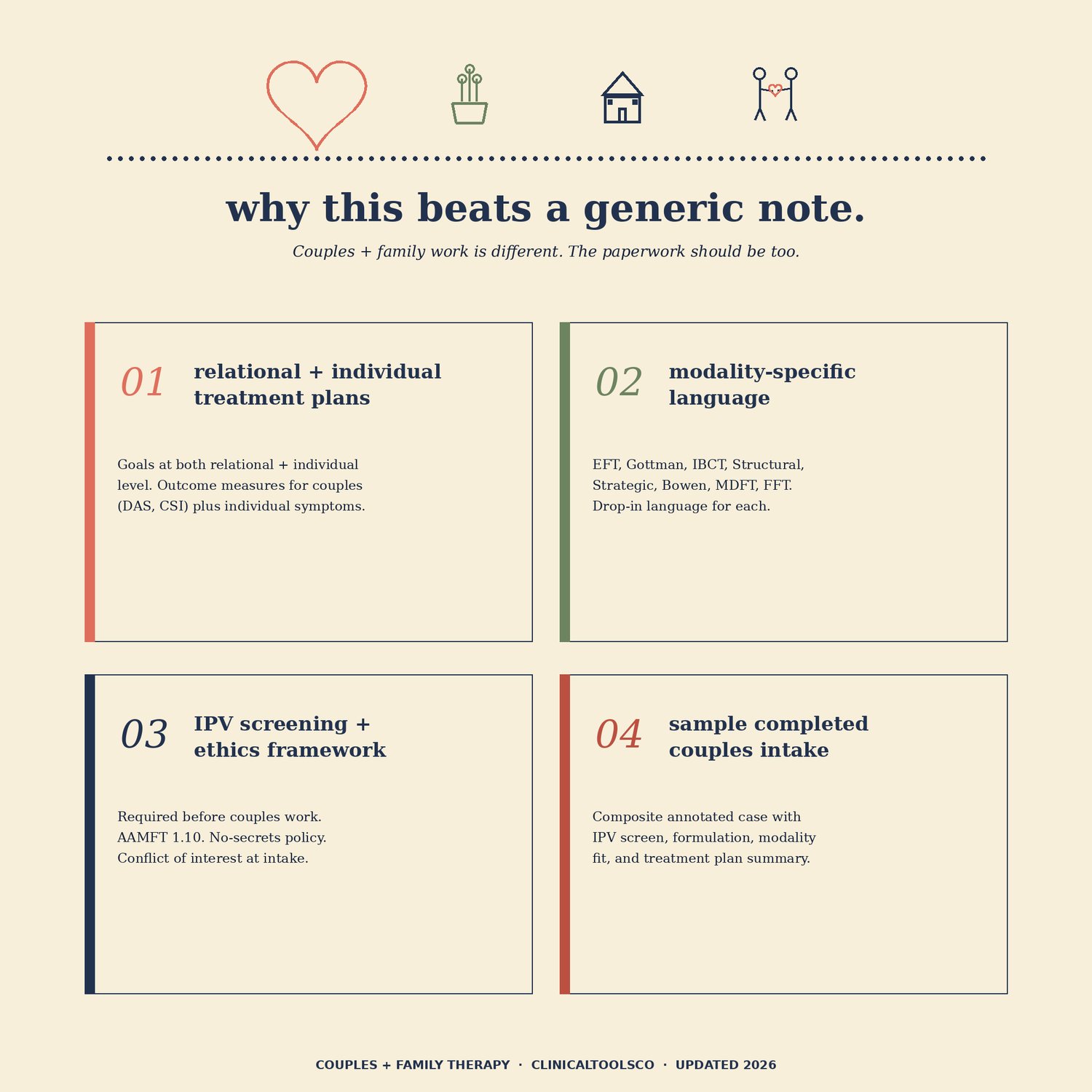
The usual failure in relational work is running couples and family cases on individual-therapy forms. You end up with two parallel individual records that miss the system, do not support 90847, and leave you exposed on group identification and no-secrets.
The two-perspective intake keeps both partners in their own words and the clinician's synthesis of the relational pattern in one chart-ready document. The conjoint note documents attendees, group identification, the modality named, the interactional pattern rather than content alone, each partner's contribution proportionally, and medical-necessity language an auditor will accept. 90847 is among the most commonly miscoded sessions in mental health.
Section 20 gets used more than anything else here. Screening before initiating couples work is rarely taught, and conjoint therapy with active intimate partner violence can escalate risk to the victim.
Format
Editable, fillable PDF, 53 pages. Editable Microsoft Word (.docx) with the same content for in-house customization. Templates ready to load into your EHR. US Letter (8.5 x 11) and A4 (8.3 x 11.7) both included. Works on Mac, Windows, iPad, GoodNotes, and Notability. Print or fill on screen. Lifetime access, unlimited prints.
Updated 2026
References AAMFT Code of Ethics Standards 1.10, 2.1, 2.2, 2.4, and 3.4. Cites EFT (Johnson, Greenberg), Gottman Method (John and Julie Gottman), IBCT (Christensen and Jacobson), Structural Family Therapy (Minuchin), Strategic Family Therapy (Haley, Madanes, Milan), Bowen Family Systems Theory, MDFT (Liddle), and FFT (Sexton). Uses 2026 CPT codes (90847, 90846, 90849, +90785). Diagnostic codes (Z63.0, Z62.820, F32.x, F33.x, F41.1, F43.x, F90) are ICD-10-CM as used in DSM-5-TR practice. IPV resources include the National Domestic Violence Hotline at 1-800-799-7233 and Crisis Text Line, text START to 88788.
How to use it
New relational case: Section 4 to pick the intake architecture, Section 5 or 6 for the intake, Section 20 to screen before initiating couples work, Section 9 or 10 for the plan. Every conjoint session after that: Section 11 or 12 for the note, with modality language pulled from Sections 14 to 18. For supervisees, Sections 2 and 3 plus the completed sample intake in Section 13 make a good teaching trio. Print Section 23 and keep it at the intake workstation.
Instant digital download. No physical product ships. Message us if anything does not work.