
Crisis Intervention Toolkit (2026)
A crisis intervention toolkit: a crisis typology, a multi-type triage algorithm, and protocols for suicidal crisis, homicidal ideation and duty to warn, self-injury and acute psychosis.
What is in the bundle
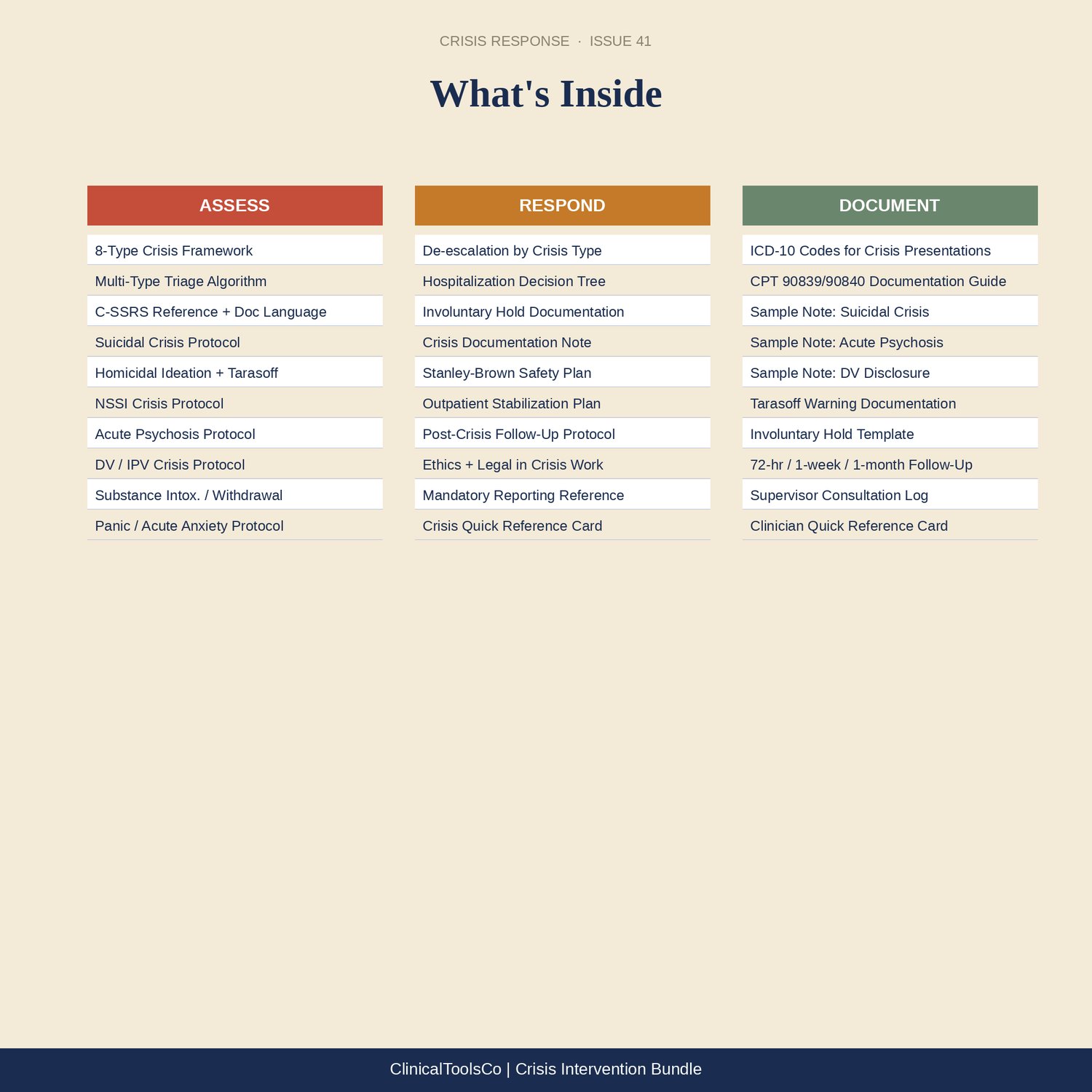
- Foundation: how to use it, and the structured five-step crisis response sequence of recognize, assess, intervene, document, follow up
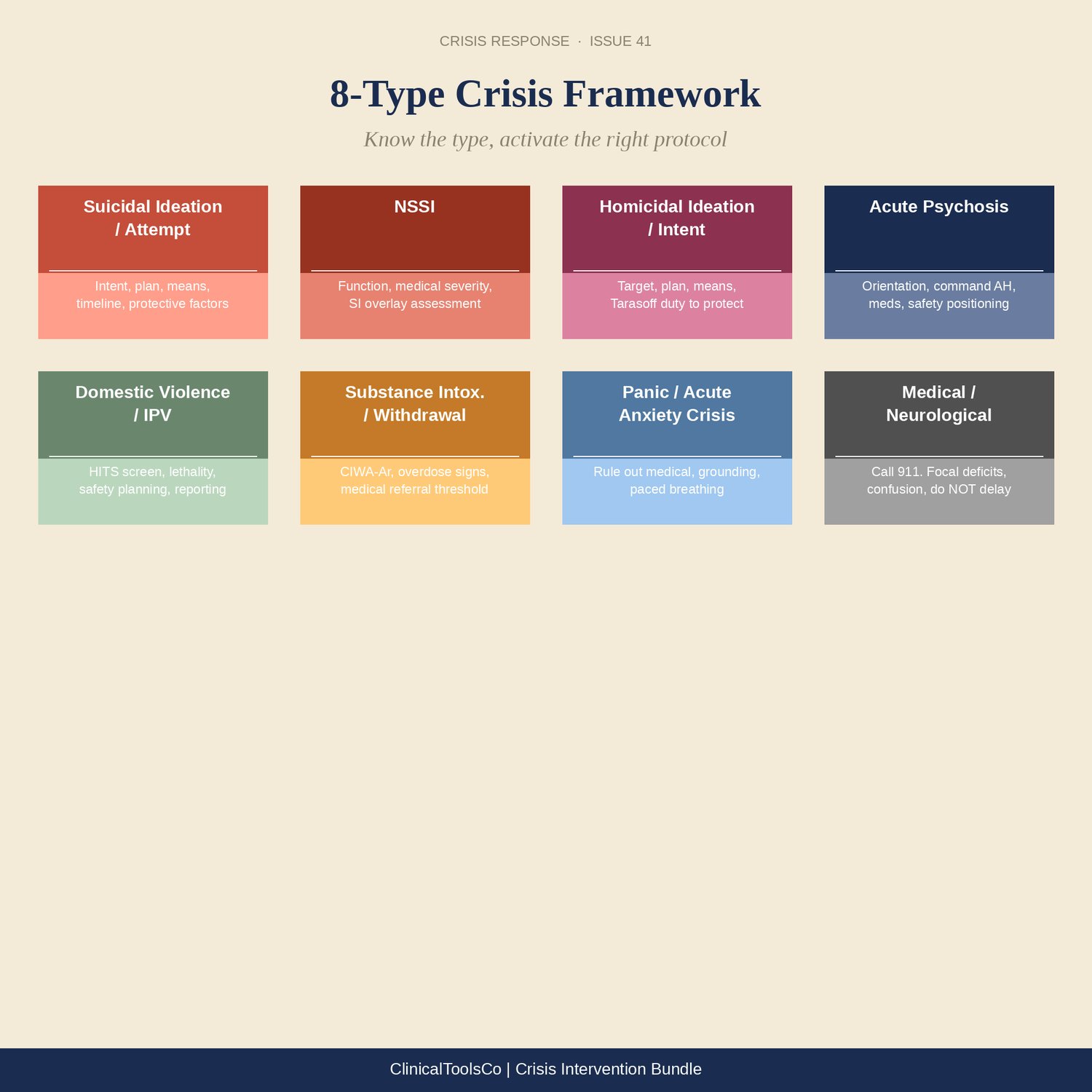
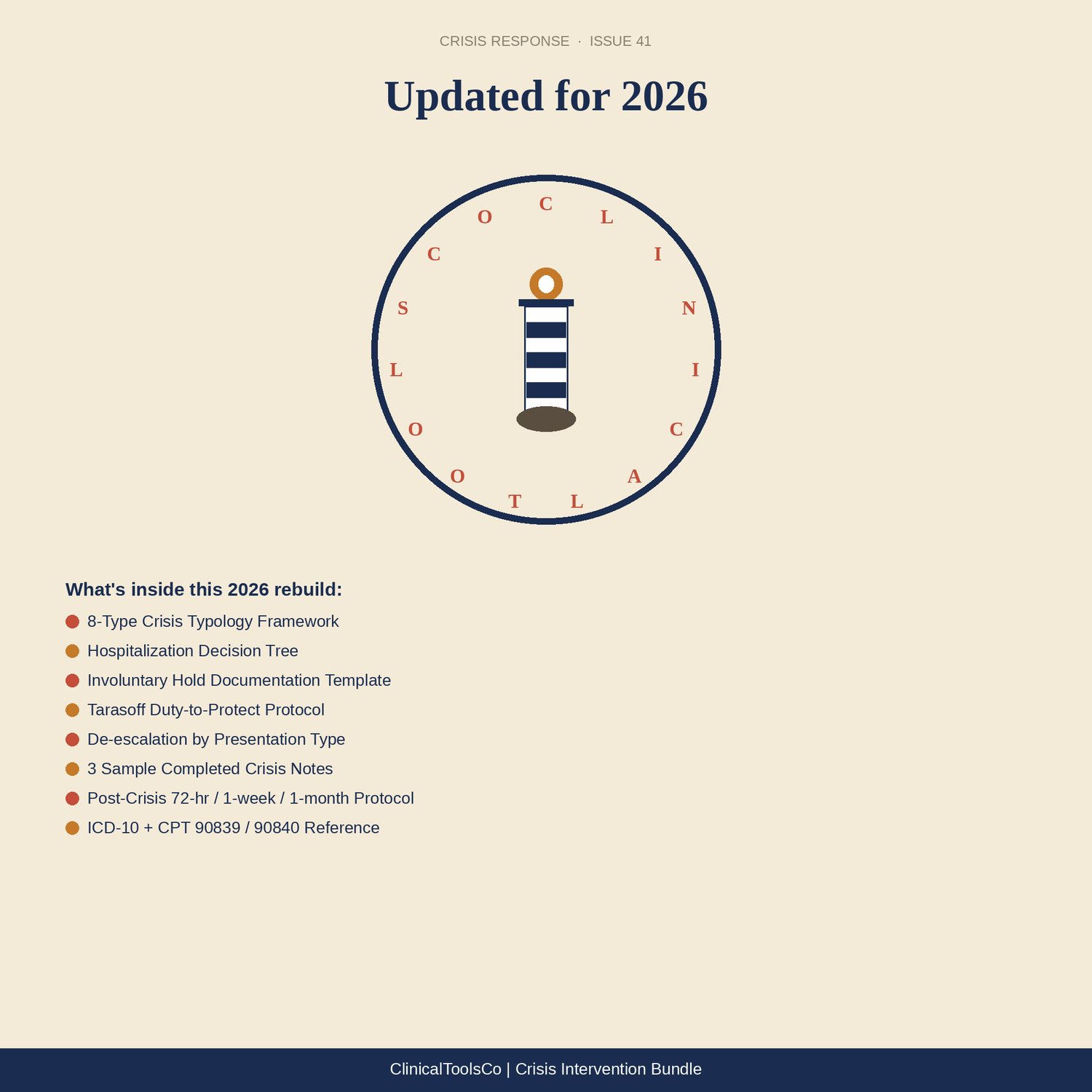
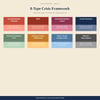
- Crisis typology framework covering eight distinct presentations (suicidal ideation or attempt, non-suicidal self-injury, homicidal ideation, acute psychosis, domestic violence and IPV, acute substance intoxication or withdrawal, panic and acute anxiety, medical or neurological emergency) with core risk, key assessment questions and intervention priority for each
- Multi-type crisis triage algorithm: four triage questions to run in the first 60 to 90 seconds of any crisis contact, with routing to the correct protocol section
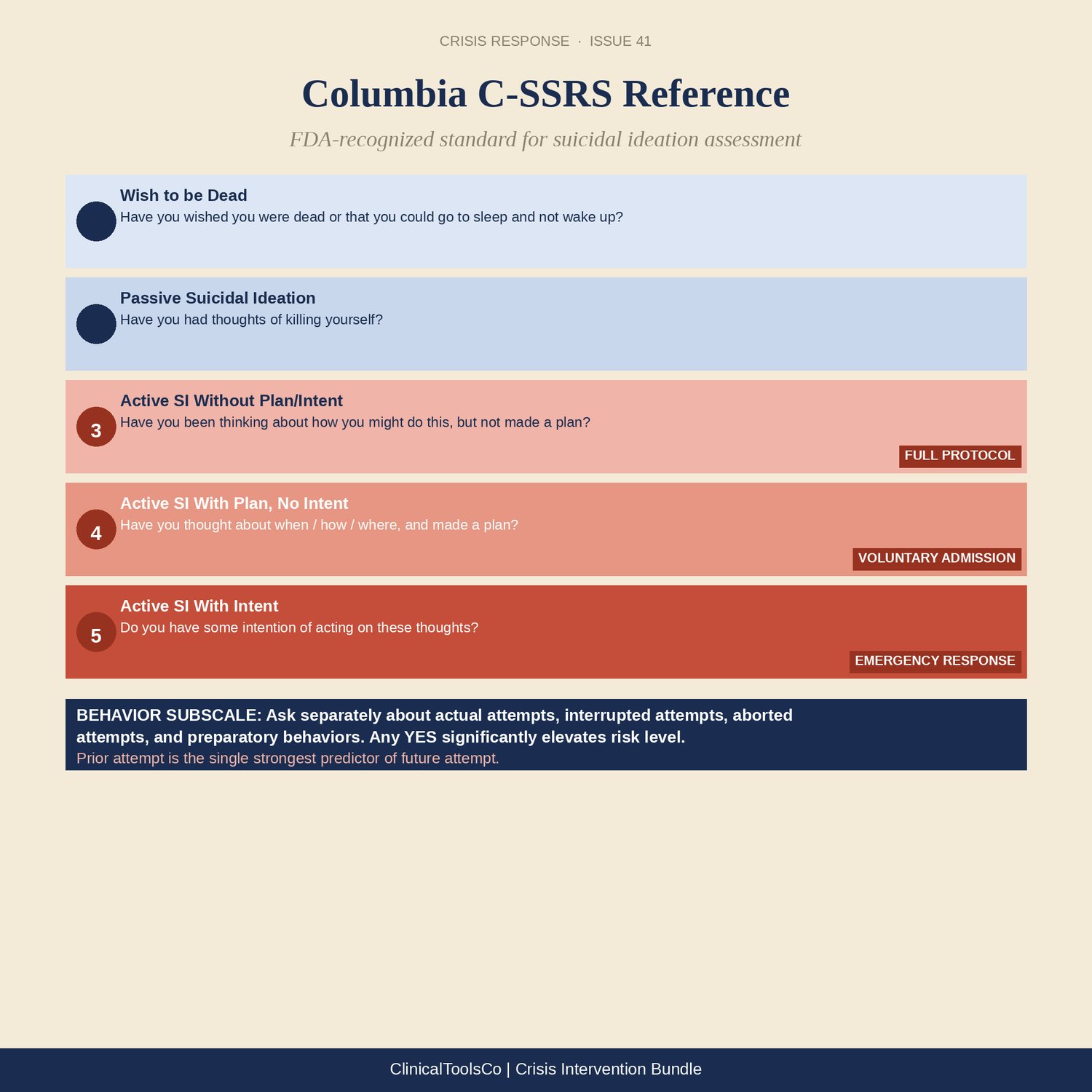
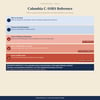
- Columbia Suicide Severity Rating Scale reference: five ideation levels with a screening question for each, behavior subscale guidance, and per-level documentation language
- Suicidal crisis full assessment protocol: structured assessment of intent, plan, means and timeline, prior attempts and lethality, protective factors, and three-tier risk stratification with a recommended action for each level
- Homicidal ideation and Tarasoff duty to protect: assessment questions for identified target, plan, means, timeline, command hallucinations and prior violence history, a four-step duty-triggered action sequence, and documentation requirements
- Non-suicidal self-injury protocol: differentiation from suicidal behavior, function assessment, medical severity assessment and documentation language
- Acute psychosis protocol: rapid assessment, de-escalation approach for environment, communication and safety positioning, and level-of-care criteria
- Domestic violence and IPV protocol: HITS screening, lethality indicators, safety planning questions and hotline resources
- Acute substance intoxication and withdrawal protocol: CIWA-Ar score ranges with clinical action for each severity band, opioid overdose response with naloxone guidance, and stimulant intoxication
- Panic and acute anxiety protocol: medical rule-out questions, a grounding and regulation sequence, and post-episode assessment
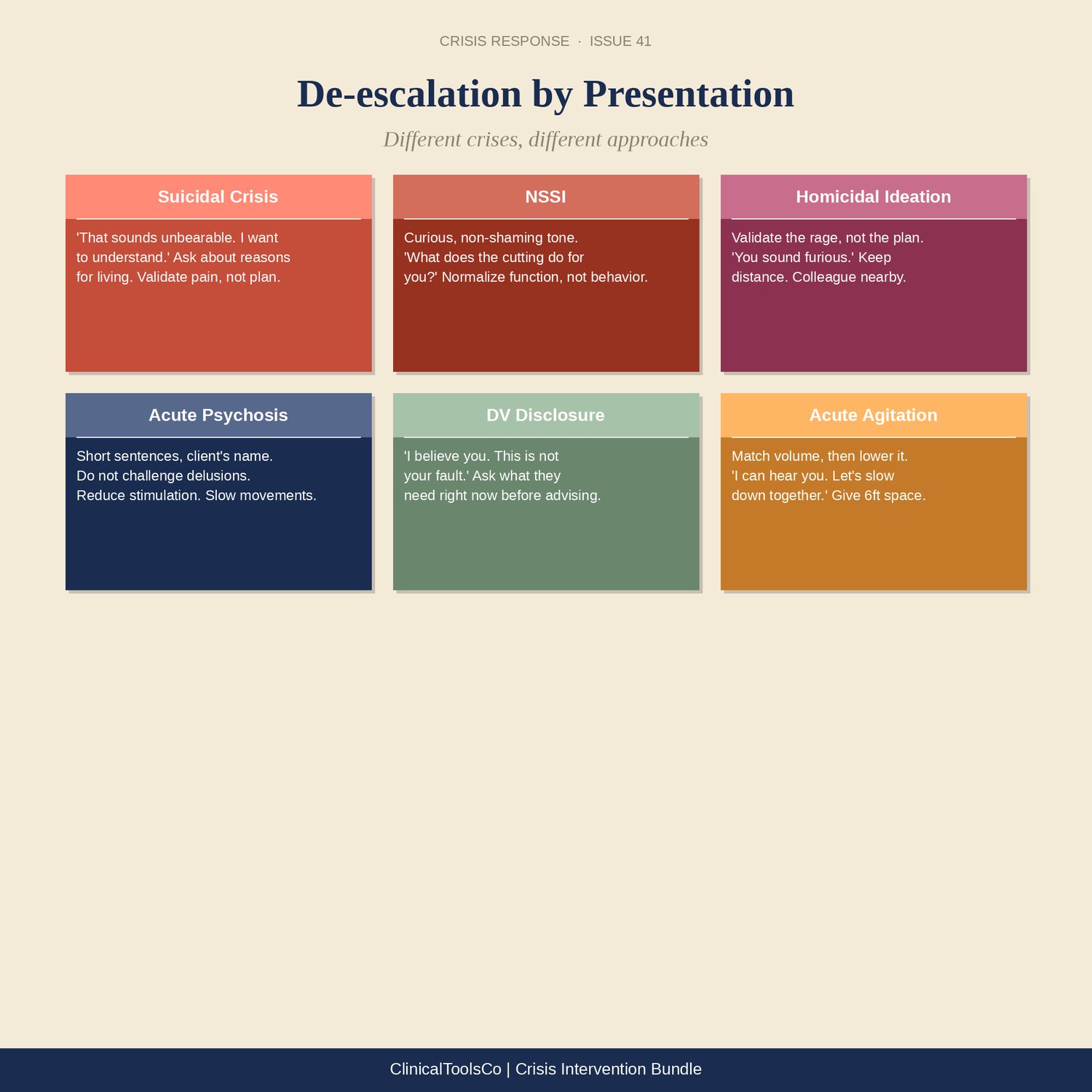
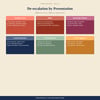
- De-escalation techniques by presentation type: verbal approach plus environmental and physical strategy for each of the eight types
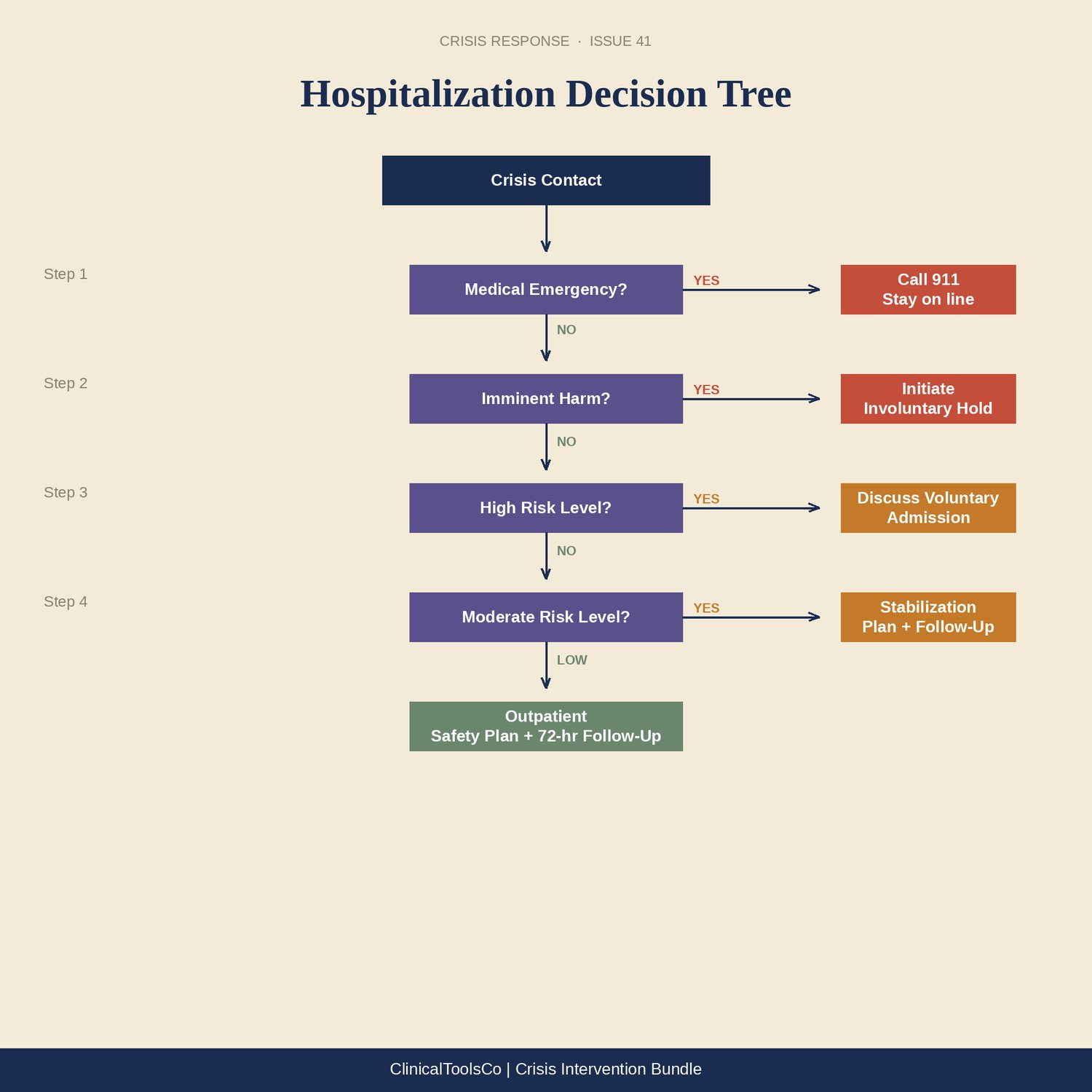
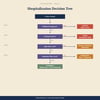
- Hospitalization decision tree: voluntary criteria and process, involuntary hold criteria across state statutes, the grave disability pathway, and a six-step hold initiation
- Involuntary hold documentation template with basis-for-hold checkbox, mental disorder description, behavioral support, risk score, prior holds, means and weapon access, protective factors, voluntary offered, emergency services contacted with timestamp, receiving facility and emergency contact notification
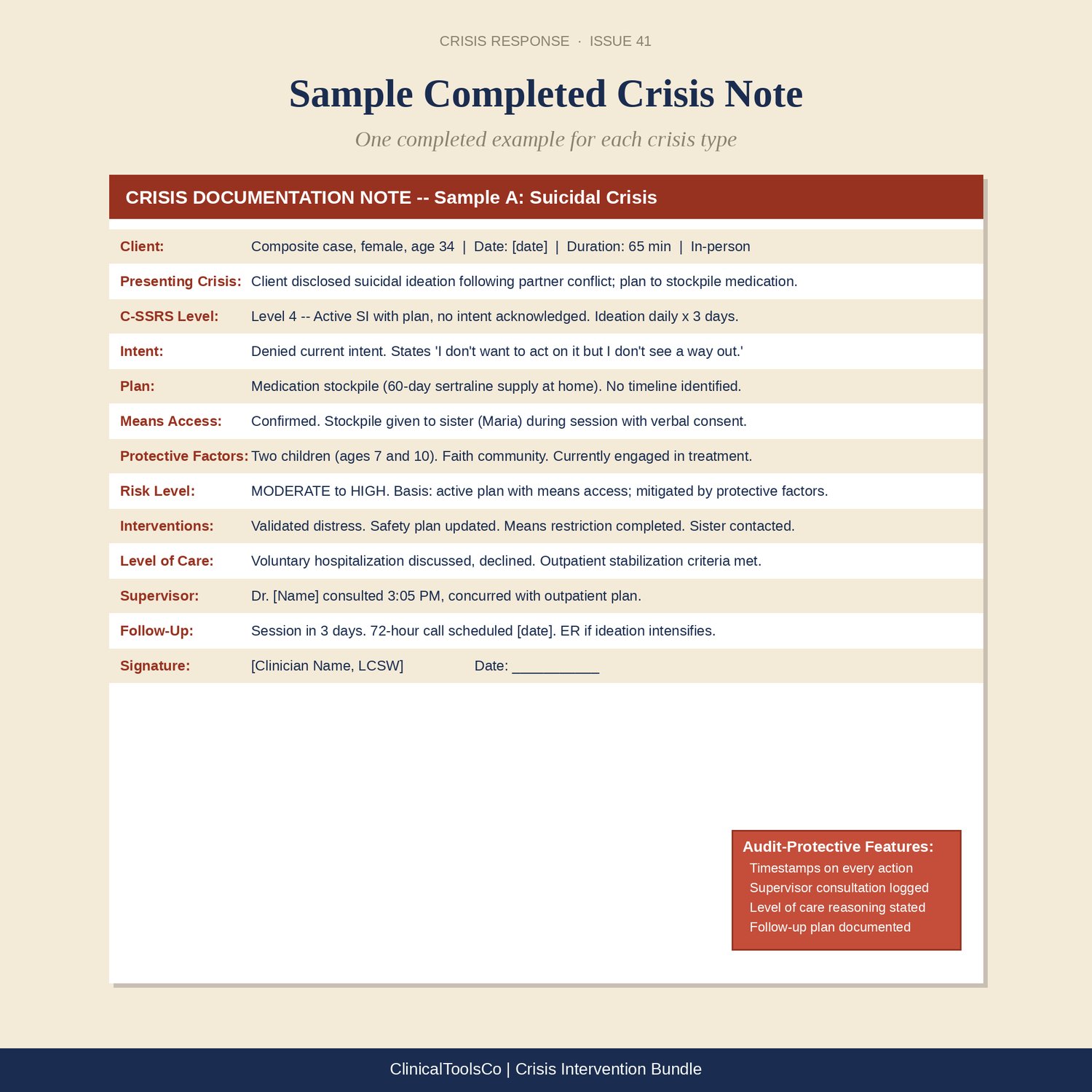
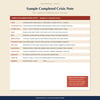
- Crisis documentation note template covering contact type, presenting crisis, mental status, crisis type, risk level with clinical basis, interventions provided, level of care decision with reasoning, supervisor consultation and follow-up plan
- Stanley-Brown safety plan template: the six-step evidence-based plan with the research citation
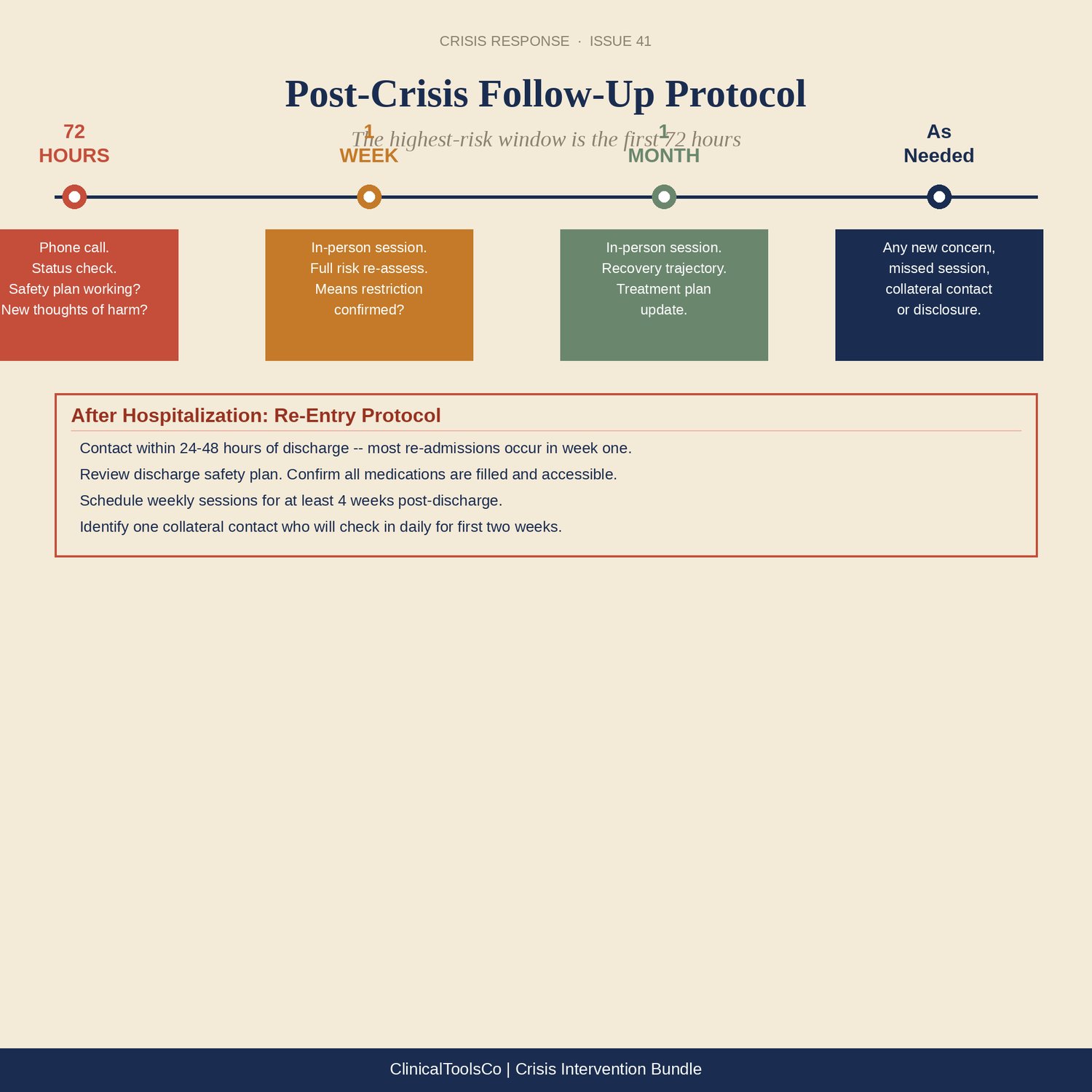
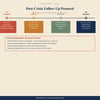
- Post-crisis follow-up protocol at 72 hours, one week, one month and as needed, plus a post-hospitalization re-entry protocol
- Outpatient crisis stabilization plan for when outpatient stabilization is appropriate despite elevated risk, documenting the clinical basis for not hospitalizing
- Ethics and legal considerations in crisis work, with code citations, duty to warn versus duty to protect, documentation as protection, and peer consultation
- Mandatory reporting reference during crisis: child protective services, adult protective services, domestic violence, gunshot and stab wounds, and communicable disease triggers
- ICD-10 quick reference for crisis presentations with 18 codes, and CPT codes for crisis services with documentation requirements for each
- Three sample completed crisis notes: a suicidal crisis with a declined voluntary hospitalization, an acute psychosis walk-in with involuntary transport, and a domestic violence disclosure with lethality assessment and safety planning
- A print-and-keep crisis quick reference card with first-90-seconds triage, level-of-care criteria, key resources, documentation essentials and consult-immediately triggers
Who it is for
- Licensed clinicians taking crisis calls or walk-ins in private practice, community mental health, college counseling or agency settings
- Crisis-line and mobile crisis response clinicians
- Inpatient and emergency department clinicians documenting crisis encounters under time pressure
- Telehealth clinicians managing crisis contacts from a remote setting
- Pre-licensed clinicians, interns and trainees building their first crisis documentation under supervision
- Clinical supervisors teaching crisis response and gatekeeping protocols
- Group practice owners standardizing crisis documentation across associates
- Psychiatric nurse practitioners and psychiatrists handling crisis evaluations
Why it exists
The client is on the line saying things you do not have a protocol for. The next twenty minutes will be remembered in the chart, and the chart will be read by the licensing board, the insurance auditor and the malpractice attorney if anything goes wrong. You have a generic crisis note template that says describe presenting concern and nothing more.
This is the crisis binder I built after working overnight shifts on a community mental health emergency line and realizing that the typology of crises I was responding to, eight distinct presentations each with its own assessment focus, de-escalation strategy and documentation requirement, was nowhere written down in one place. Generic crisis notes do not protect anyone. Type-specific protocols do.
43 pages covering the full operational and clinical paperwork for crisis response in outpatient, community, inpatient and telehealth settings, organized into 24 sections. Written by a practicing clinician for licensed clinicians and supervised pre-licensed staff.
Why this is different
Most crisis documentation in clinical practice is a generic session note saying the client expressed suicidal ideation or that a crisis call was addressed. That is not enough for a board audit, an insurance review or a malpractice attorney. This bundle gives you presentation-specific protocols and documentation templates that hold up.
The eight-type typology matters because the assessment focus, de-escalation strategy and documentation requirements differ for each. A suicidal crisis, an acute psychosis and a domestic violence disclosure require different first questions and different chart entries. The typology routes you to the right protocol in the first 90 seconds.
The C-SSRS reference matters because Columbia is the FDA-recognized standard for suicidal ideation assessment across emergency departments, clinical trials and outpatient settings.
The Tarasoff protocol matters because duty-to-warn and duty-to-protect standards vary by state, the four-step action sequence is rarely written down, and the documentation requirements are the most common gap when a third-party harm case is later reviewed.
The hospitalization decision tree and hold documentation template matter because clinicians who initiate holds without a documented basis, supervisor consultation and timestamped action sequence are exactly the targets of post-hold litigation.
The Stanley-Brown safety plan matters because the 2018 JAMA Psychiatry research associated it with half the odds of suicidal behavior over six months compared with standard treatment, and with significantly higher outpatient treatment engagement.
Format
- Editable, fillable PDF (43 pages)
- Editable Microsoft Word (.docx) with the same content for in-house customization
- Crisis note, hold documentation, safety plan and stabilization plan templates ready to drop onto letterhead or load into your EHR
- US Letter and A4 sizes both included
- Works on Mac, Windows, iPad, GoodNotes, Notability
- Lifetime access, unlimited prints
Updated 2026
References the Columbia Suicide Severity Rating Scale, Tarasoff v. Regents of the University of California (1976) and the duty-to-warn versus duty-to-protect framework, CIWA-Ar for alcohol withdrawal severity, HITS for IPV screening, and the Stanley-Brown Safety Planning Intervention (Stanley et al., 2018, JAMA Psychiatry). Ethics codes cited include APA 4.05, ACA B.2.a, NASW 1.07(c) and AAMFT 2.1. Uses 2026 CPT codes and ICD-10-CM diagnostic codes as used in DSM-5-TR practice. Crisis resources include the 988 Suicide and Crisis Lifeline, the National Domestic Violence Hotline, the SAMHSA helpline and Crisis Text Line.
A note from the designer
I am a practicing clinician. I built this after working overnight shifts on a community mental health emergency line. The section I send every supervisee is the hospitalization decision tree, because the involuntary hold decision is the most consequential call a crisis clinician will make and most training does not walk it step by step.
Generic crisis notes do not protect anyone. Type-specific protocols and audit-ready documentation do.
Digital download. No physical product ships. Reach out by email if anything does not work or if you have questions.