



DBT Skills Group Kit (2026)
A nine chapter kit for launching and running a DBT skills group: the standard curriculum, intake and member contract, weekly session structure, diary cards, billing and outcome tracking.
What is in the kit
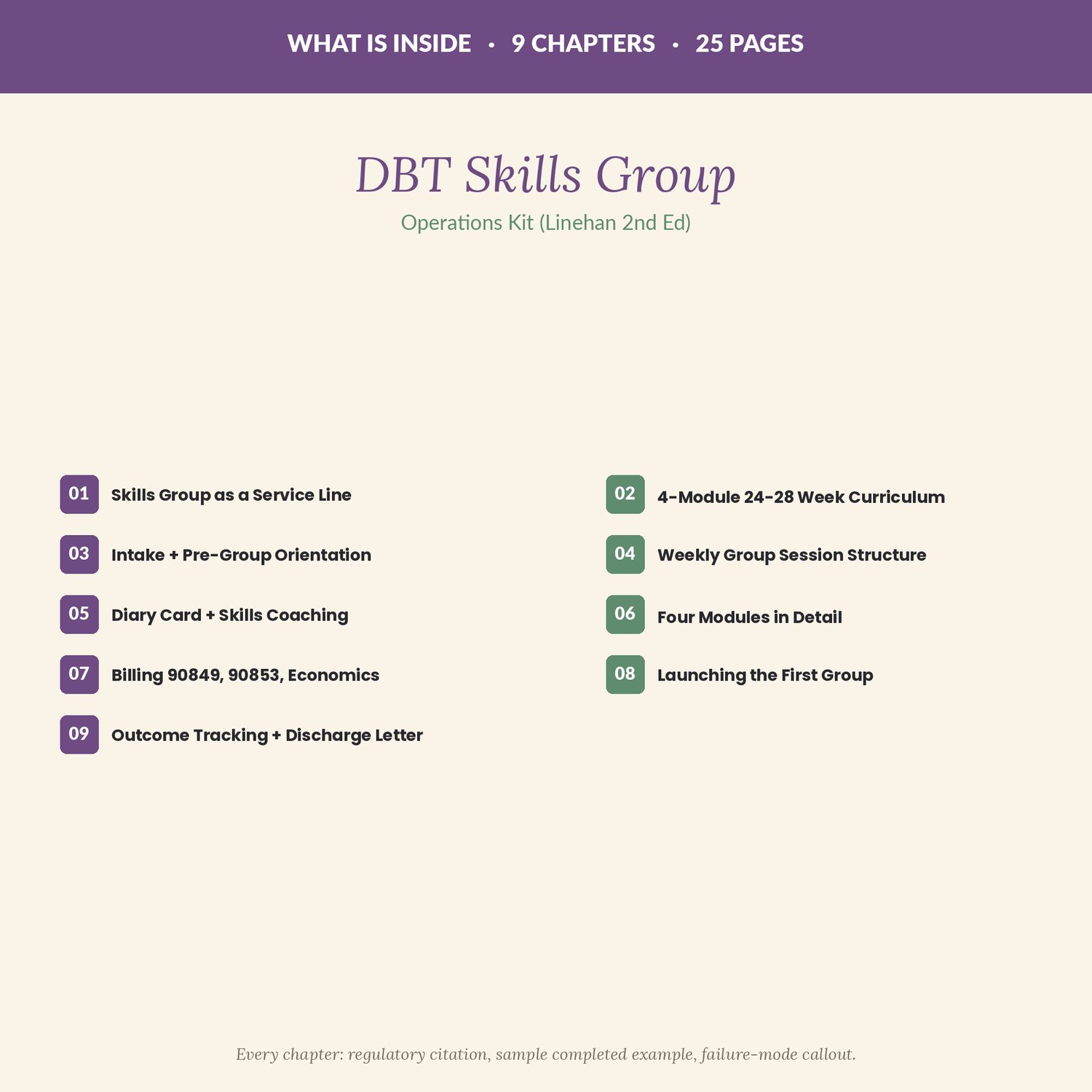
- Chapter 1: DBT skills groups as a structured service line. What this kit covers and what it does not, the evidence base, who is appropriate and who is not, and a practice service-line revenue example
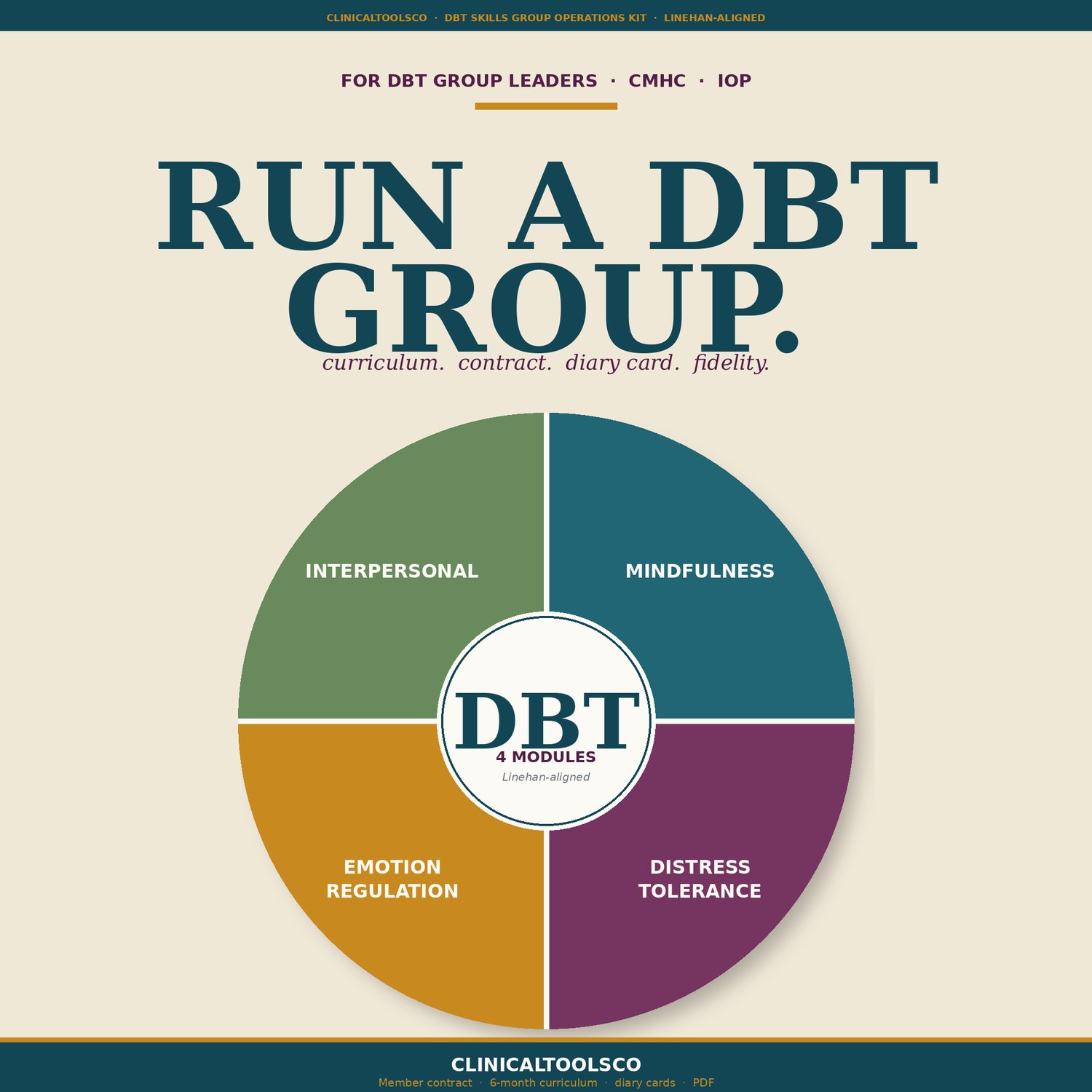
- Chapter 2: The standard skills curriculum. The four-module 24 to 28 week sequence, curriculum adaptations for adolescents, substance use and eating disorders, plus a completed 26-week calendar
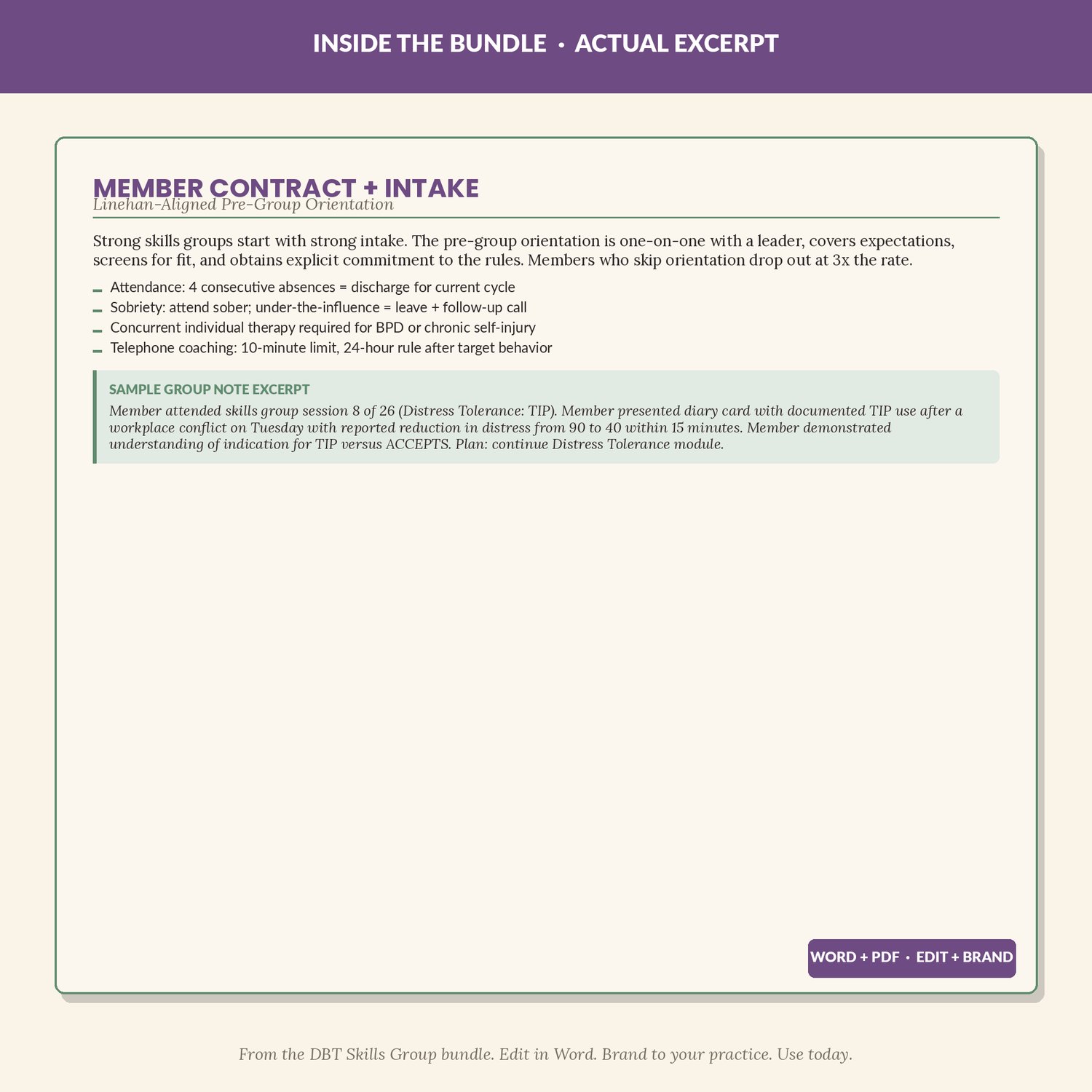
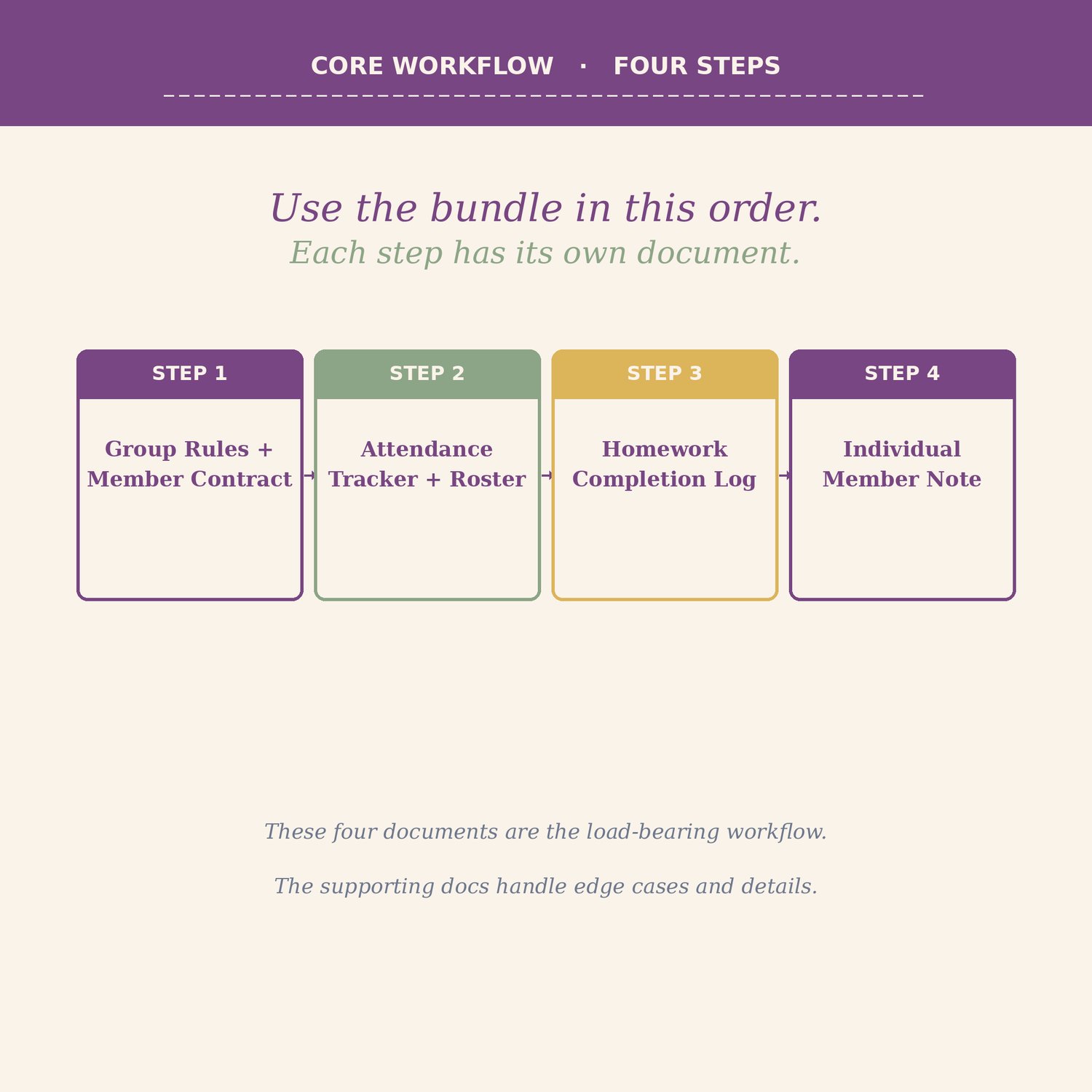
- Chapter 3: Intake, pre-group orientation and the member contract. A 60-minute orientation structure, all core contract elements covering attendance, sobriety, confidentiality, crisis flow, devices and cancellation, the screening battery, and a completed orientation summary
- Chapter 4: The weekly group session structure. Standard 120-minute timing from mindfulness anchor through diary card review, break, skills teaching, homework and closing, plus co-leadership roles, diary card protocol, homework principles, group process management and a completed diary card share example
- Chapter 5: The diary card and skills coaching between sessions. Diary card components, the four-option coaching policy, the 24-hour rule after target behavior, and a completed text-based coaching exchange
- Chapter 6: The four modules in detail. Reference summaries for mindfulness, distress tolerance, emotion regulation and interpersonal effectiveness, with a complete DEAR MAN teaching example
- Chapter 7: Billing, reimbursement and group economics. The five-code billing framework, the group note documentation that survives a payer audit, economics by member count, concurrent individual therapy billing, pre-authorization considerations and a completed 26-week cycle economics example
- Chapter 8: Launching the first group. The 90-day setup checklist from pre-launch through first session, covering training confirmation, co-leader and room logistics, member fee setting, handouts ordering, referral outreach and a completed launch timeline
- Chapter 9: Quality, outcome tracking and the discharge letter. The standard outcome battery cadence, group-level quality metrics, the end-of-cycle letter structure and a complete sample letter
- A pre-group orientation script and intake template, a member contract template, and a group note outline that satisfies payer audit requirements
Who it is for
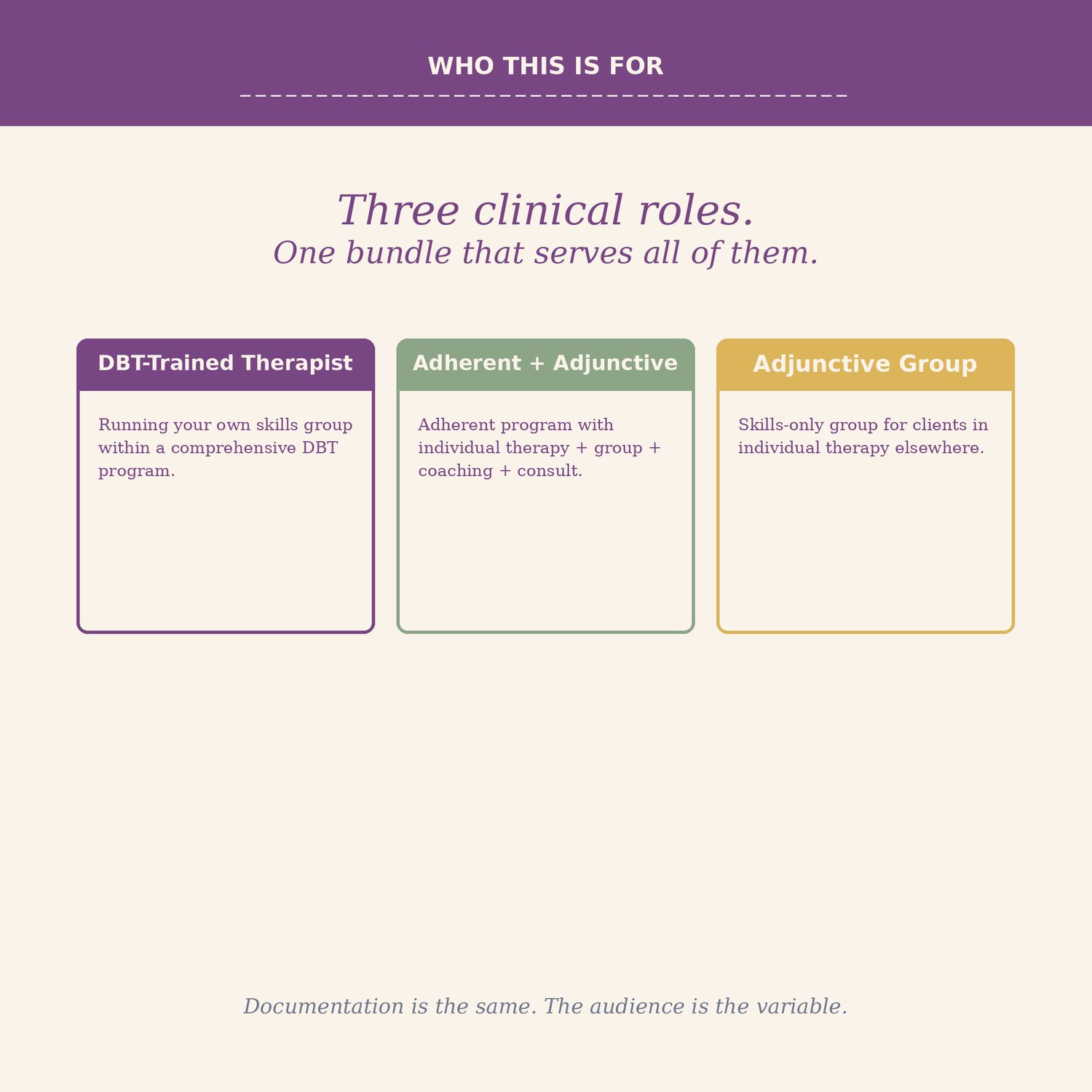
- Licensed psychologists (PhD, PsyD) launching or running a DBT skills training group
- Licensed clinical social workers co-leading skills groups in outpatient or community settings
- LMFTs, LMHCs and LPCs trained in DBT delivering skills groups
- Group practice owners building a skills training service line with multiple weekly groups
- Community mental health programs systematizing skills group delivery and documentation
- Postdoctoral fellows and early-career clinicians launching their first group after intensive training
- Clinical supervisors teaching skills group leadership to trainees
Why it exists
You finished the intensive in October. You have eight prospective members on a waiting list, one co-leader at the same group practice, a Tuesday evening room booking from 6 to 8 PM starting in January, no member contract, no diary card system, no idea how to bill group psychotherapy in a way the next payer audit will accept, and a strong suspicion that figuring it out as you go is the wrong launch strategy.
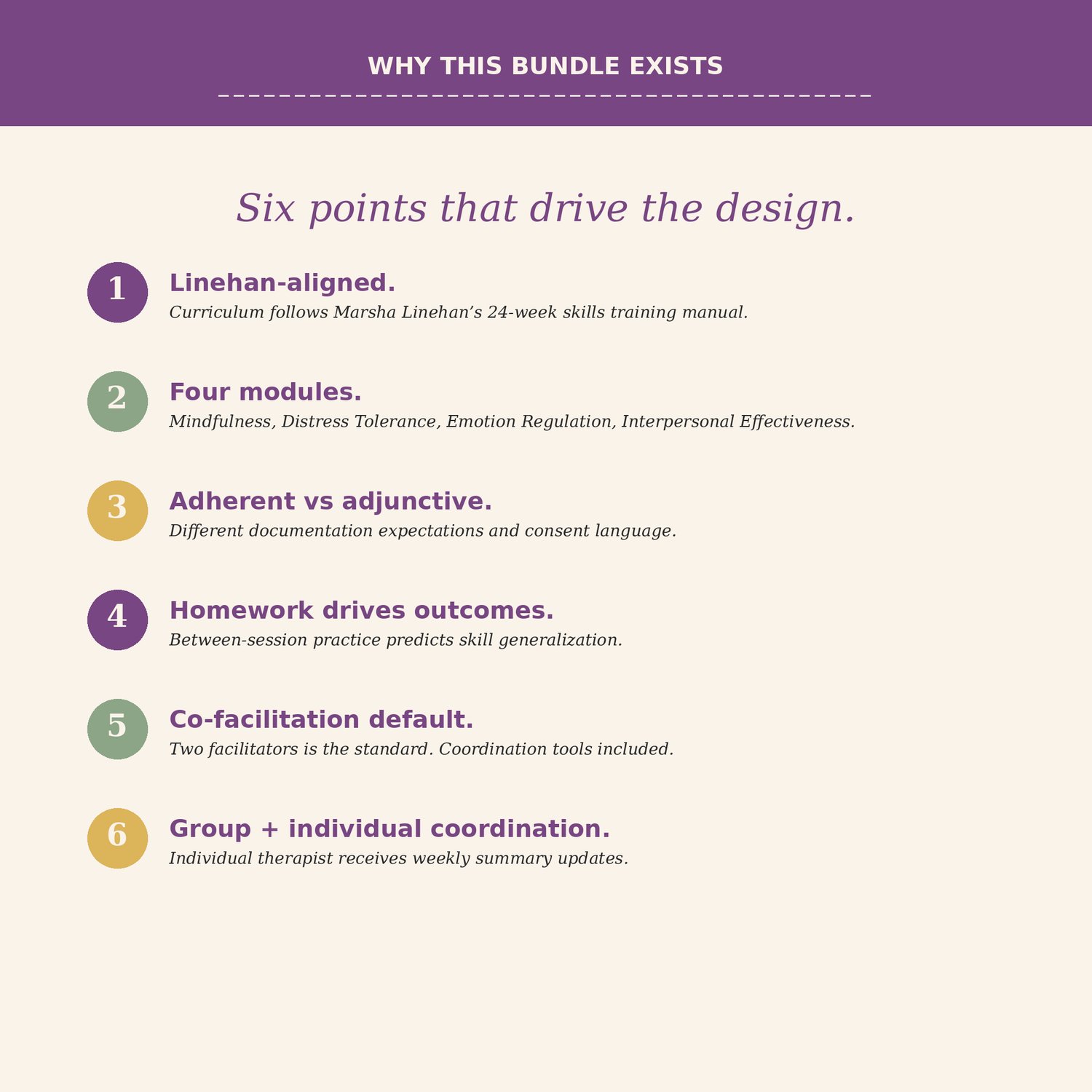
A DBT skills training group is not a process group, not a psychoeducation class, and not a substitute for individual therapy. It is a structured 24 to 28 week curriculum with weekly diary card review, a coaching policy, a member contract and member-specific documentation. The Linehan manual gives you the curriculum. This kit gives you the operations.
I built this after launching two skills groups at a community mental health center and a third at a private practice. The first launch was rough. I wrote the member contract on a Saturday the week before the first session. I invented the diary card workflow on the fly in session 3. I learned the group billing documentation rules from a payer audit letter. This kit is the operating system I wish I had handed myself in October instead of the following May.
31 pages, 9 chapters, written for the licensed psychologist, LCSW, LMFT, LMHC or LPC who has completed intensive DBT training and is launching or systematizing a skills training group as a service line.
Why this is different
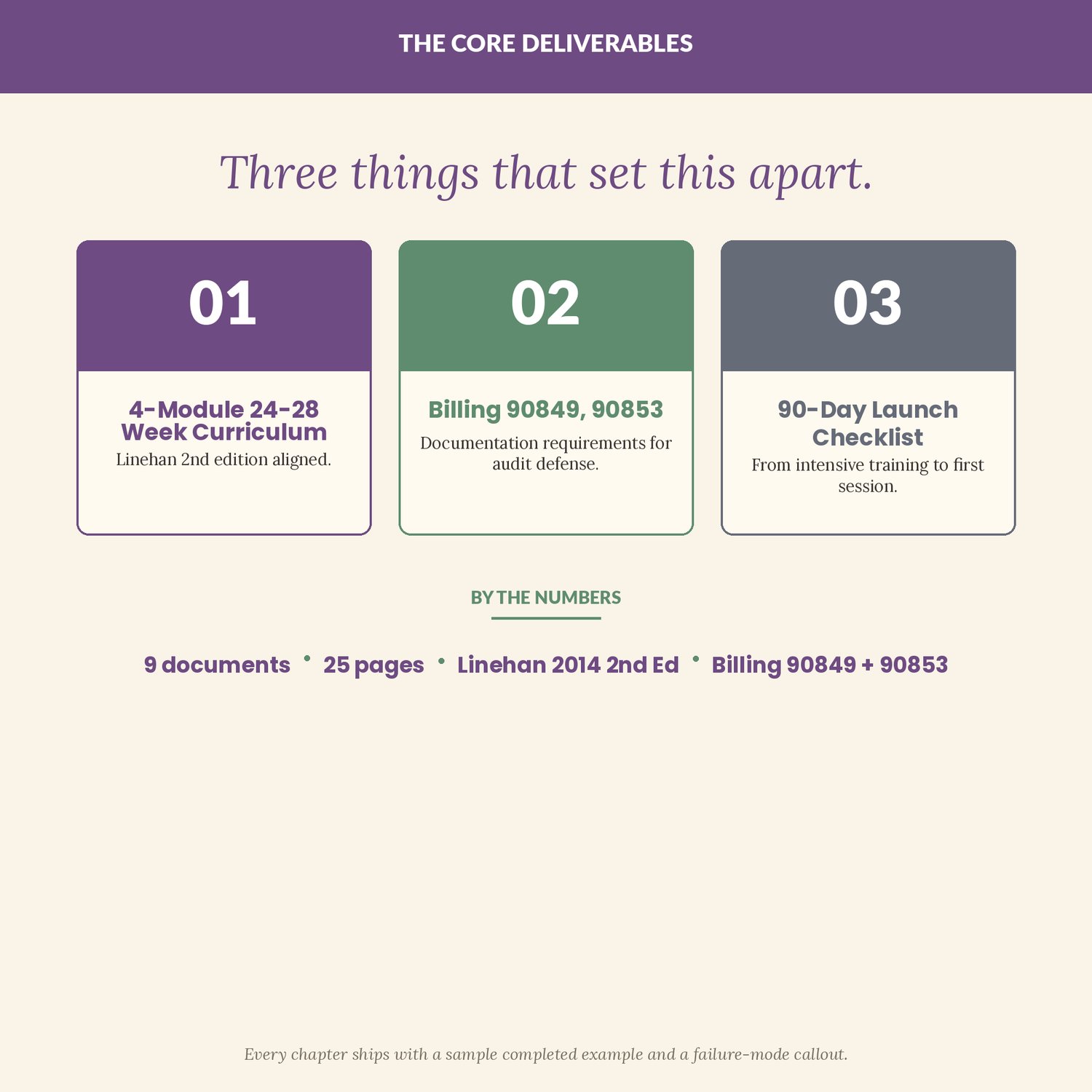
The Linehan manual gives you the curriculum. It does not give you the member contract, the billing framework, the 90-day launch checklist, the coaching policy with the 24-hour rule, the audit-defensible group note or the end-of-cycle letter. This kit is the operations layer between the manual and a payer-defensible service line.
The intake and contract chapter matters because most failed groups fail at intake. The pre-group orientation is where you screen for fit, communicate expectations, obtain explicit commitment and prevent the mid-cycle attrition that wrecks cohesion.
The billing chapter matters because the group code looks simple and is not. The documentation must be member-specific rather than a copy-paste group note, time-anchored and clinically substantive.
The 90-day launch checklist matters because most clinicians who finish intensive training stall on launch. It breaks the process into discrete tasks from day minus 90 to day zero, and is the difference between launching in January and launching in May.
The coaching policy chapter matters because skills-only programs need an explicit between-session contact framework, and it prevents the slow drift from skills coaching into between-session psychotherapy that overwhelms leaders.
The end-of-cycle letter closes the loop with the individual therapist, the prescriber and the referring source, with outcome language anchored to baseline-to-discharge change.
Format
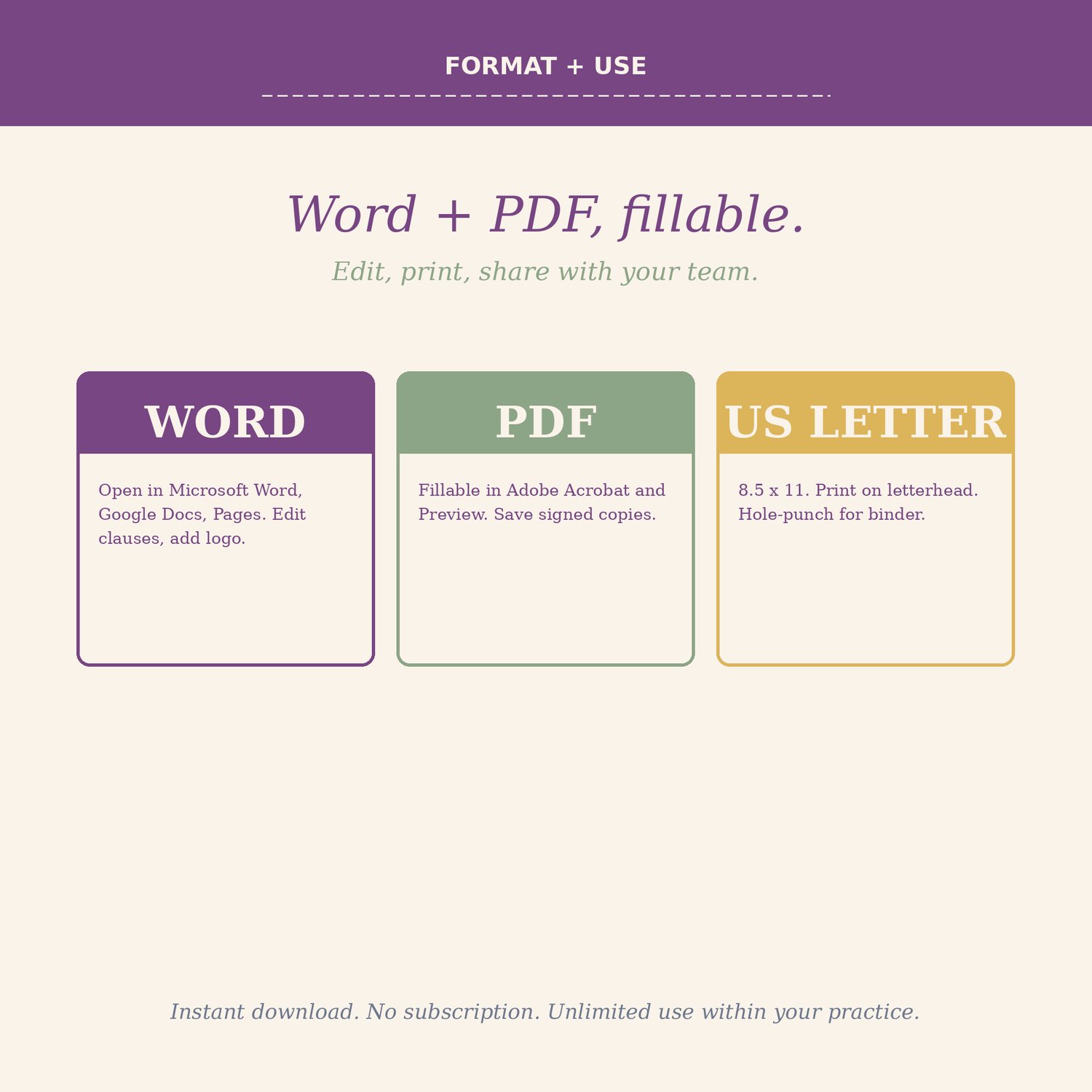
- Editable, fillable PDF (31 pages)
- Editable Microsoft Word (.docx, 31 pages)
- Member contract, intake script and end-of-cycle letter ready to adapt to your practice letterhead
- US Letter and A4 sizes both included
- Works on Mac, Windows, iPad, GoodNotes, Notability
- Lifetime access, unlimited prints
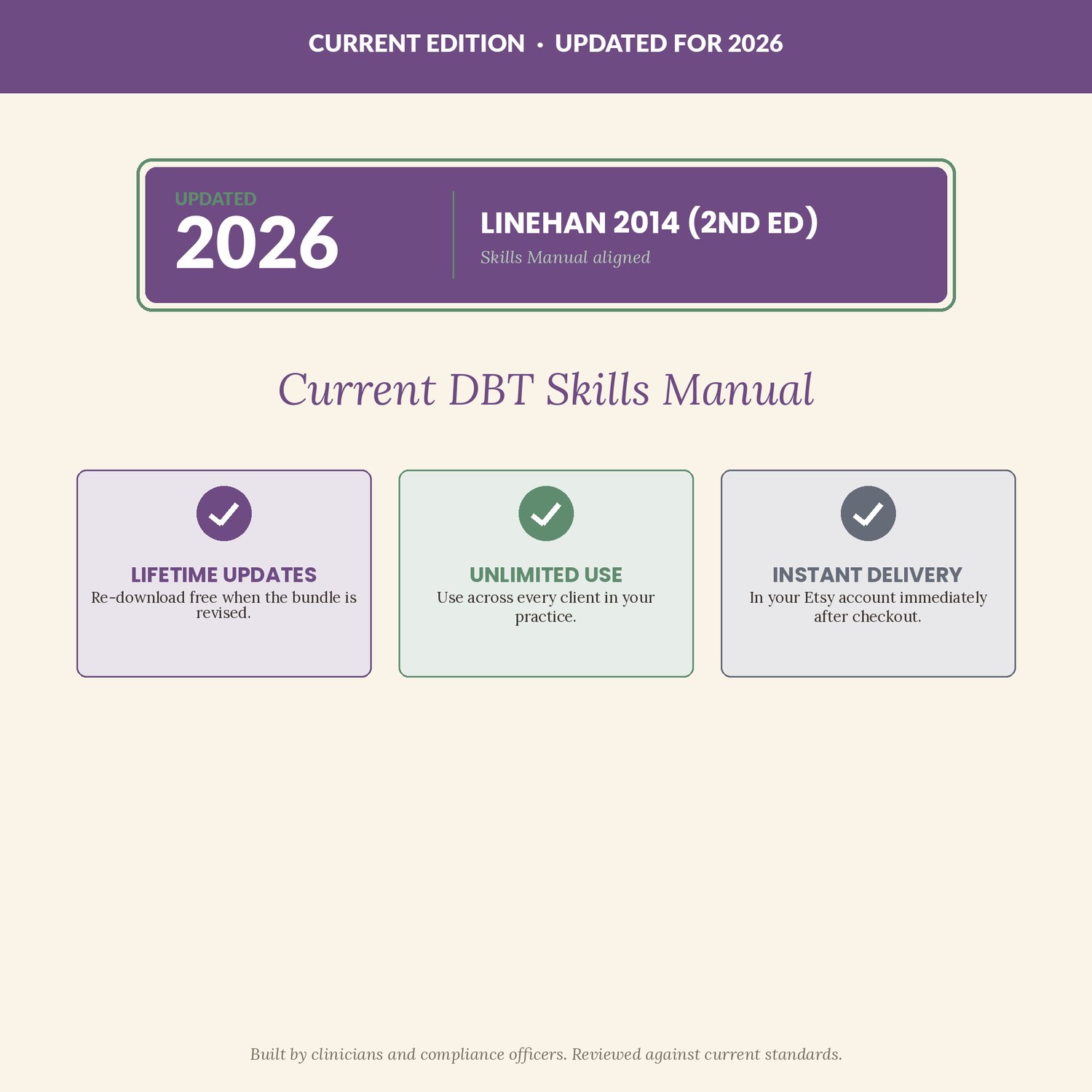
Updated 2026
Reflects the Linehan (2014) DBT Skills Training Manual second edition and the (2015) handouts and worksheets second edition, the Linehan et al. (2015) component analysis, the Valentine et al. (2015) meta-analytic review of skills training as a stand-alone treatment, Neacsiu et al. (2014) on transdiagnostic emotion dysregulation, adolescent, substance use and eating disorder adaptations, the Mehlum et al. (2014) adolescent trial, the APA Specialty Guidelines for Group Psychotherapy, 2026 group psychotherapy coding, and NCQA behavioral healthcare standards. This kit does not authorize delivery of full standard DBT and does not substitute for intensive training.
A note from the designer
I am a practicing clinician with formal DBT intensive training and three completed skills group launches across community mental health and private practice. I built this after my first launch went sideways at intake and my second generated a payer audit letter because the group documentation was a single paragraph copied across all members. Chapter 8 is the one I print and tape inside my notebook every time I help a colleague launch.
This is the complete operations kit for a DBT skills training service line, not a substitute for the Linehan manual or intensive training.
Digital download. No physical product ships. Reach out by email if anything does not work or if you have questions.