

Disability Evaluation Report Templates (2026)
Disability evaluation report templates for SSA Consultative Examinations, workers compensation and IMEs, with an SSA Listings quick reference, a function-based interview and a validity screening protocol.
What is in the bundle
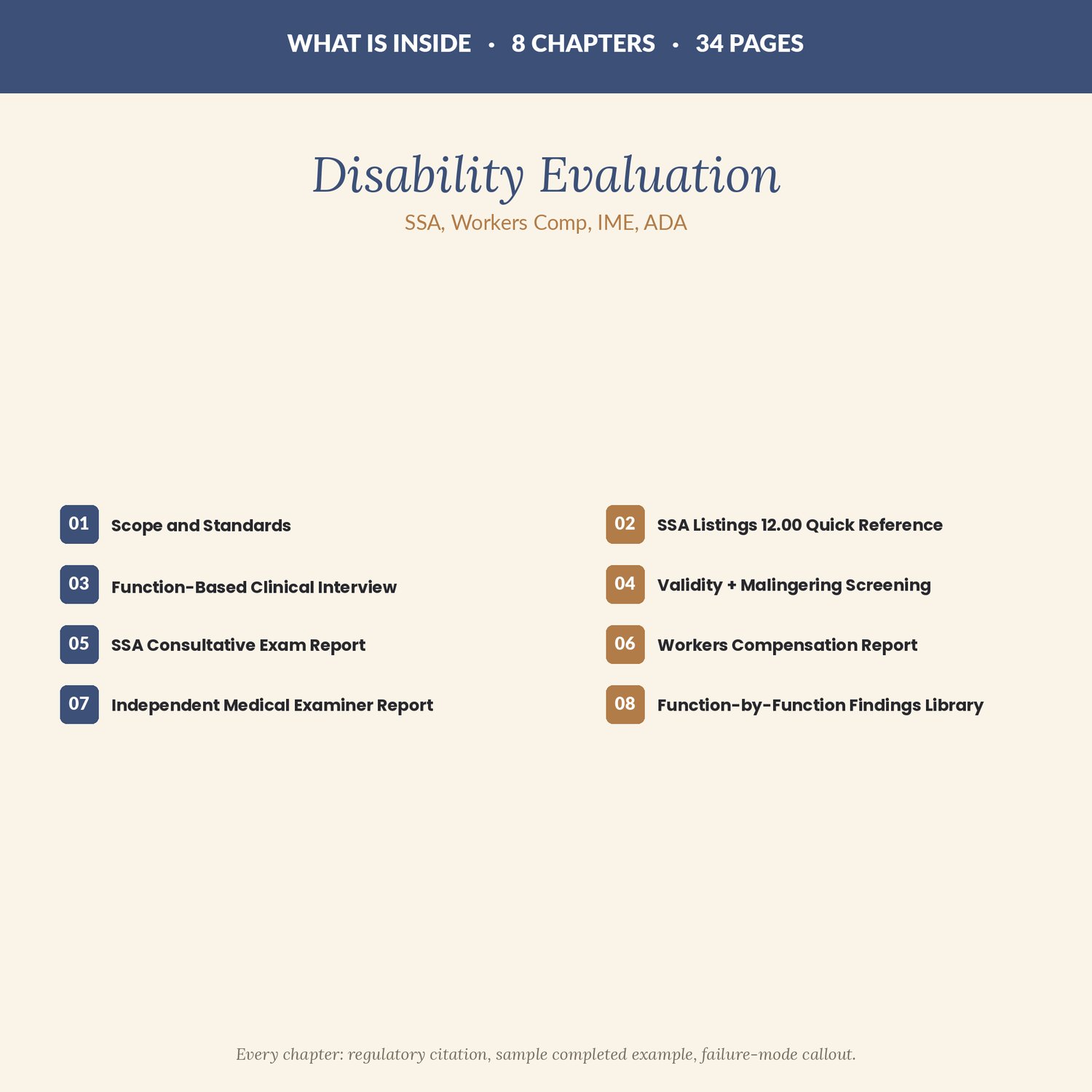
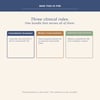
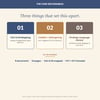
- The four evaluation contexts side by side, the universal methodology that runs through all of them, and the evaluator's role as neutral fact-finder rather than treating provider or advocate, with what that means for confidentiality, clinical responsibility, and mandatory reporting.
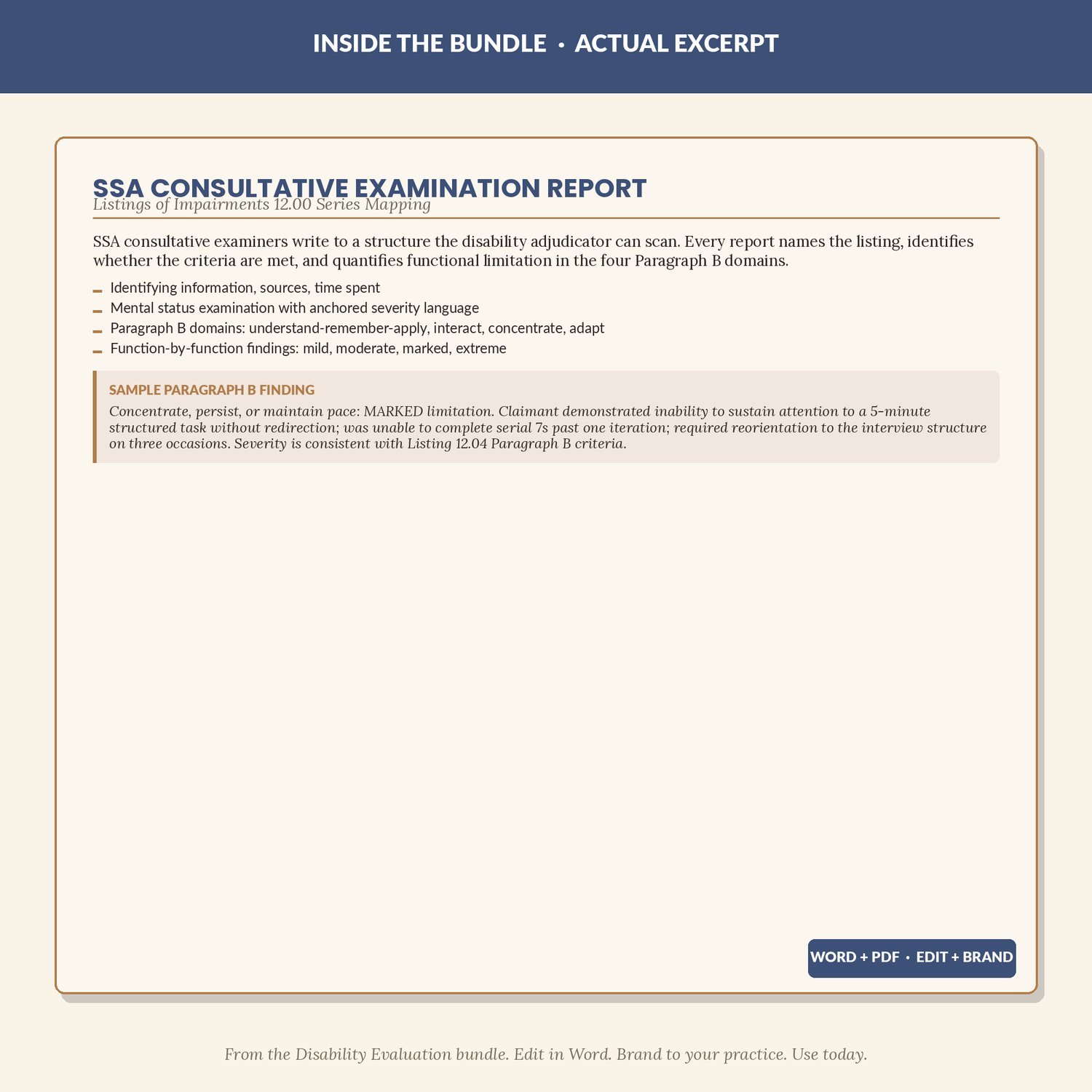
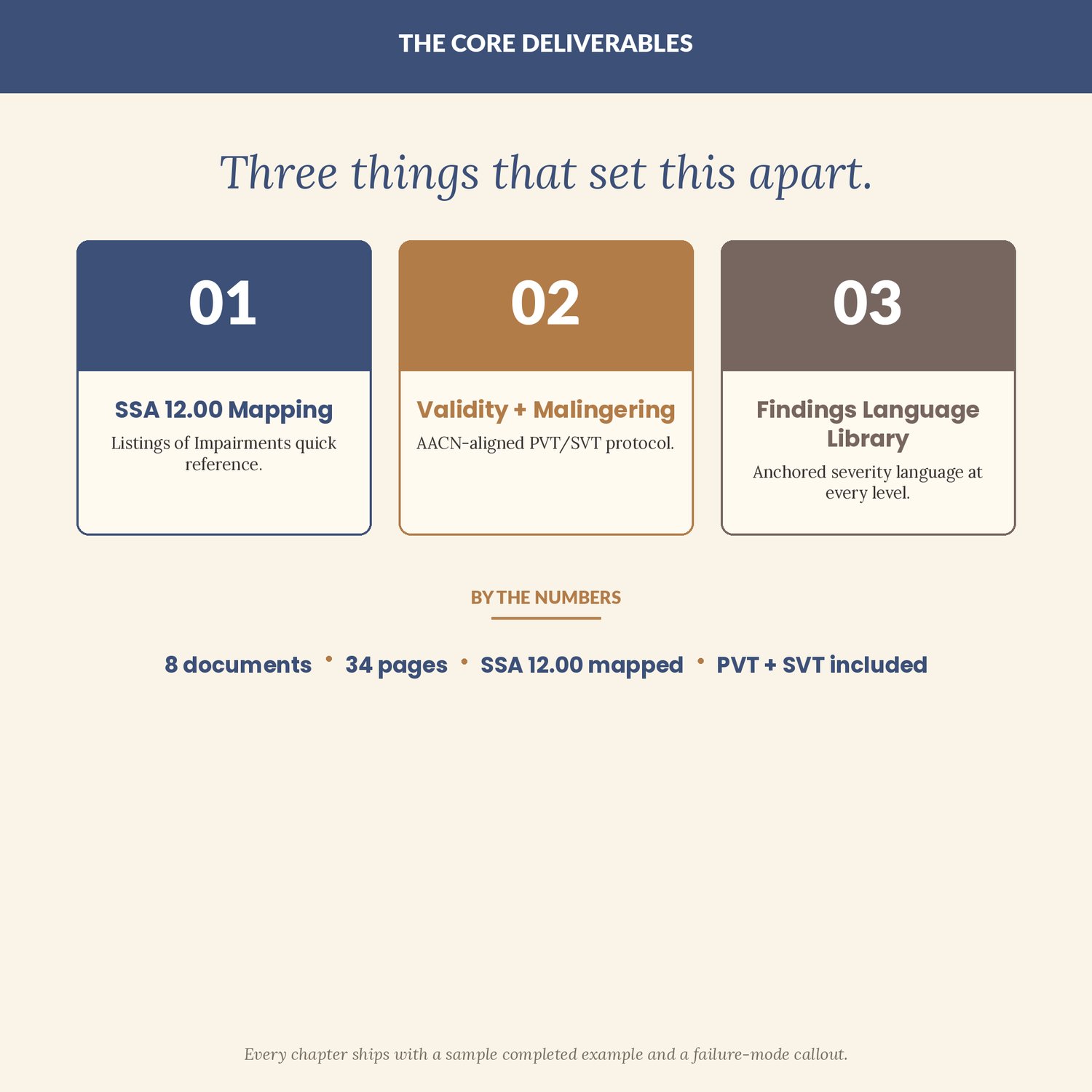
- An SSA Listings quick reference for all 11 mental disorder categories from 12.02 through 12.15, the A-B-C structure of each listing, and the four Paragraph B functional domains explained in detail: understand, remember, apply; interact with others; concentrate, persist, maintain pace; and adapt, manage oneself. Plus the current None, Mild, Moderate, Marked, Extreme descriptors and what changed in 2017.
- A function-based clinical interview, 90 to 120 minutes across eight sections: forensic notice, identification, presenting concerns, functional domains, ADLs, treatment history, substance use, and mental status. With specific probe language for each B-domain and a full MSE structure.
- A validity and malingering screening protocol built on the Larrabee base rate data. A PVT battery (TOMM with the Trial 2 cutoff below 45, Reliable Digit Span at or below 6, Word Memory Test) and an SVT battery (SIMS above 14, MMPI-3 validity scales from VRIN-r through L-r and K-r, M-FAST above 5, PAI validity scales), with convergence rules for two or more PVT failures, one PVT plus an SVT elevation, and how to read a single failure. Worked examples for valid and invalid presentations, mixed-finding guidance, and the differential for non-credible performance across malingering, somatoform presentation, cry for help, genuine severe impairment, and low education plus low effort.
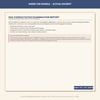
- An SSA Consultative Examination report template with all 19 required sections, sample B-domain findings anchored to specific examples, and Paragraph C findings where they apply to 12.02, 12.03, 12.04, 12.06, and 12.15.
- A Workers Compensation template with 15 sections including causation analysis, MMI determination, AMA Guides impairment rating, and work capacity. The workers comp concepts laid out (compensability, apportionment, MMI, permanent impairment, work capacity), a causation methodology covering the work event, temporal relationship, pre-existing conditions, alternative explanations, and literature support, AMA Guides Class 0 through Class 4 ratings with whole-person percentage ranges, and worked samples: a PTSD causation finding at 100 percent apportionment, a Class 2 impairment rating, and a work capacity determination with permanent restrictions.
- An IME report template structured for Daubert and Frye review across 12 sections, including examiner qualifications, retention and scope, and conclusions stated to a reasonable degree of medical certainty, with a sample opinion section carrying six numbered findings on causation, apportionment, impairment, MMI, and restrictions.
- A function-by-function findings library with anchored model language at every severity level for each B-domain and for AMA Guides Classes 1 through 4, plus a causation language library covering direct causation, aggravation of a pre-existing condition, and no causal relationship.
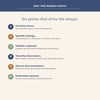
- What-to-do-when callouts at every chapter: the findings do not support disability, the claimant's report and the records diverge, validity testing suggests non-credible performance, DDS rejects your report, pre-injury records reveal undisclosed conditions, and your opinions will not favor the retaining party.
- Sources per chapter, including 20 CFR Part 404 Subpart P Appendix 1, SSA POMS DI 22510 and DI 24500.060, AMA Guides 6th Edition Chapter 14, the AACN consensus, Larrabee, Bush et al., Heilbrun, the Slick et al. criteria, the APA Specialty Guidelines, AAPL Practice Guidelines, Frye (1923), Daubert (1993), and Federal Rule of Evidence 702.
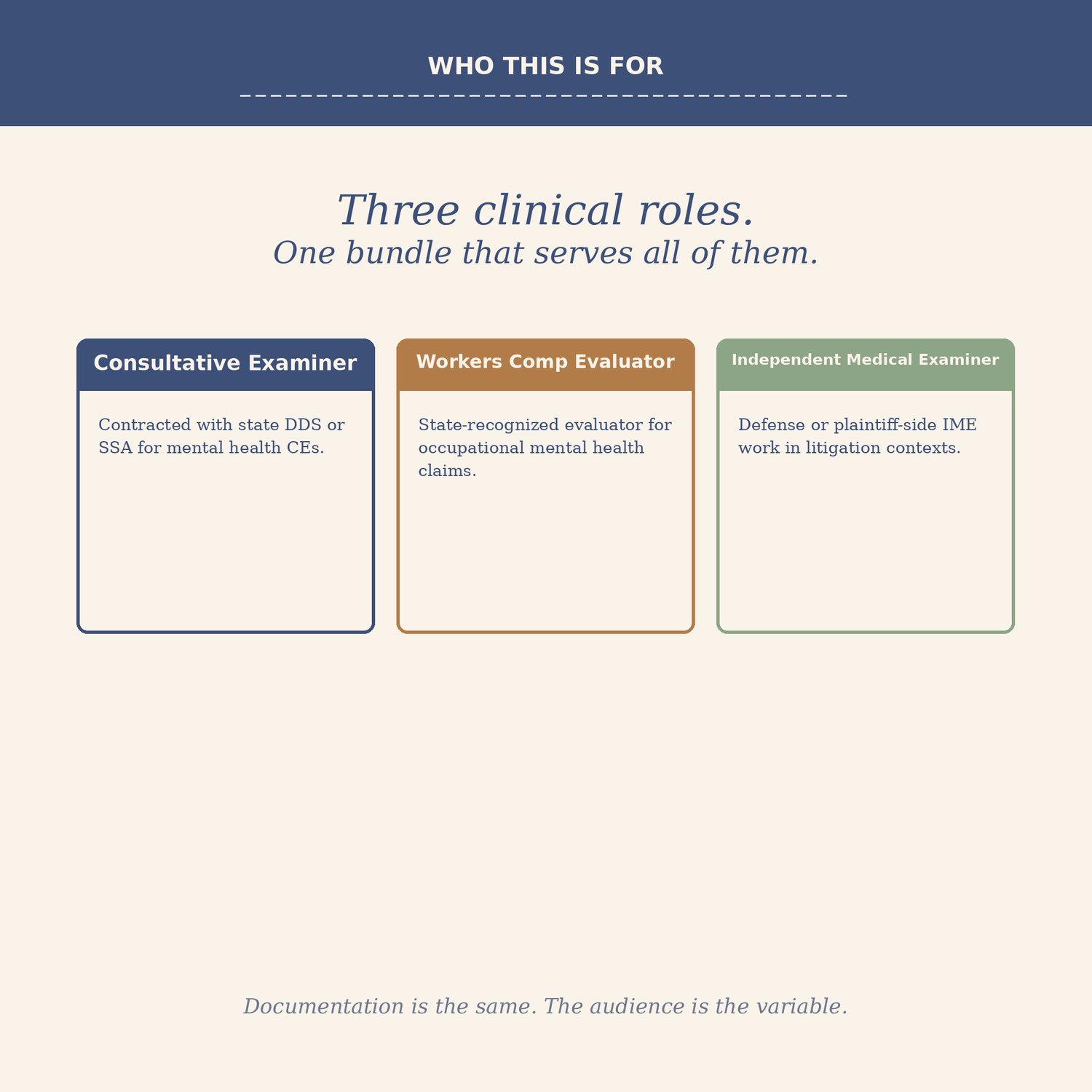
Who it is for
- Psychologists (PhD, PsyD) contracting with state DDS offices as Consultative Examiners. Psychiatrists and PMHNPs doing SSA, workers comp, and IME work. Forensic psychologists with an active disability practice. Master's-level clinicians serving as ADA accommodation evaluators within scope. Neuropsychologists doing IME work in personal injury or workers comp. Practice owners building a disability service line. Clinicians moving from primarily clinical work into forensic and disability evaluation. Forensic postdoctoral fellows. Retained IME examiners working under Daubert or Frye.
- This kit assumes the evaluator is appropriately licensed and trained. If you are not yet trained in forensic disability evaluation, complete relevant CE or fellowship training first.
Why it exists
A state DDS office calls about a Consultative Examination contract. A workers comp insurer asks about an IME on a workplace assault PTSD case. A litigator emails about a personal injury matter with claimed psychiatric damages. Three different frameworks, three different report formats, three different decision-makers. Write a good clinical evaluation for any of them and you get a report remanded by SSA, rejected by the carrier, or impeached on cross.
50 pages covering all four contexts: SSA Consultative Exam, Workers Compensation, Independent Medical Examiner, and ADA accommodation. Aligned with 20 CFR Part 404 Subpart P Appendix 1 (the 12.00 series), AMA Guides 6th Edition Chapter 14, the AACN consensus on validity assessment, the APA Specialty Guidelines for Forensic Psychology, and the AAPL Practice Guidelines.
Why it is built this way
Most references here are SSA-only with no workers comp or IME, a workers comp manual with no SSA crosswalk, or a textbook chapter that never produces a deployable report. This covers all four contexts with the templates, the battery, and both language libraries in one document.
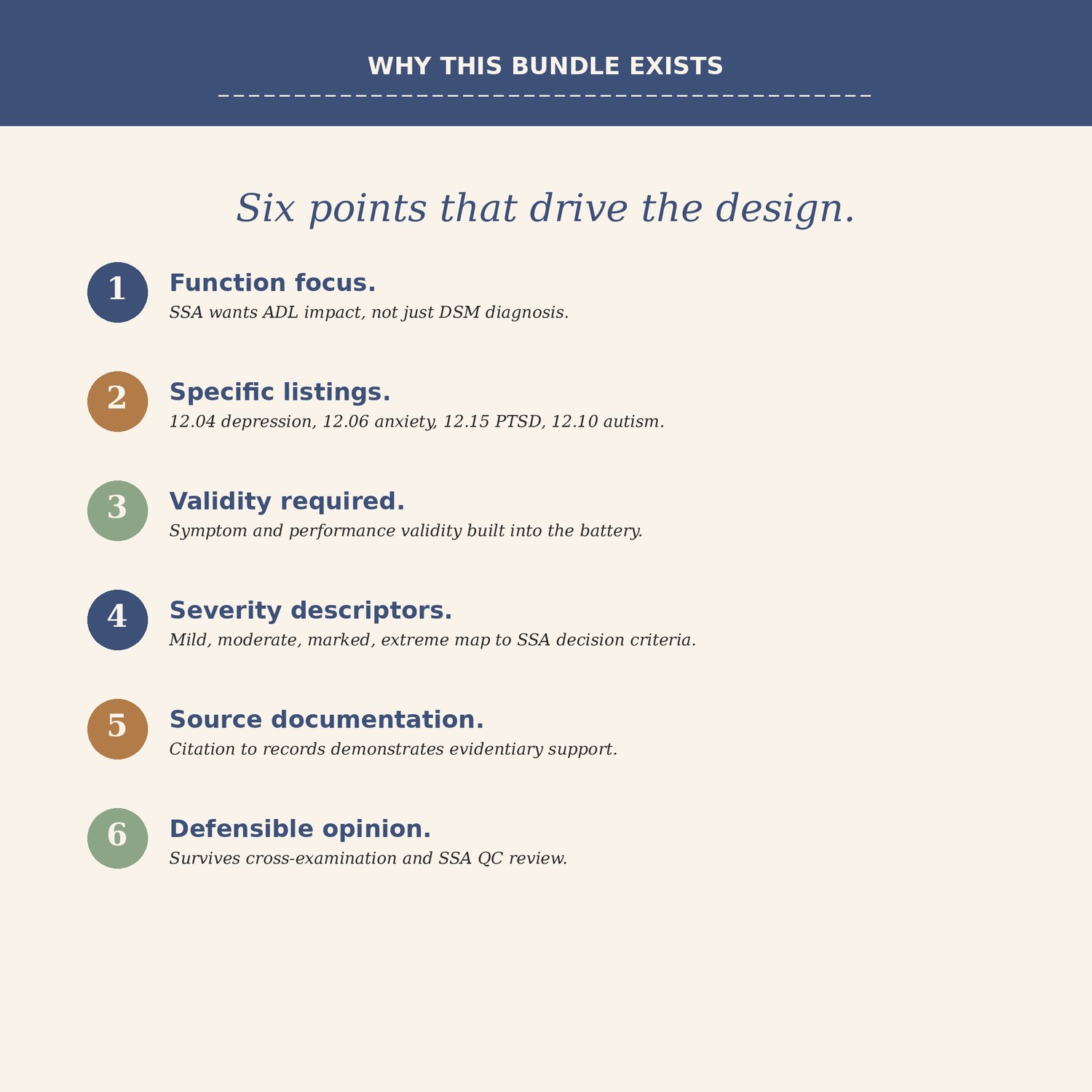
SSA does not award disability for a diagnosis. Function is the question, and findings must map to the specific Paragraph B domains using the current descriptors. The 2017 scale change still catches evaluators who trained on the old five-point scale, and that is a remand.
Validity assessment is now expected by SSA, most workers comp systems, and most IME contexts, with non-credible performance base rates in compensation-related populations reported at 30 to 40 percent. Omitting it is a common basis for rejection or impeachment.
The workers comp report is structurally different: causation, apportionment, MMI, impairment rating, and work capacity each carry methodological standards. IME reports face admissibility challenges more often than administrative reports, where the reasonable-degree-of-medical-certainty standard, the explicit differential, and the methodology grounding are what survive cross.
The findings library is the time-saver. Customize the language; the architecture is what you are buying.
Format
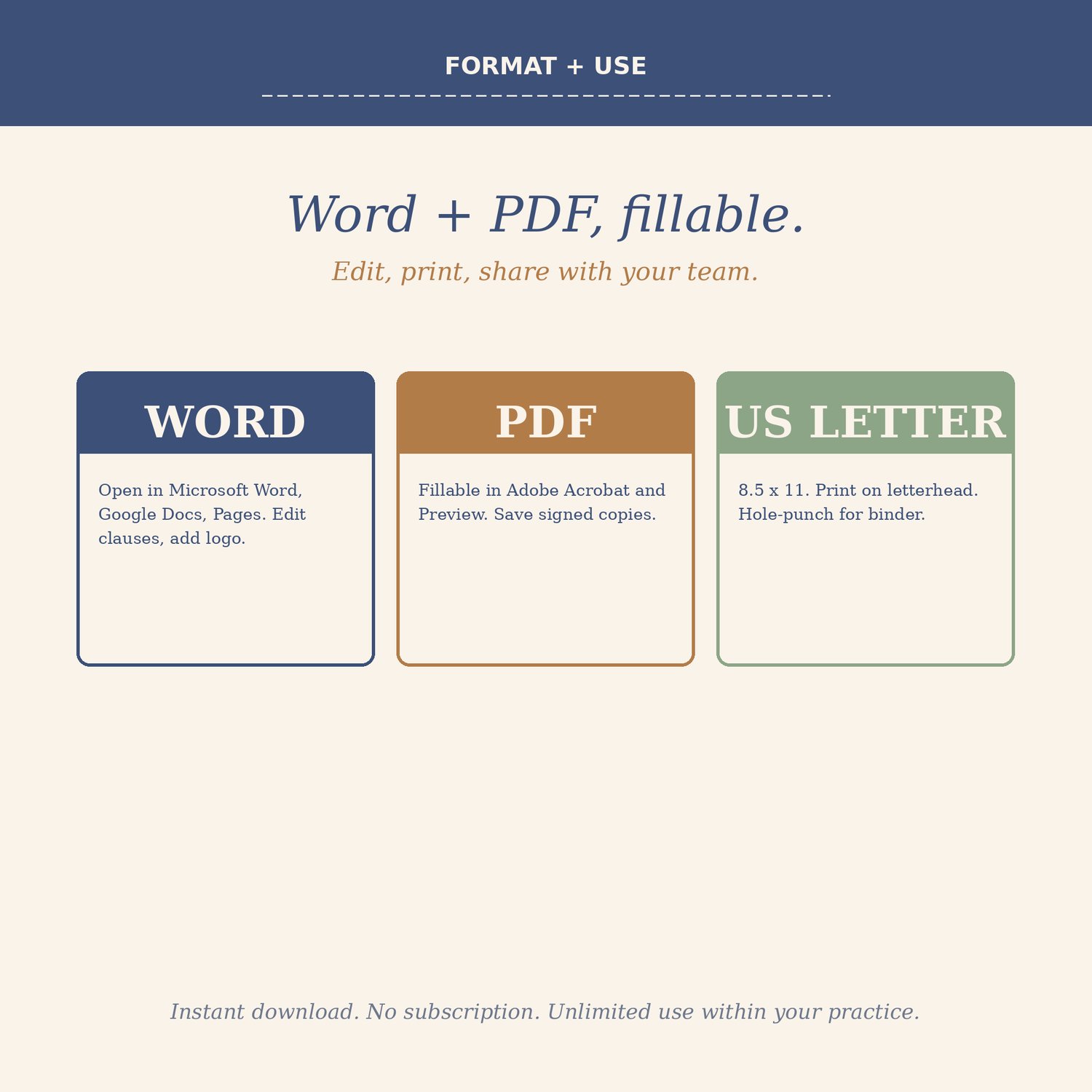
Editable, fillable PDF, 50 pages. Editable Microsoft Word (.docx), same length. Templates and the findings library copy straight into your report-writing workflow. US Letter (8.5 x 11) and A4 (8.3 x 11.7) both included. Works on Mac, Windows, iPad, GoodNotes, and Notability. Lifetime access, unlimited prints.
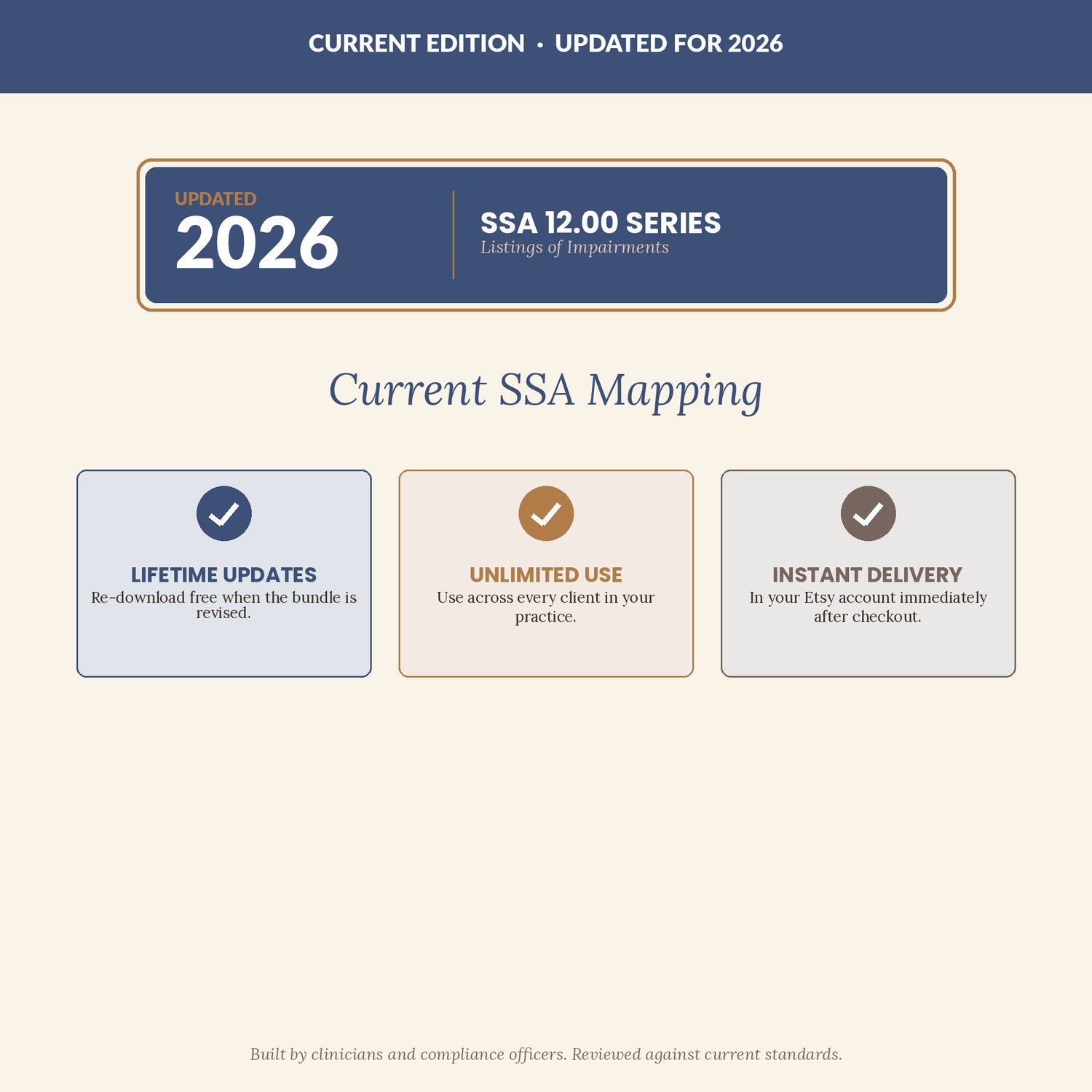
Updated 2026
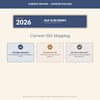
SSA Listings reflect current 20 CFR Part 404 Subpart P Appendix 1, 12.00 series, with the current severity descriptors. POMS citations reflect current DI 22510 and DI 24500.060. Impairment rating reflects AMA Guides 6th Edition Chapter 14. Validity references reflect the AACN consensus (Bush et al.) and Larrabee's Forensic Neuropsychology (2012). Diagnostic criteria reflect DSM-5-TR. Forensic standards reflect the APA Specialty Guidelines (2013) and the AAPL Practice Guideline. Admissibility references reflect current Daubert and Frye standards and FRE 702.
How to use it
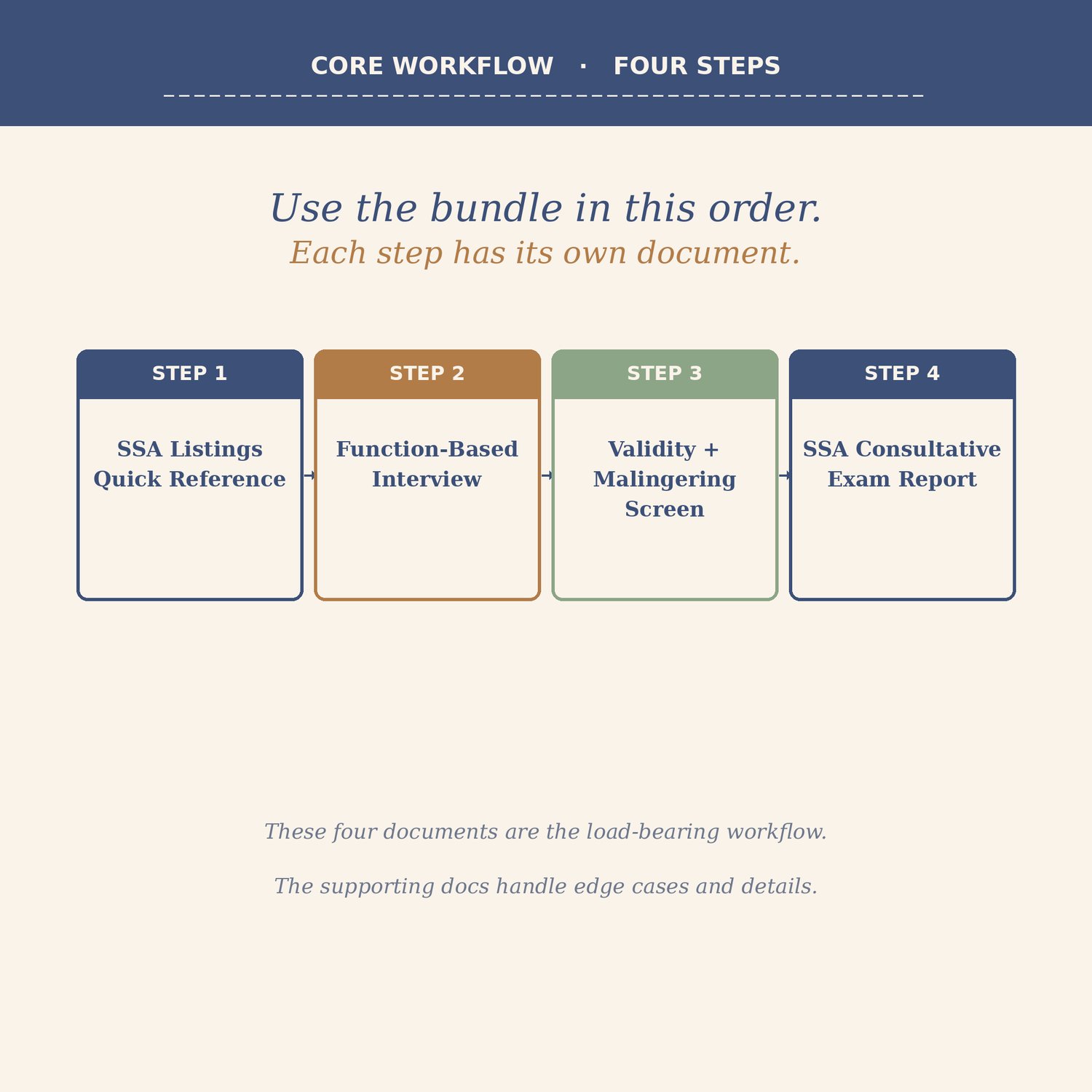
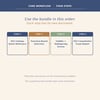
New SSA Consultative Exam: run the Chapter 3 interview in the appointment, administer the Chapter 4 battery, write from the Chapter 5 template, and pair every finding with anchored language from Chapter 8. Workers comp: the Chapter 6 template with AMA Guides rating from Chapter 8. IME: the Chapter 7 template with the certainty standard and the explicit differential. The Chapter 2 quick reference is the print-and-tab page for the 12.00 series. The Chapter 4 battery belongs in every evaluation.
This is a clinical operations reference for licensed forensic evaluators. It is not training and not legal advice. The evaluator remains responsible for all evaluation decisions within their scope of practice and licensure.
Instant digital download. No physical product ships. Message us if anything does not work.