





Court Documentation for Therapists (2026)
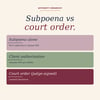
A court documentation manual for therapists: the treating versus forensic role line, privilege and HIPAA rules, and a step by step subpoena response protocol.
What is in the manual
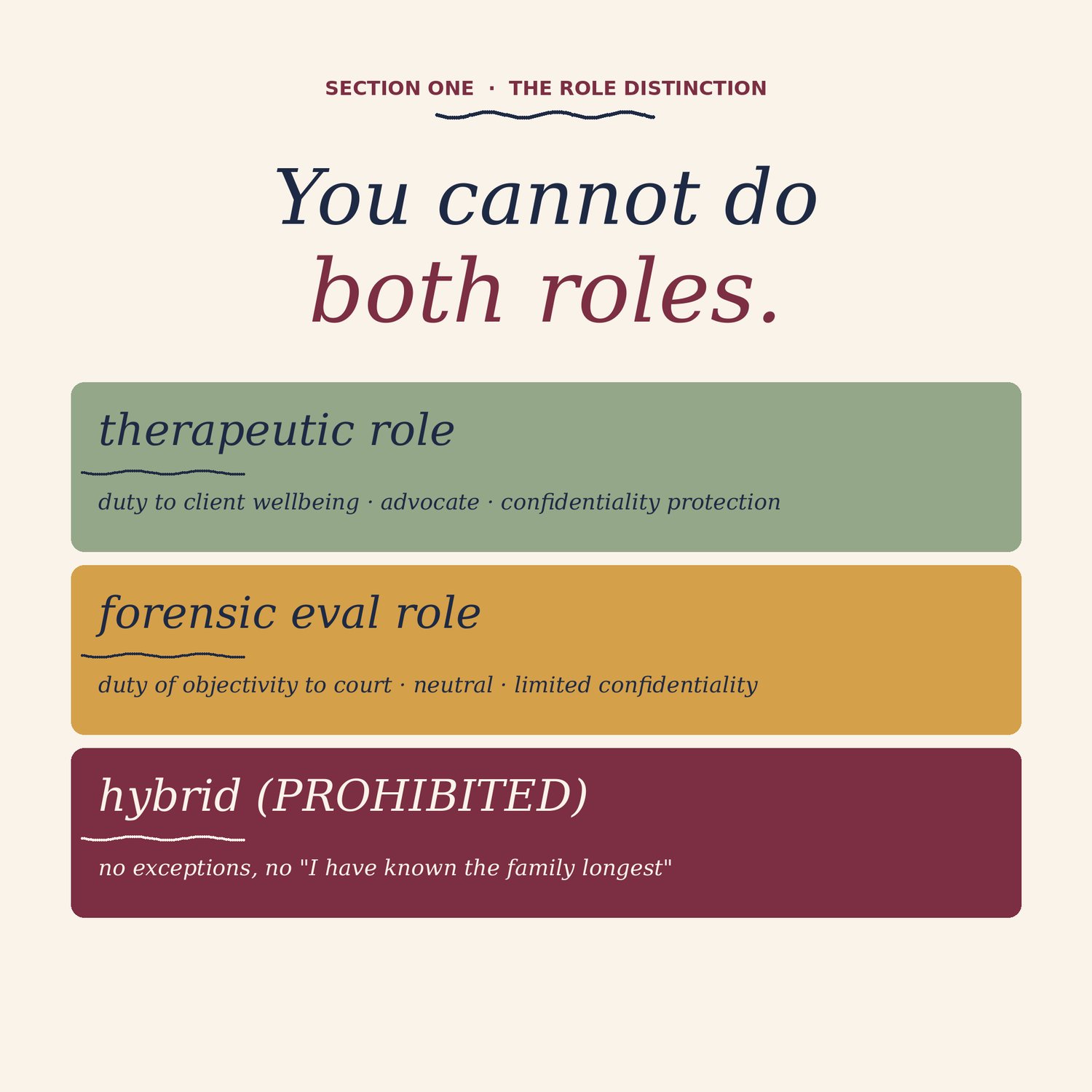
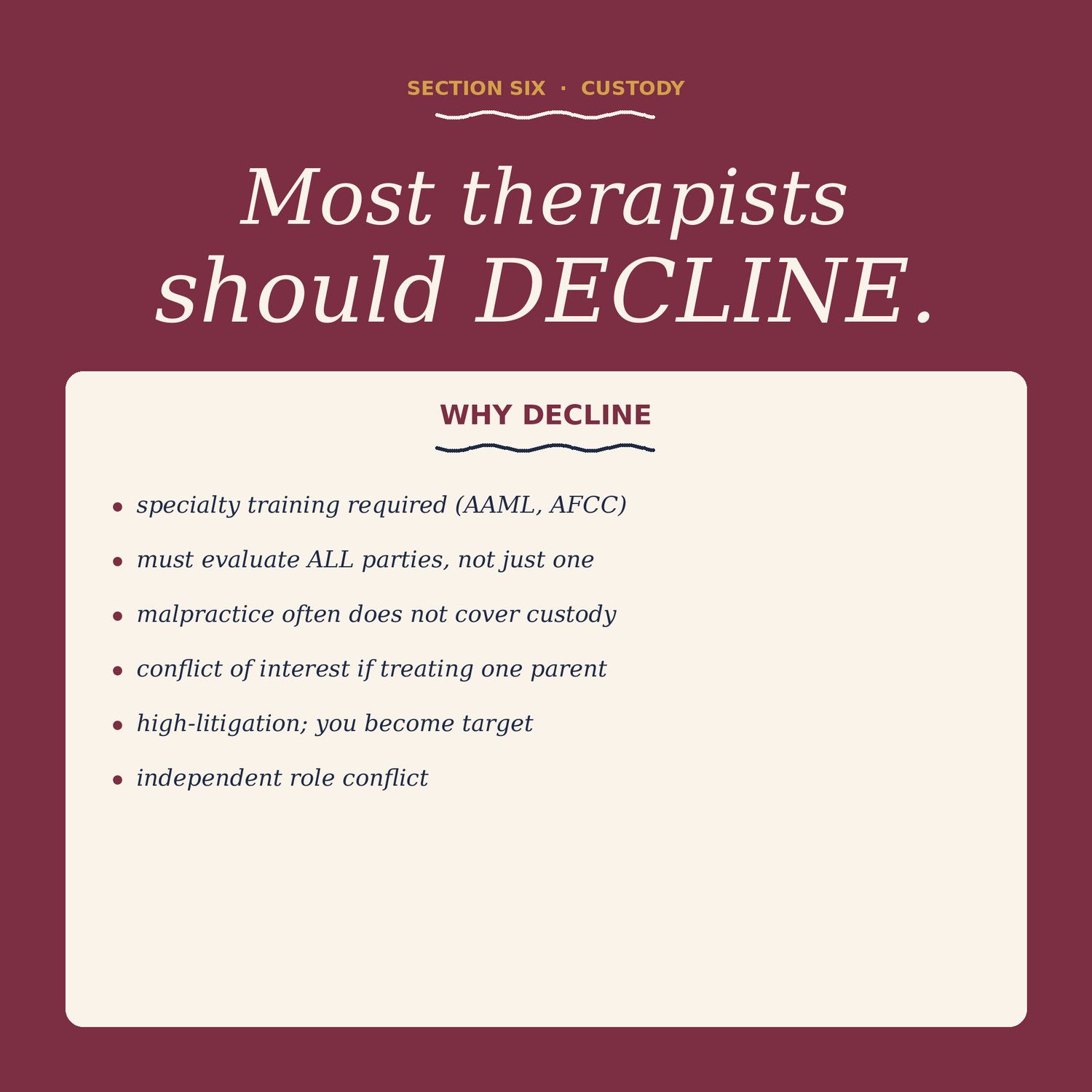
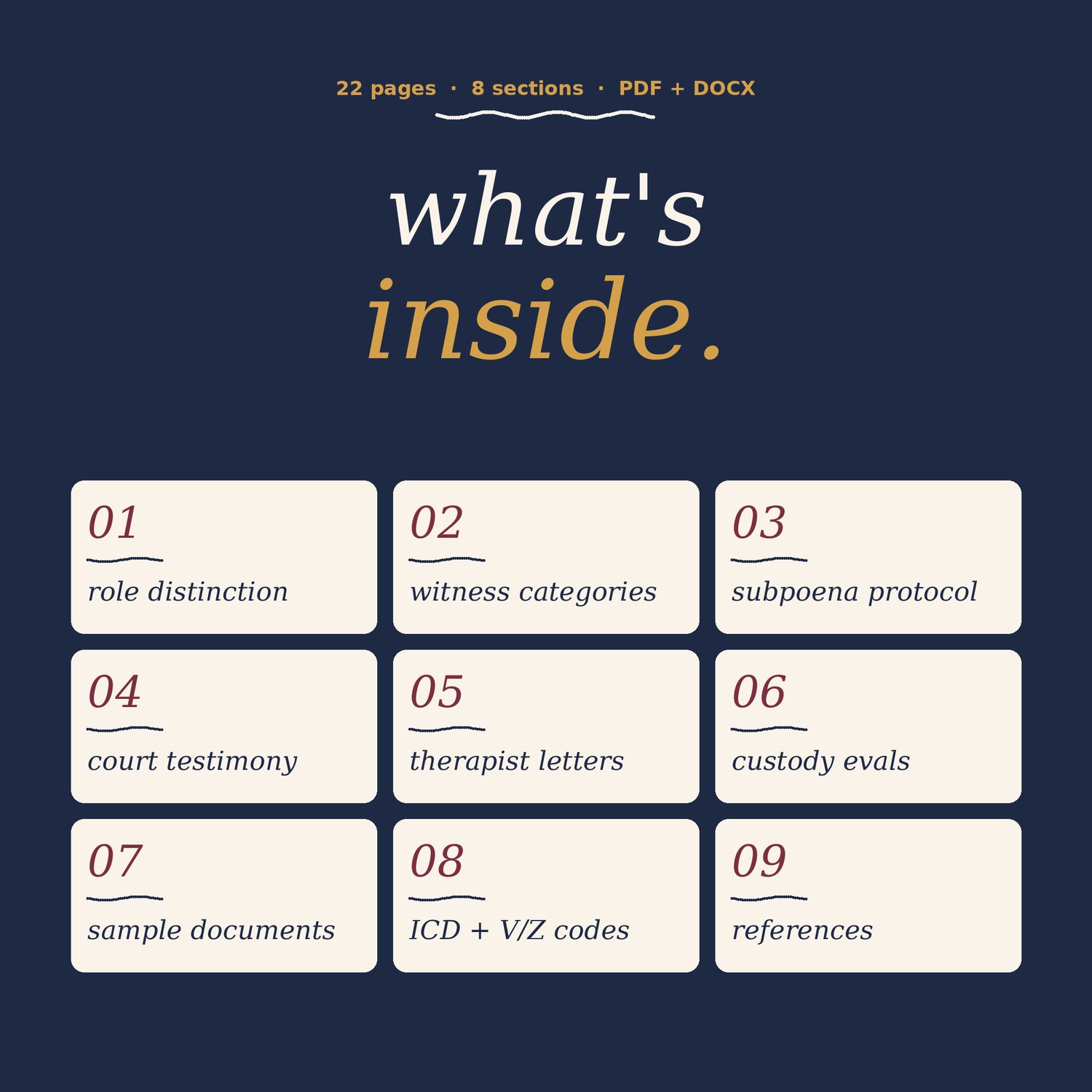
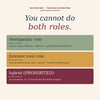
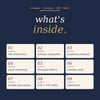
- The treating versus forensic role distinction: the ten conflicts, seven practical reasons treating clinicians should decline forensic work, and a side-by-side comparison across 11 dimensions
- The role-boundary chart entry to make after every court contact, a single contemporaneous note that prevents most ethics complaints
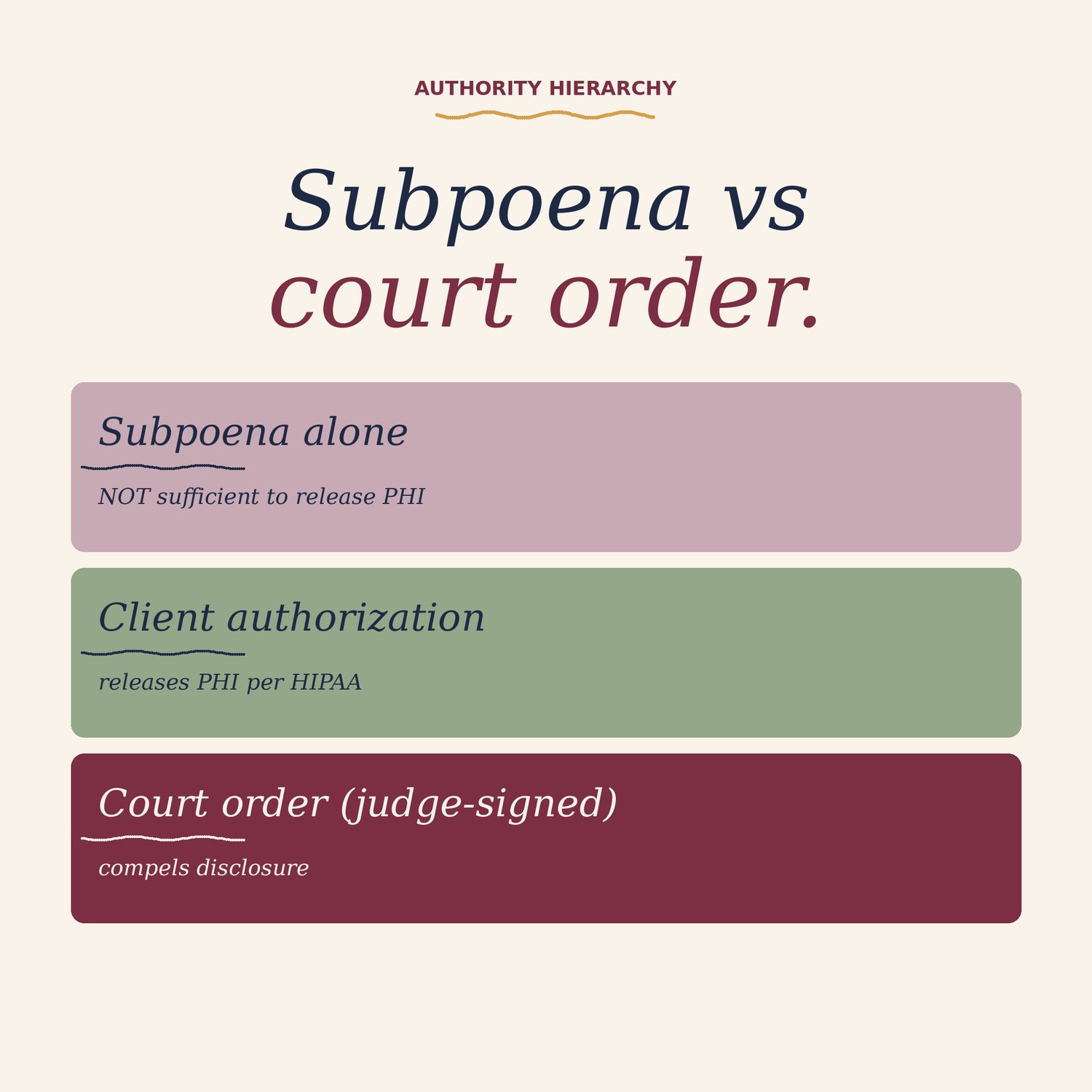
- HIPAA and state privilege primer: court orders versus attorney subpoenas, the psychotherapy notes definition and protection, and the more-protective-rule analysis
- State privilege framework: the patient-litigant exception, Jaffee v. Redmond federal privilege, and mandated reporter overrides
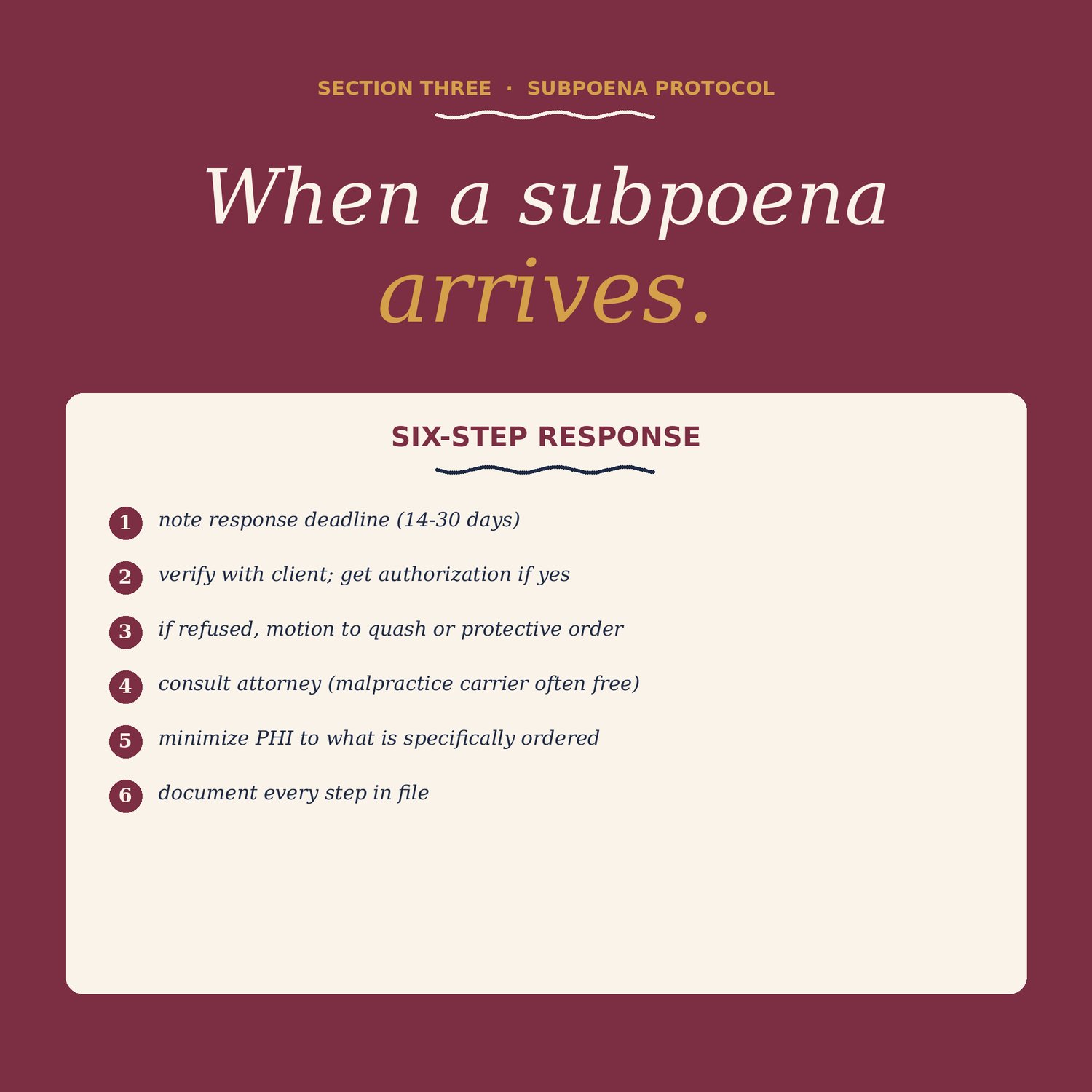
- Six-step subpoena response decision tree with branching rules, plus a subpoena types reference
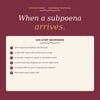
- Standard eight-step subpoena response protocol, from date-stamp through filing a motion
- The most common HIPAA errors in mental health subpoena response, with prevention for each
- Sample objection letter to the issuing attorney, in full text, ready for attorney adaptation
- Sample motion to quash skeleton with a seven-paragraph structure and model language
- Sample decline letter to an attorney requesting a forensic opinion, with role-conflict citations
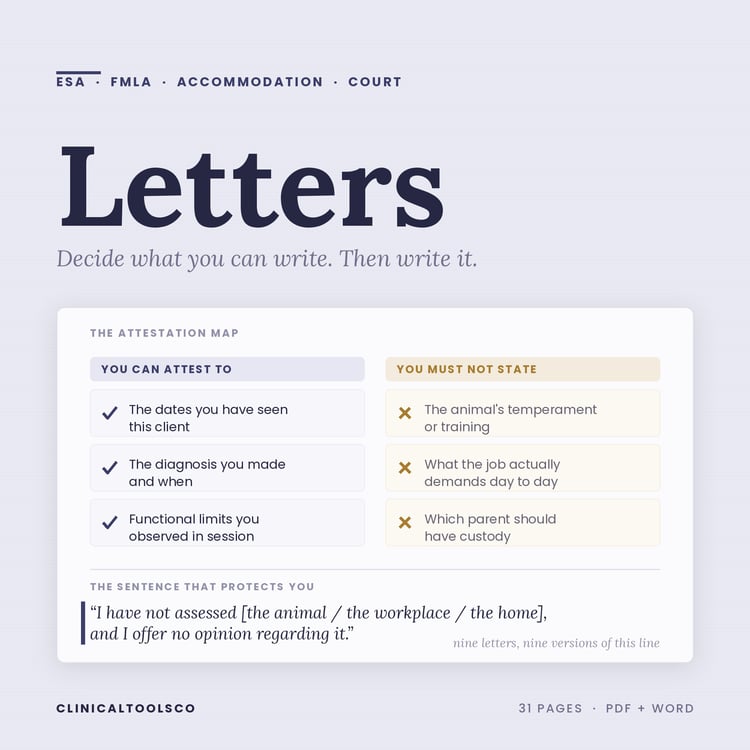
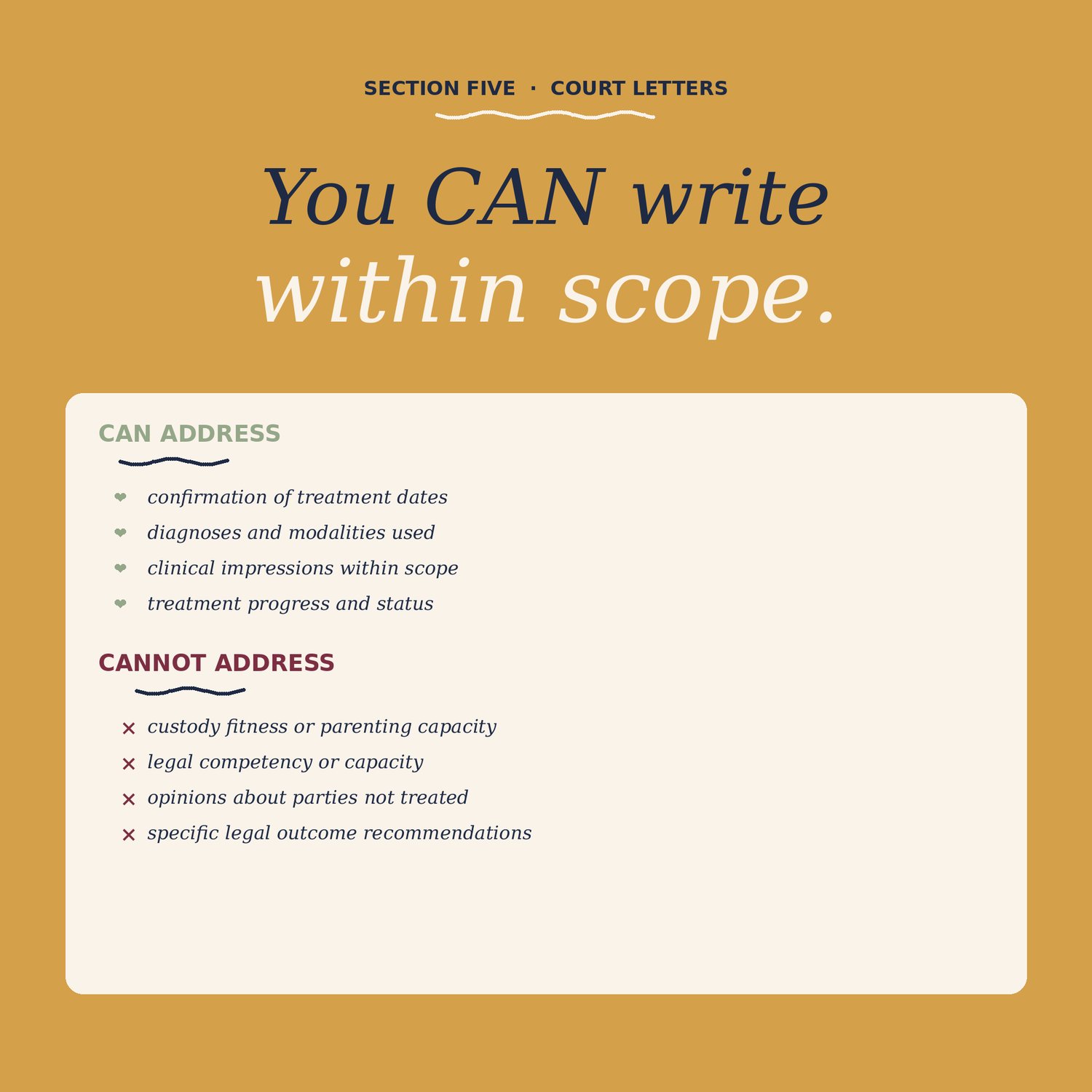
- Court letters treating clinicians can and cannot write: the three-column rule covering what to say, what to qualify and what never to say
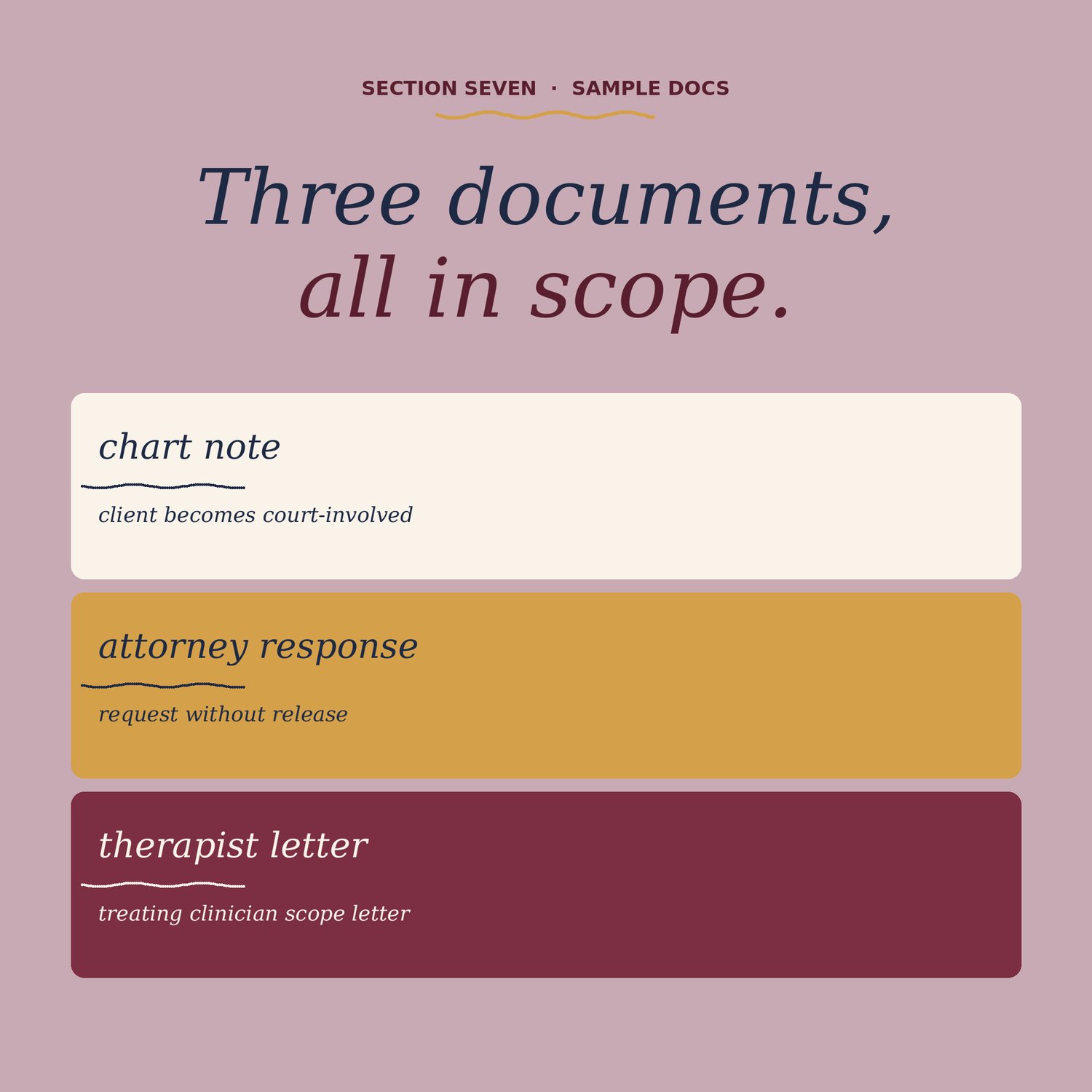
- Three full sample court letters: medical necessity and treatment status, mandated reporter documentation, and a parental fitness request declined with a script
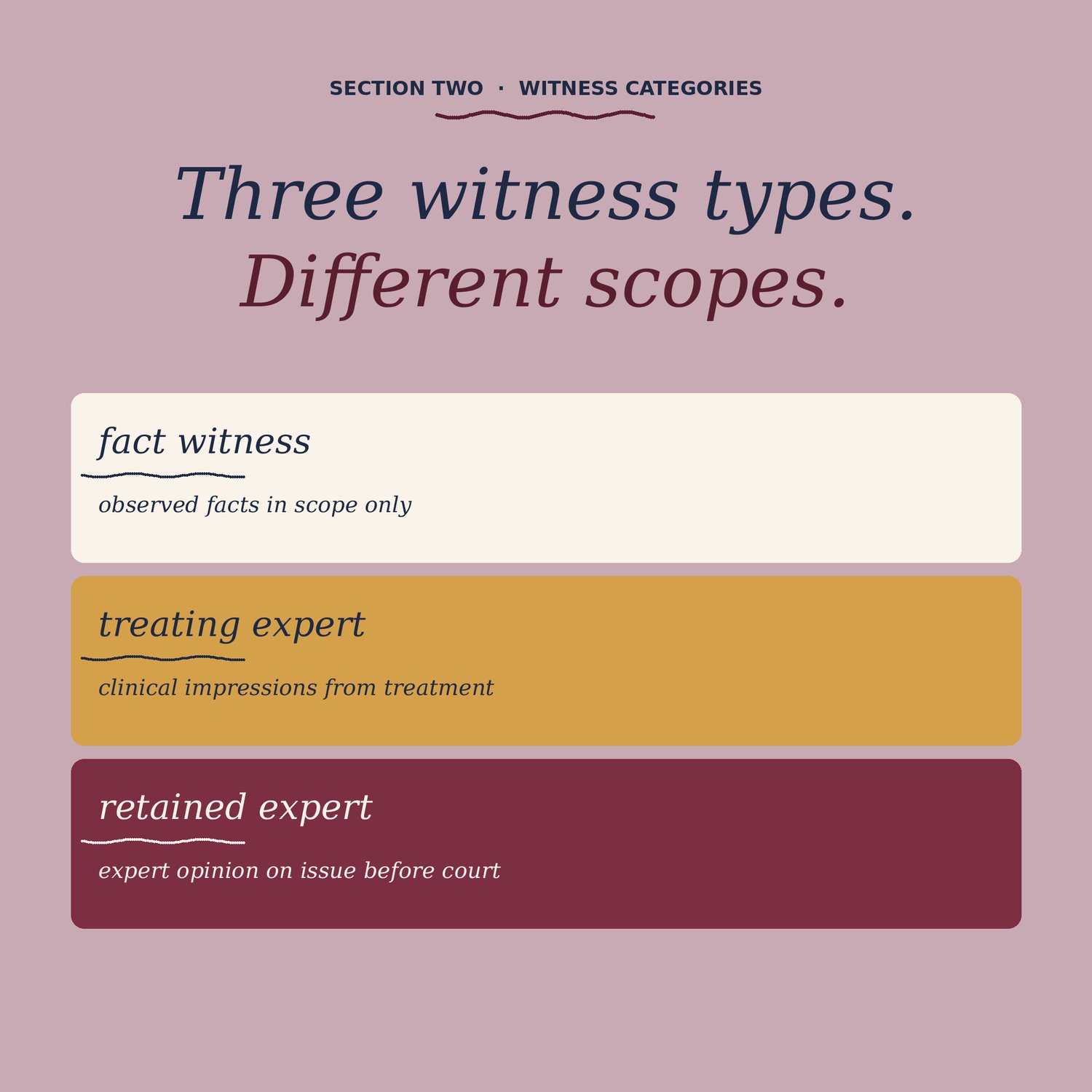
- Testimony preparation: fact witness versus expert witness under FRE 701 and 702, the Daubert standard, and the voir dire response when a treating clinician is offered as an expert
- An 11-step direct and cross-examination preparation checklist with the four answers that cover most cross
- The hybrid treating clinician witness framework and the two phrases to memorize
- Chart documentation that survives both audit and court scrutiny: six conventions, side-by-side risky versus defensible examples, and an eight-element progress note template
- State-by-state snapshot for California, New York, Texas, Florida and Illinois, plus quick practice notes on the high-volume privilege traps
- Custody evaluation participation rules: the three doors and the right response for each, plus a collateral source interview matrix
- Forensic-adjacent fee structure: treatment fee versus forensic hourly rate, retainer practice, billing the retaining party, per-page record charges, deposition and trial day rates, and cancellation policy
- Trauma-informed practice when the client is a litigant, covering six litigation-specific clinical issues
- Twelve mistakes that generate licensing-board complaints with prevention for each, plus a five-minute pre-response checklist
Who it is for
- LCSW, LMFT, LPC, LPCC, LMHC and generalist psychologists in outpatient practice
- Master's-level clinicians who have never been subpoenaed and want to be ready before the first one arrives
- Group practice owners and clinical directors building forensic-response protocols
- Solo private-practice clinicians treating clients in family court, divorce, custody and personal injury proceedings
- Pre-licensure clinicians under supervision who are starting to see litigant clients
- Clinical supervisors training supervisees on subpoena response
- Therapists moving from agency work, where the agency attorney handled subpoenas, into private practice
- Telehealth clinicians treating clients across state lines who need the state-by-state privilege primer
- This manual is built for treating clinicians, not for forensic specialists. If you are a board-certified forensic psychologist running custody evaluations, this is not your reference.
Why it exists
A subpoena arrived in Tuesday's mail. Your patient is mid-divorce. Opposing counsel wants the full chart in 14 days. You have never been subpoenaed before, the malpractice carrier's hold music is playing for the third time today, and the client just texted asking whether you would write something for the custody hearing. This is the moment every treating clinician finds out whether they prepared for forensic-adjacent work or whether they will improvise and learn the hard way which choices generate licensing-board complaints.
This is the manual I wish I had two weeks before my first subpoena. The subpoena response decision tree, the HIPAA and state privilege primer, the Greenberg and Shuman framework for the treating versus forensic role distinction, sample motion-to-quash and objection letters, three worked court letters, testimony preparation as a fact witness, documentation conventions that survive both audit and court, a state-by-state snapshot for the five largest states, custody-evaluator collateral interview rules, the fee structure for forensic-adjacent work, and the twelve mistakes that generate complaints.
22 pages. Fillable PDF plus editable Word. Aligned with the APA Specialty Guidelines for Forensic Psychology (2013, reaffirmed 2018), AFCC Model Standards of Practice for Child Custody Evaluation (2006), the Greenberg and Shuman framework, the HIPAA Privacy Rule at 45 CFR 164.512(e) and 164.508, Federal Rules of Evidence 701 through 705, Jaffee v. Redmond (1996), and the ACA, NASW, AAMFT and APA codes of ethics.
Why this is different
Most forensic references are written for forensic specialists conducting court-ordered evaluations. This manual is for the generalist clinician who treats clients in routine outpatient practice and now finds a subpoena on the desk. The organizing principle is that the therapeutic role and the forensic role are different jobs, and almost every problem covered here flows from one source: a treating clinician pulled into the forensic role.
The subpoena decision tree matters because most attorney-issued subpoenas in most states are not, standing alone, sufficient legal authority to release psychotherapy notes, and the most frequent HIPAA violation in mental health practice is complying with one without verifying satisfactory assurance.
The three sample court letters matter because the single most damaging document a treating clinician can produce is a letter that crosses from observation into forensic opinion. Such letters are frequently disregarded by judges and routinely cited in licensing board complaints.
The testimony preparation matters because the treating clinician will almost always testify as a fact witness, not an expert witness, and two memorized phrases cover the cross-examination posture that protects the clinician.
The chart-documentation conventions matter because audit-friendly and court-friendly documentation are not the same thing. The six conventions produce a chart that holds up to both audiences.
Format
- Editable, fillable PDF (22 pages)
- Editable Microsoft Word (.docx, 22 pages)
- Sample letters and motion skeleton copy directly into your attorney's drafting workflow
- US Letter and A4 sizes both included
- Works on Mac, Windows, iPad, GoodNotes, Notability
- Lifetime access, unlimited prints
Updated 2026
HIPAA Privacy Rule citations reflect current 45 CFR 164.512(e) and 164.508 provisions. Federal Rules of Evidence citations reflect 2023 amendments to Rules 501, 701, 702 and 703. APA Specialty Guidelines reflect 2013 adoption, reaffirmed 2018. AFCC Model Standards reflect the 2006 publication and the 2011 Court-Involved Therapy Guidelines. State privilege snapshots verified current as of 2025 and 2026 for California, New York, Texas, Florida and Illinois.
A note from the designer
I am a practicing clinician with experience treating litigant clients and responding to subpoenas, depositions and court letter requests. I built this after watching too many colleagues stumble into role confusion, write a letter they should not have written, and field a licensing complaint they did not see coming. The section I refer back to most is the subpoena decision tree. The section I share with every supervisee is the three-column rule for court letters.
This manual is not legal advice. Always contact your malpractice carrier's risk-management line and consult a healthcare attorney before responding to any subpoena or court demand.
Digital download. No physical product ships. Reach out by email if anything does not work or if you have questions.