
Gottman Couples Therapy Documentation Bundle (2026)
Couples therapy documentation built around the Gottman Method: initial sessions, the oral history interview, the four horsemen and their antidotes, conflict management, and a treatment plan with session notes.
What is in the bundle
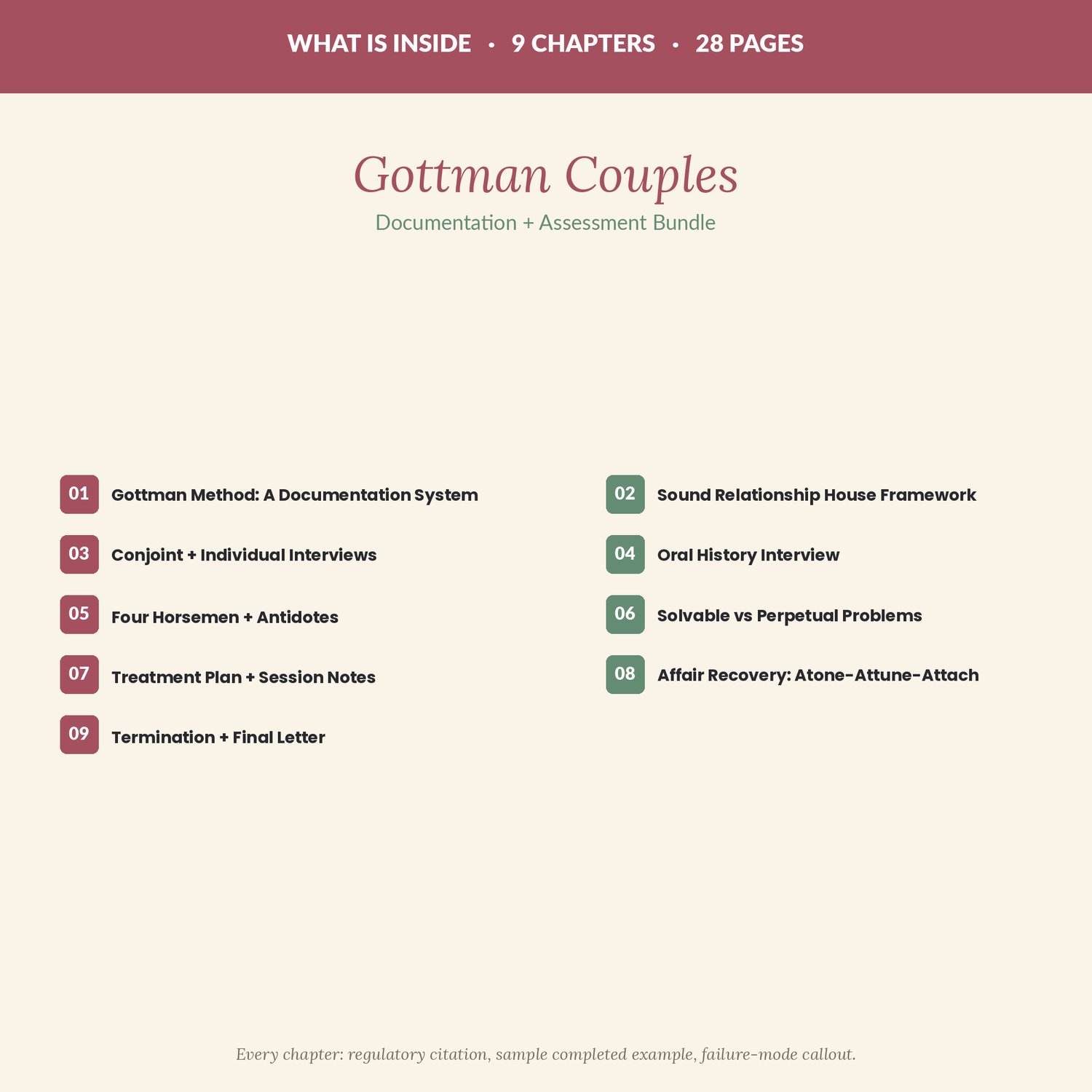
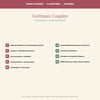
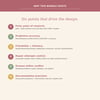
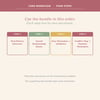
- Chapter 1: The method as a documentation system. Scope, the evidence base, appropriate populations, refer-out triggers including intimate partner violence typology, and a typical couples caseload revenue example
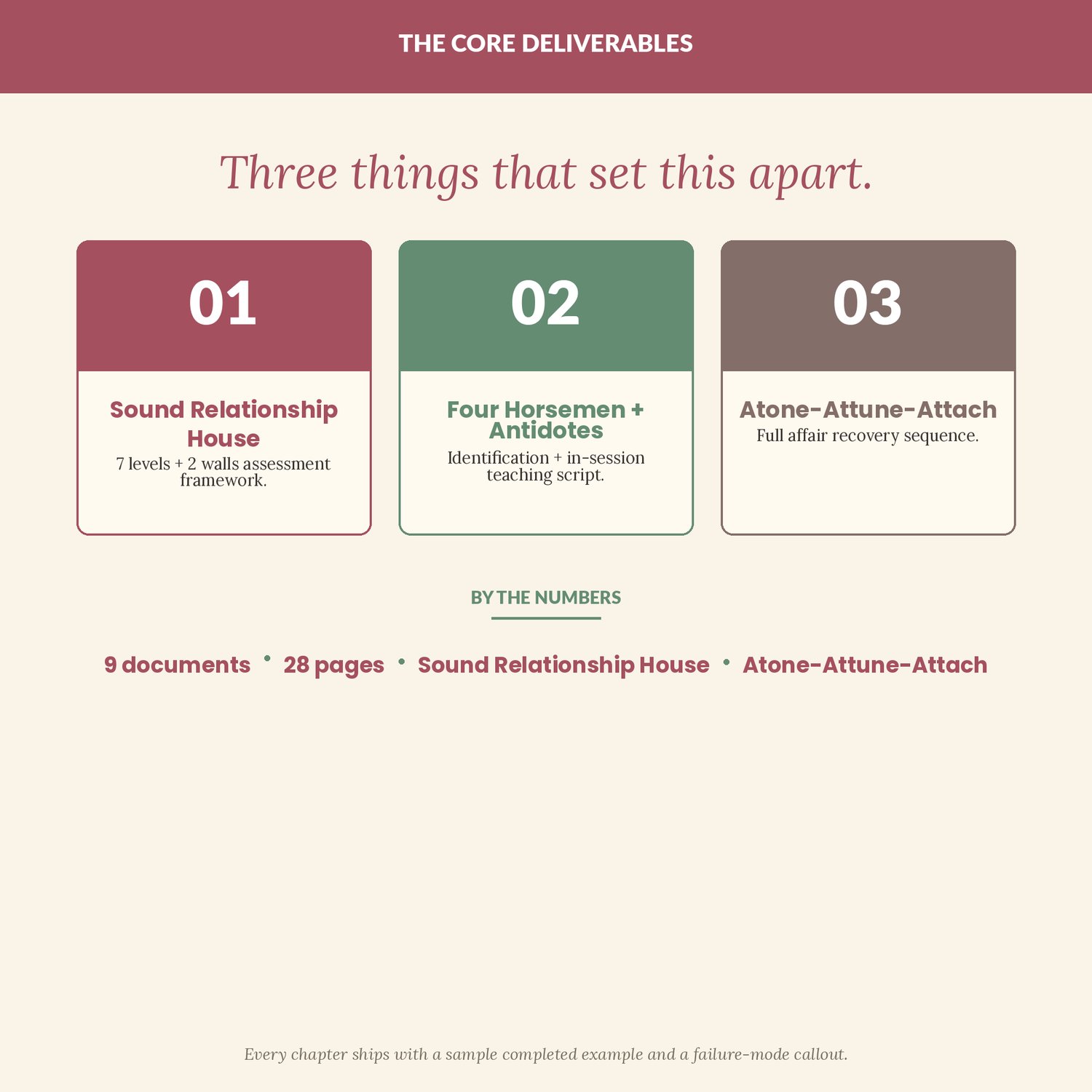
- Chapter 2: The Sound Relationship House. All seven levels with the two walls of trust and commitment, the Magic Five Hours routine, and a completed assessment summary
- Chapter 3: The initial sessions. Session 1 conjoint intake structure, sessions 2 and 3 individual interviews with the no-secrets and limited-secrets confidentiality options, session 4 conjoint feedback, the standard self-report battery, and a complete individual interview confidentiality statement
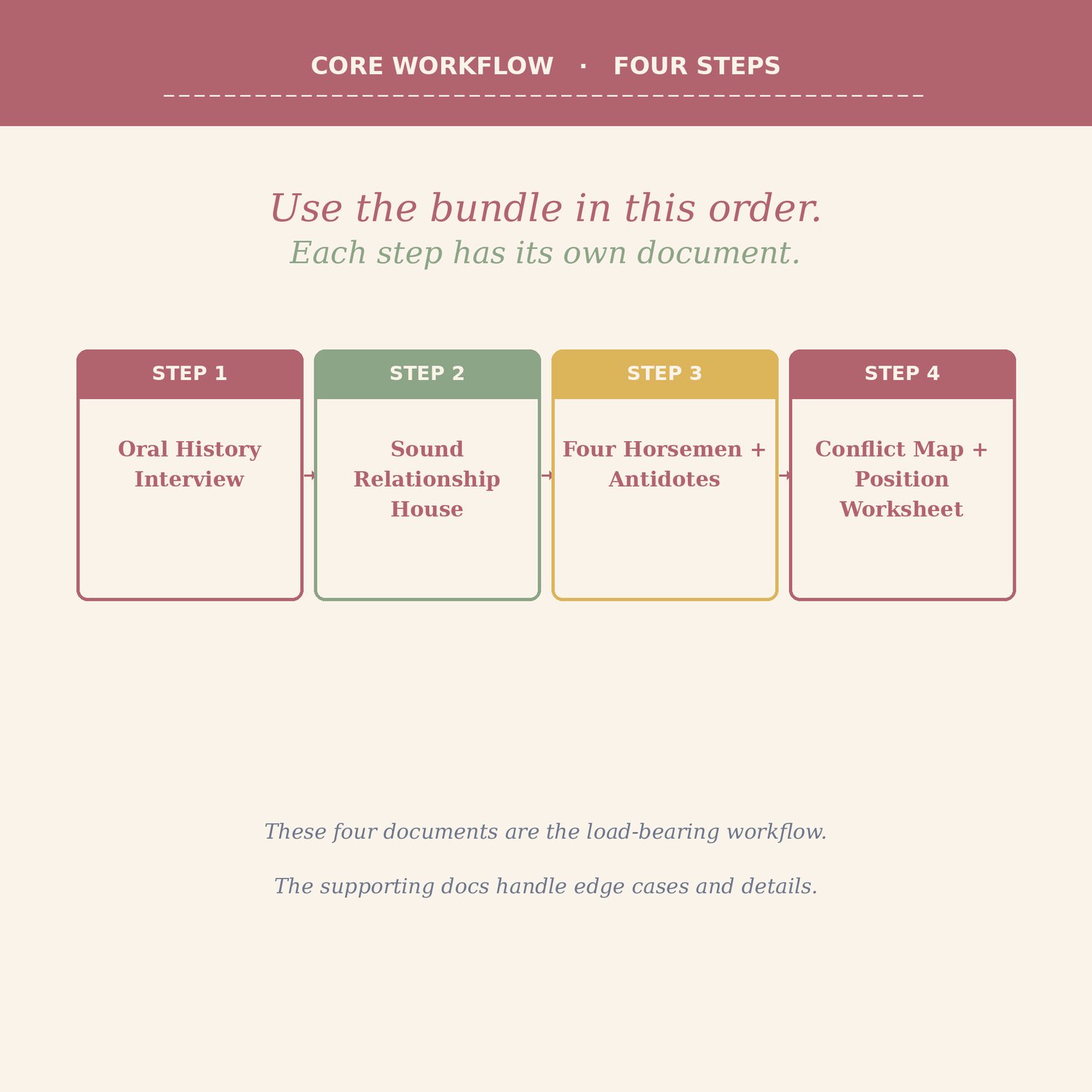
- Chapter 4: The oral history interview. The twelve standard questions, what to listen for, formal versus clinical coding, and a completed clinical observations note
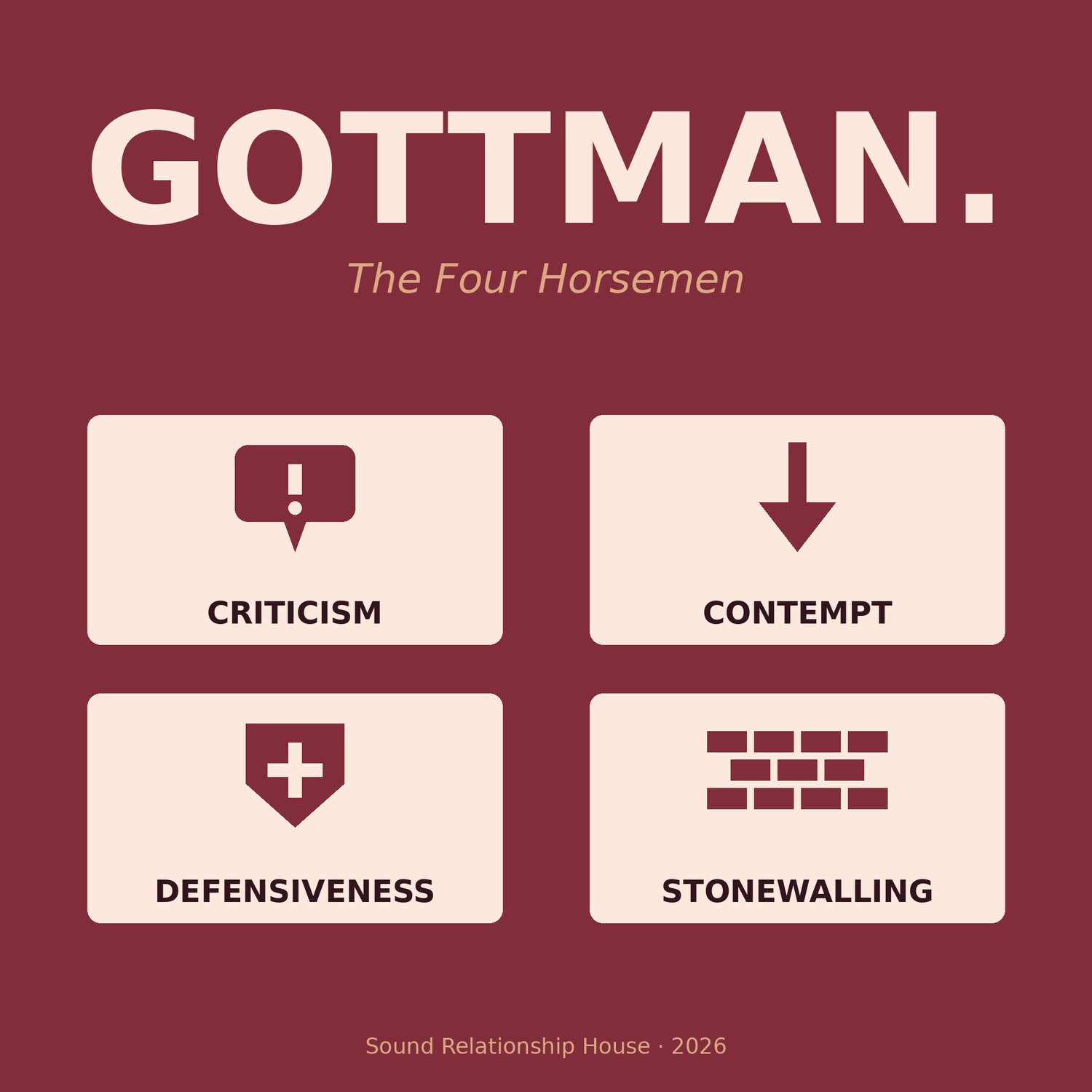
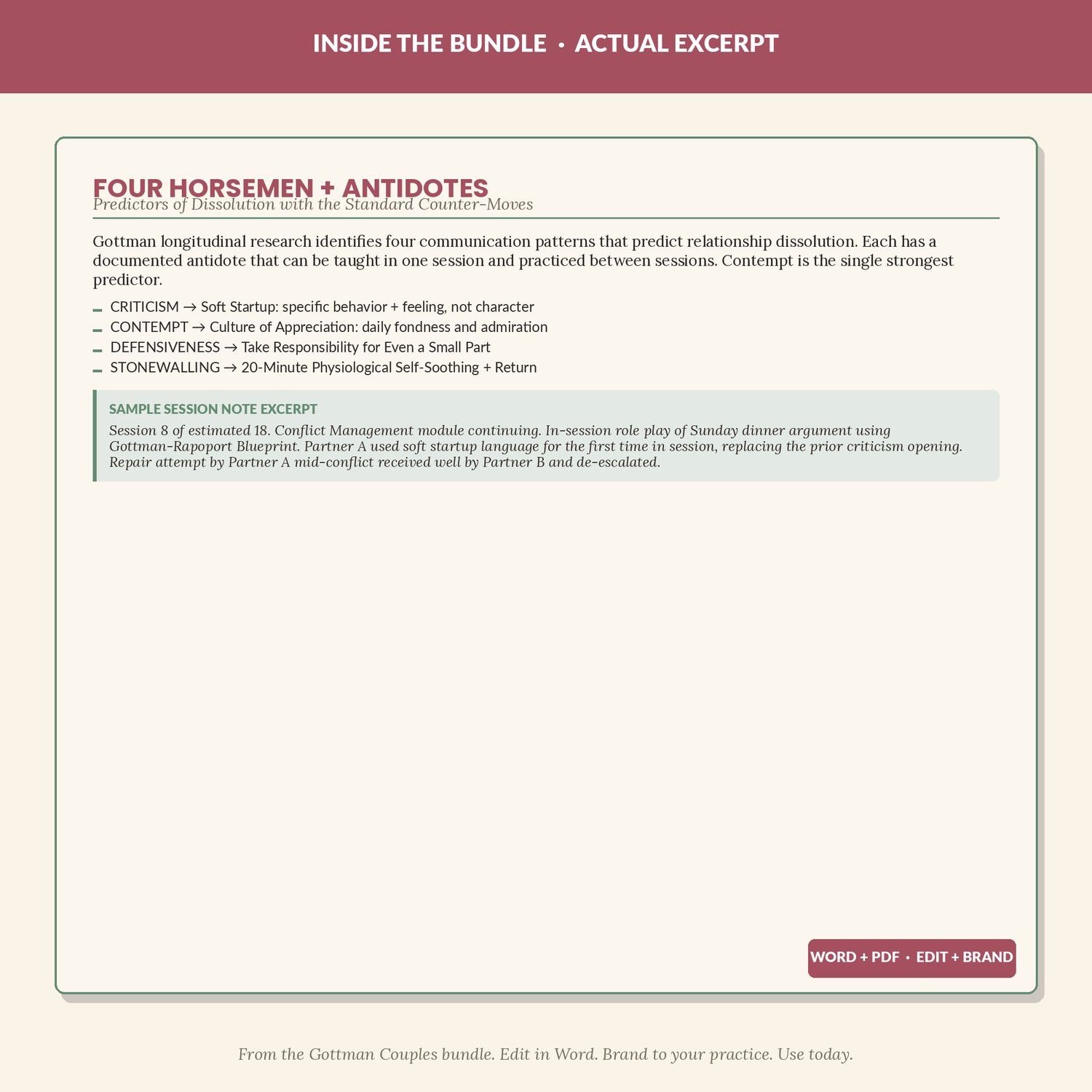
- Chapter 5: The four horsemen and their antidotes. Identification of criticism, contempt, defensiveness and stonewalling with dialogue examples, the antidotes, the flooding construct with the 20-minute break protocol, and a complete antidote teaching session
- Chapter 6: Conflict management. The solvable versus perpetual problem distinction, the five-step solvable problem module, the dreams within conflict dialogue for perpetual problems, the conflict blueprint, and a complete perpetual problem dialogue
- Chapter 7: The treatment plan and session notes. The full treatment plan template, the weekly session note structure, a chart language library translating clinical findings into payer-ready documentation, and a completed session note
- Chapter 8: Affair recovery. The atone, attune and attach sequence with phase requirements, a realistic 18 to 36 month time frame, trust trauma symptoms, and a complete phase one session example
- Chapter 9: Termination, outcome documentation and the final letter. The termination phase structure across sessions 16 to 20, outcome measures with the minimal clinically important difference, the letter's required elements, the booster session schedule, and a complete sample letter
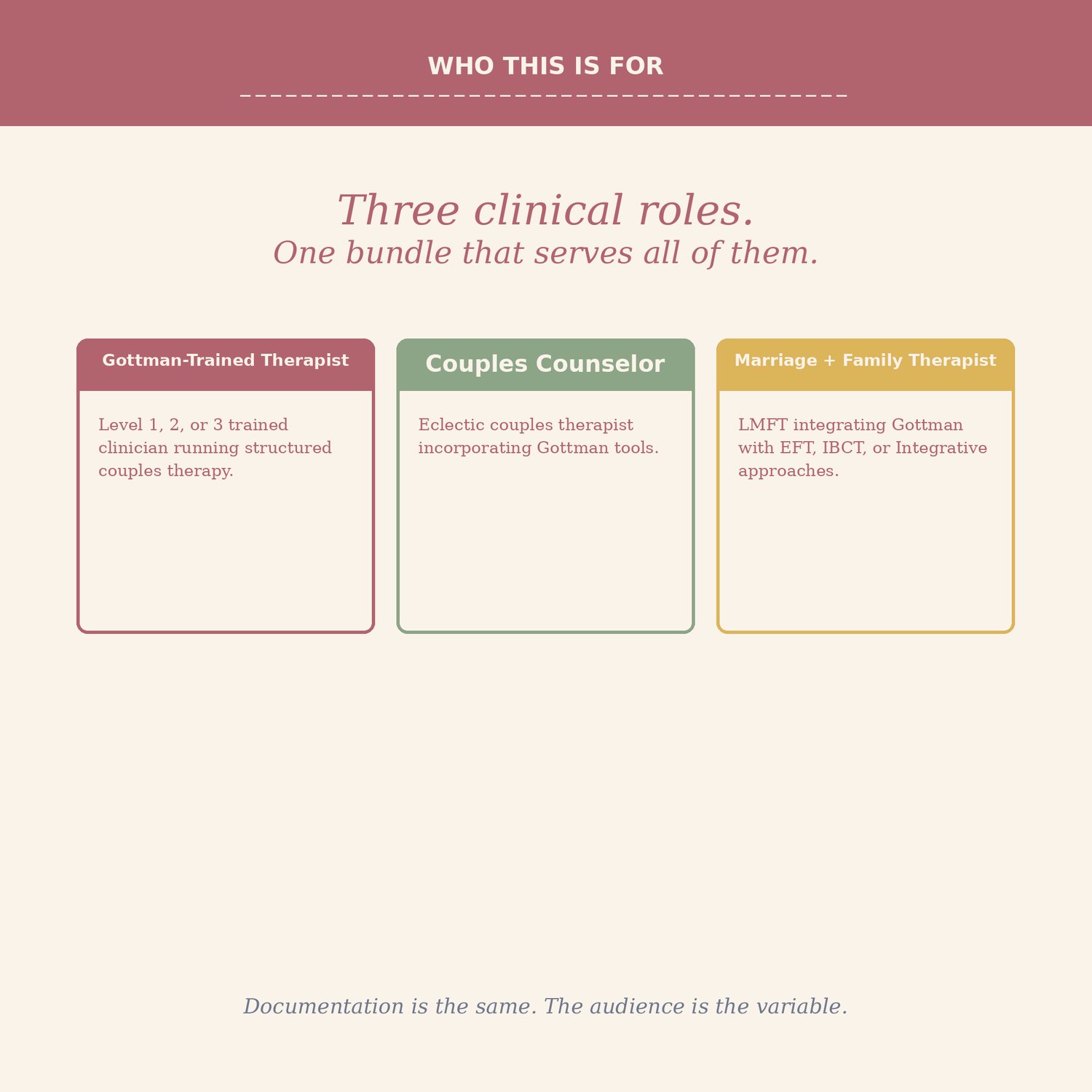
Who it is for
- Licensed marriage and family therapists practicing Gottman-informed couples therapy
- Licensed clinical social workers delivering couples therapy as a service line
- Licensed psychologists and licensed mental health counselors trained in this or other couples models
- Clinicians who have completed Level 1, and ideally Level 2 or 3, and want a systematized documentation pack
- Group practice owners building or scaling a couples therapy service line
- Postdoctoral fellows and early-career clinicians learning structured couples work under supervision
- Clinical supervisors teaching couples therapy methodology to trainees
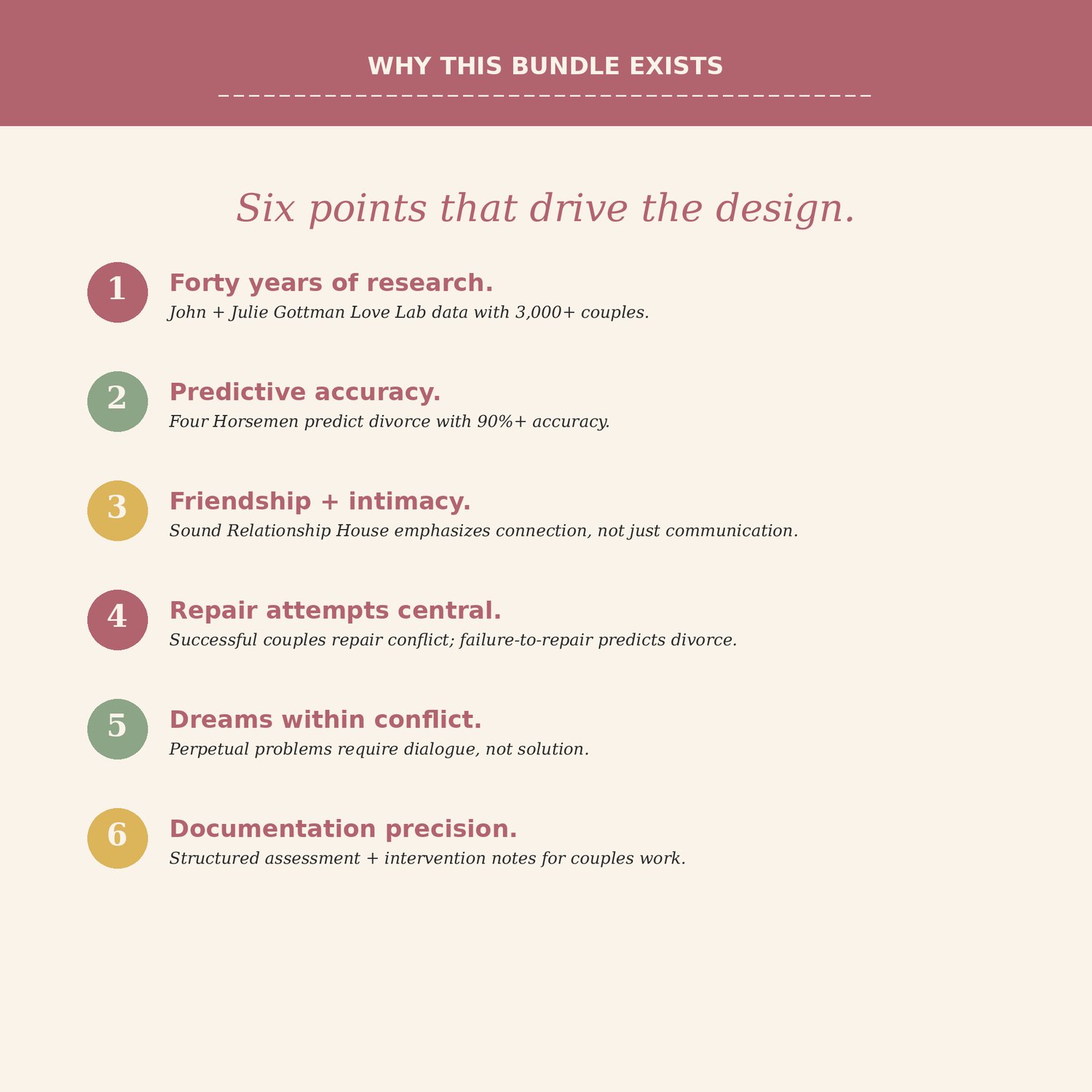
Why it exists
A couple sits across from you in session 1. Partner A starts the meeting narrative. Partner B corrects the year. Partner A rolls their eyes. Partner B sighs and looks at the floor. You have 90 minutes for the conjoint intake, two self-report measures to assign before next week, two individual sessions to schedule with a confidentiality script you need to deliver cleanly, an oral history interview to conduct without losing the room, and a feedback session in session 4 where you present the treatment plan.
The Level 1 and Level 2 trainings gave you the model. They did not give you the intake forms, the individual interview confidentiality language, the chart language library, the affair recovery sequence, or the termination letter the payer will accept. This bundle is the documentation operating system that sits between the training and the practice.
I built this after seven years of couples work, two Level 2 cohorts, and a payer audit that taught me chart language matters as much as the clinical work. The first three years I rebuilt every treatment plan from a blank page. The scoring guide was a folded printout in my desk drawer. The atone, attune and attach phase summaries lived in my head until a case in year four required me to write them down for a co-therapist.
27 pages, 9 chapters, written for the licensed psychologist, LMFT, LCSW, LMHC or LPC delivering Gottman-informed couples therapy in outpatient practice.
Why this is different
The trainings teach you the model. They do not give you the documentation. This bundle is the documentation layer: intake forms, individual interview confidentiality scripts, the interview question set, the chart language library, the affair recovery phase summaries, the treatment plan template and the termination letter. It is what trained clinicians stitch together themselves over the first few years.
The four-session assessment protocol matters because sessions 1 through 4 set up the entire course of treatment. You get the confidentiality script for the individual sessions, which is the most operationally tricky moment in the assessment, the violence typology that determines whether couples therapy can proceed at all, and the decision protocol when an active affair is disclosed.
The four horsemen chapter matters because identification is the most teachable skill in the model and the one couples consolidate fastest in session. Each horseman is paired with its antidote and a real dialogue example, plus the flooding construct that explains why a 20-minute break is not negotiable when a partner is physiologically activated.
The dreams within conflict chapter matters because most couple conflicts are perpetual and most clinicians, and most couples, treat them as solvable.
The affair recovery chapter matters because affair work is the highest-acuity presentation in couples therapy and the one clinicians are most likely to be underprepared for. The sequence is spelled out in order, because the order is not negotiable.
The chart language library is the chapter you keep beside your keyboard. It translates the couple is doing better with conflict into payer-ready, model-anchored language a medical reviewer recognizes.
Format
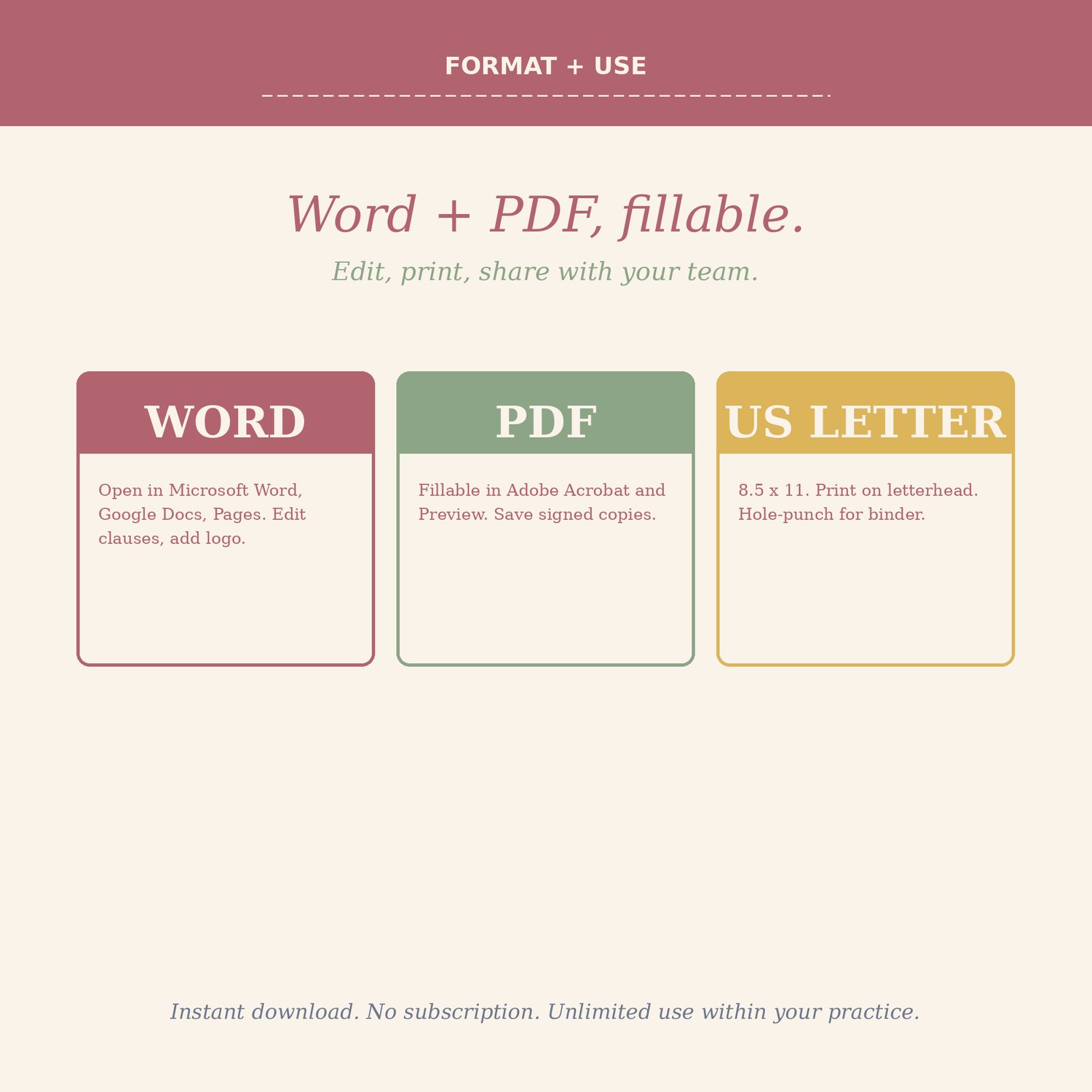
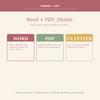
- Editable, fillable PDF (27 pages)
- Editable Microsoft Word (.docx, 27 pages)
- Treatment plan, session note, individual interview script and termination letter ready to adapt to your letterhead
- US Letter and A4 sizes both included
- Works on Mac, Windows, iPad, GoodNotes, Notability
- Lifetime access, unlimited prints
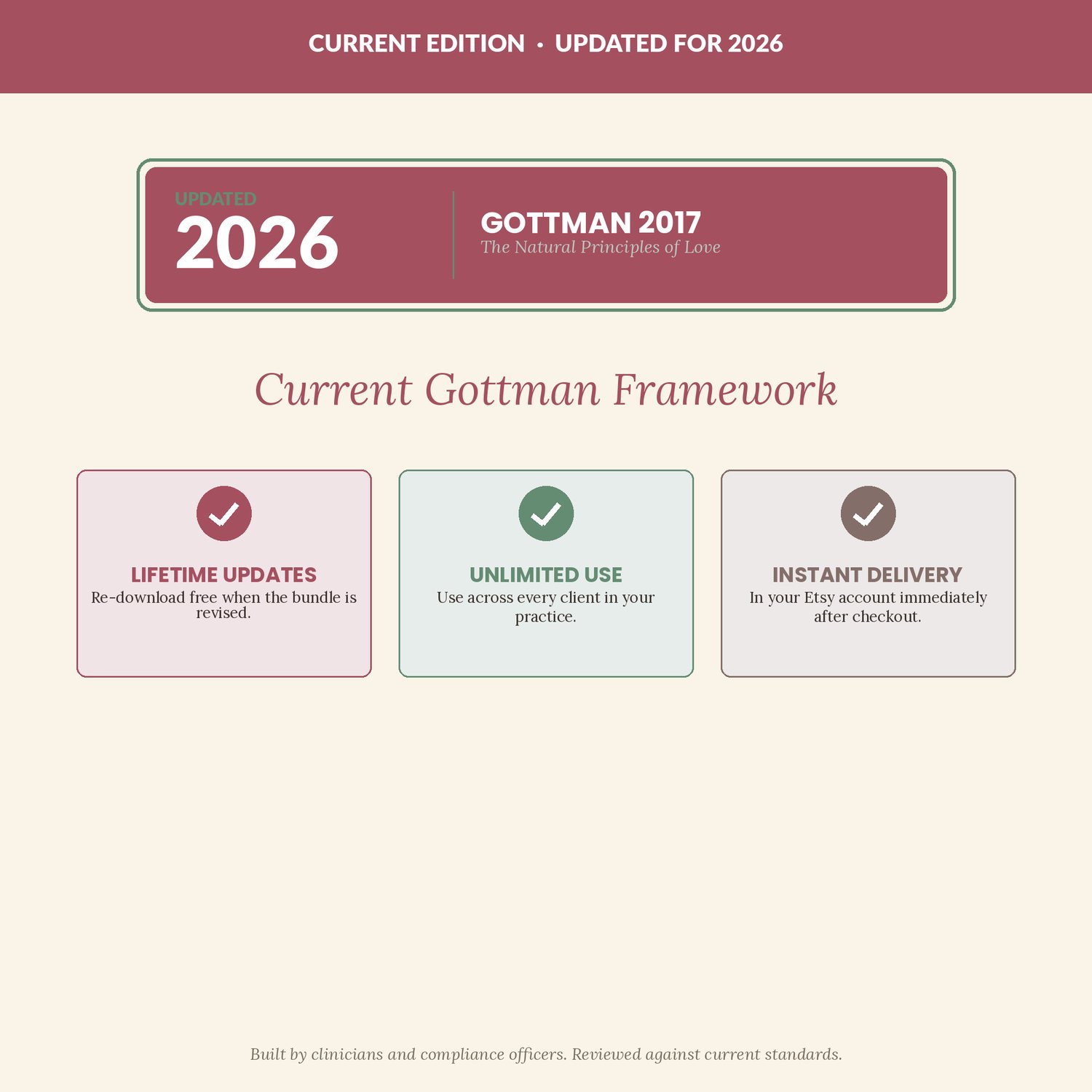
Updated 2026
Reflects Gottman and Gottman (2017), Gottman and Silver (1999 and 2015), the Gottman et al. (1998) longitudinal findings, the Buehlman, Gottman and Katz (1992) oral history interview work, Gottman (2011) The Science of Trust, the Babcock et al. (2013) pilot study, Glass (2003) and Snyder, Baucom and Gordon (2007) on infidelity, Doherty (2011) on discernment counseling, the Holtzworth-Munroe et al. (2000) typology, the APA and AAMFT codes on couples and family documentation, and current behavioral healthcare standards. This bundle is not a substitute for the Gottman Institute trainings and does not authorize representation as certified in the method.
A note from the designer
I am a practicing clinician with Level 1 and Level 2 training and seven years of couples therapy practice. I built this after rebuilding my treatment plan template for the eightieth time, and after a payer audit reminded me that documentation is the work behind the work. Chapter 3, the individual interview confidentiality script, is the one I rehearsed for a year before it came out of my mouth cleanly. If you are early-career, learn that script first.
This is the complete documentation operating system for Gottman-informed couples therapy, not a substitute for the trainings.
Digital download. No physical product ships. Reach out by email if anything does not work or if you have questions.