










Group Practice Hiring Kit (2026)
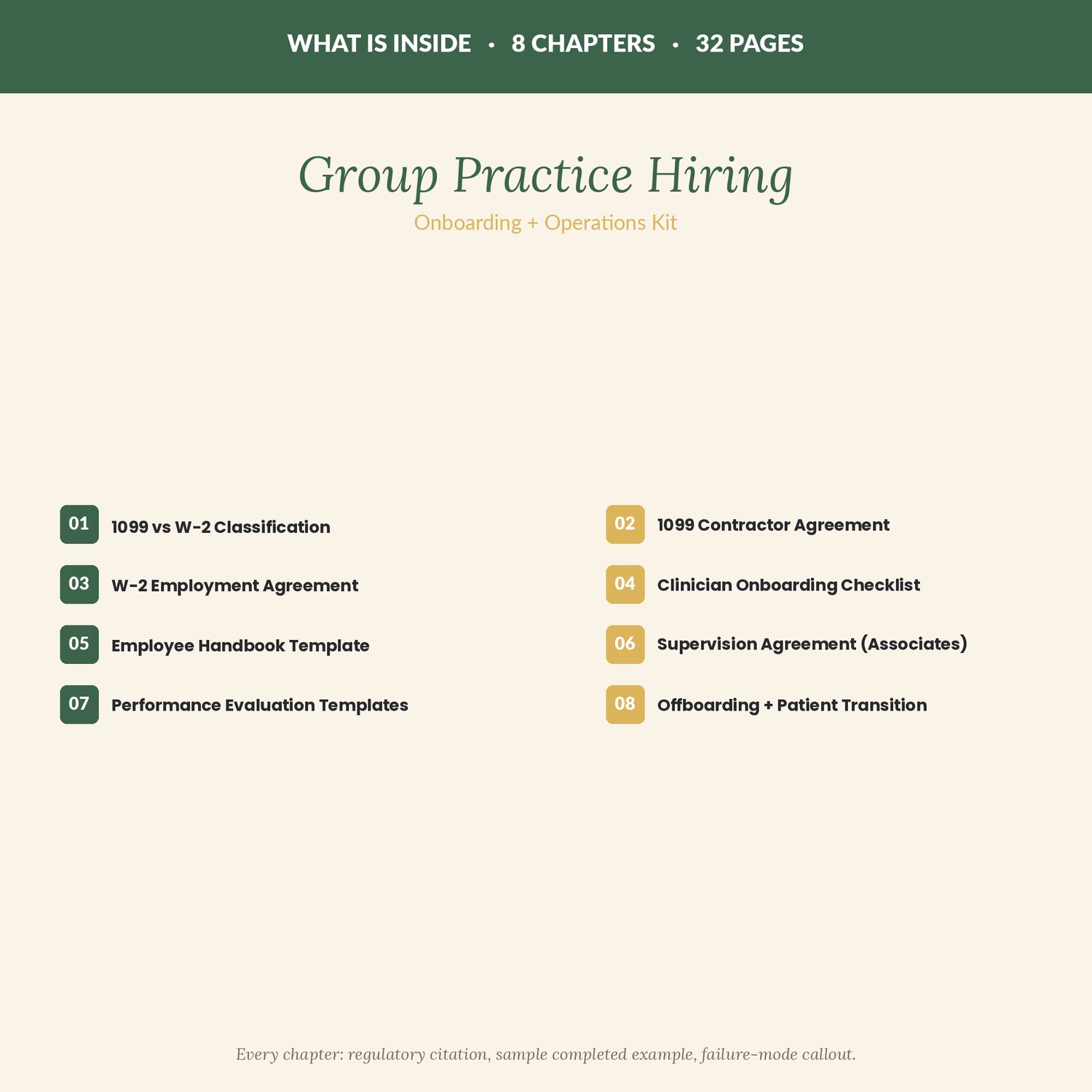
A group practice hiring kit: 1099 versus W-2 classification, contractor and employment agreements, a 30 day onboarding checklist, an employee handbook template and an associate supervision agreement.
What is in the kit
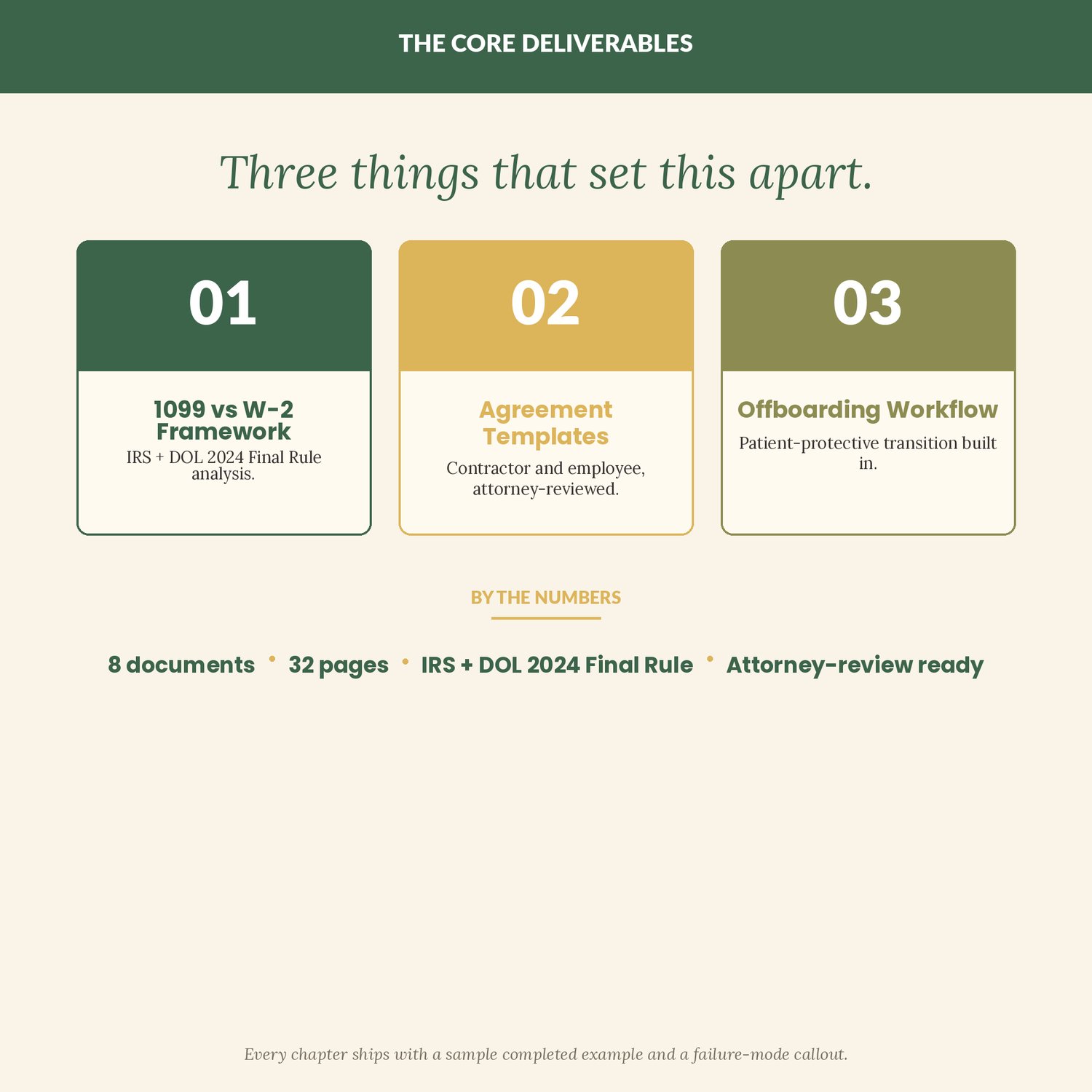
- Classification. The IRS Publication 15-A right-to-control test across behavioral control, financial control, and type of relationship. The DOL six-factor economic reality test covering profit and loss opportunity, investments, permanence, control, integral work, and skill and initiative. State-specific tests for California, Massachusetts, and New Jersey, compared against Texas, Florida, and New York. Why most therapist hires come out W-2 under every applicable test, and the narrow cases where 1099 is genuinely defensible. Plus the penalty math: IRS back tax, the FICA employer share, employment tax penalties, and DOL double back wages.
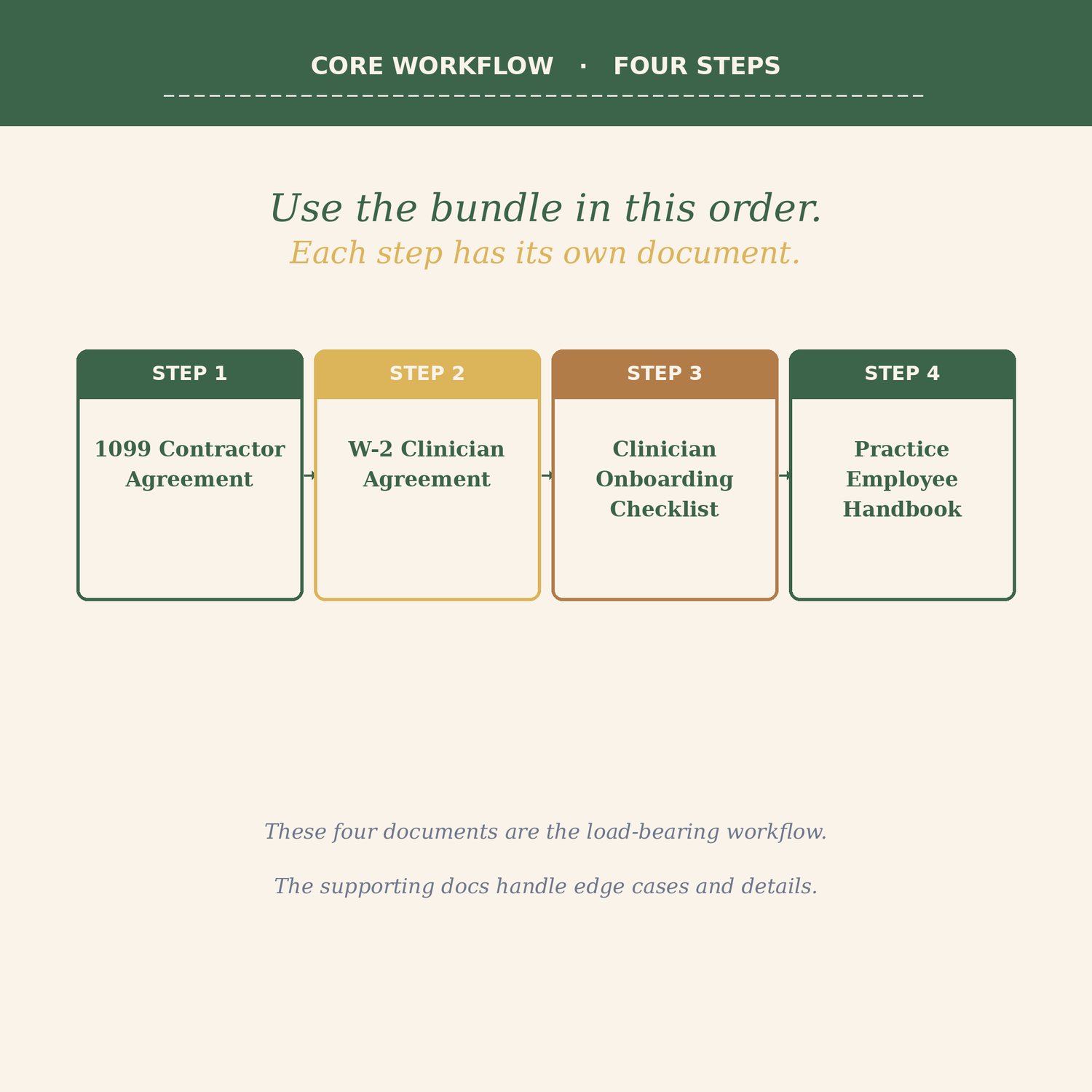
- 1099 independent contractor agreement across 12 sections, with worked examples showing where it holds up (a forensic consultant) and where it does not (a growing practice with associates).
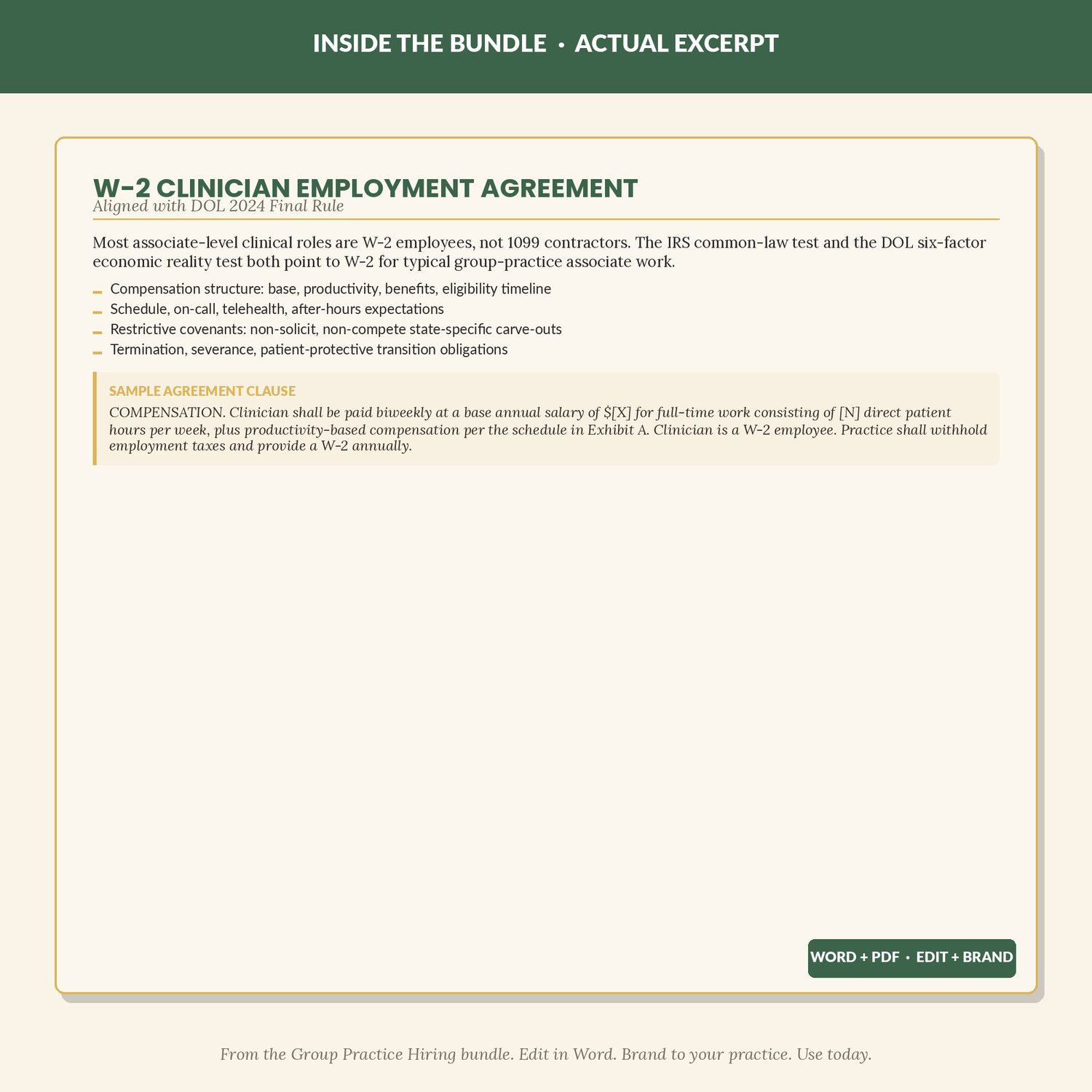
- W-2 clinician employment agreement across 12 sections covering position, compensation as salary or collection percentage with a minimum, schedule, at-will status, confidentiality, non-compete and non-solicitation, IP, professional liability, license and CE, and discipline progression. With a worked example at $65K plus benefits, a 25 patient weekly target, and supervision toward licensure. Plus a non-compete enforceability primer, since California, North Dakota, and Oklahoma do not enforce them at all.
- A 30 day onboarding checklist in three phases. Days 1 to 7 operational: I-9 within three days, W-4, HIPAA, OSHA, credentialing, technology, workspace. Days 8 to 14 clinical: EHR and documentation training, workflow orientation, practice operations. Days 15 to 30 caseload: supervision setup for pre-licensed staff, initial caseload with a ramp, team integration. With a day-by-day sample schedule.
- An employee handbook template with 12 required sections and an acknowledgment form, covering EEO, employment categories, compensation and benefits, workplace policies, health and safety, confidentiality and HIPAA, clinical standards, performance management, termination, and grievance.
- A supervision agreement for associate clinicians with 10 required sections and state-specific hour requirements detailed for California (LMFT 3000 hours with 1700 face-to-face across 104 weeks, LPCC 3000, LCSW 3200), New York (LMHC 1500, LCSW-R on a 36 month track), and Texas (LPC Associate and LMFT Associate at 3000 hours with an 18 month minimum). Plus a sample contemporaneous supervision note.
- Performance management: a quarterly evaluation template with 5 point ratings across clinical practice, documentation, practice operations, and team and professionalism, plus strengths, growth edges, goals, and self-reflection. A Performance Improvement Plan template with measurable improvement criteria, support provided, consequences, and review schedule. And a balanced sample review anchored to specific examples.
- Offboarding: a 30 day timeline across notice and planning, patient transition, administrative closeout, and the exit interview. A patient notification letter with the three transition options, a transition decision matrix by acuity, non-solicitation and patient-following guidance, a checklist covering caseload disposition, final paycheck calculation, COBRA timing, and access termination, and state-specific final paycheck timing including California's immediate rule with waiting-time penalties.
- What-to-do-when callouts at every chapter: you inherit misclassified workers, a key employee gives notice, onboarding surfaces undisclosed complications, an employee cites the handbook back at you, a supervisee leaves before licensure completes, an employee disputes an evaluation, or someone is terminated for cause.
Who it is for
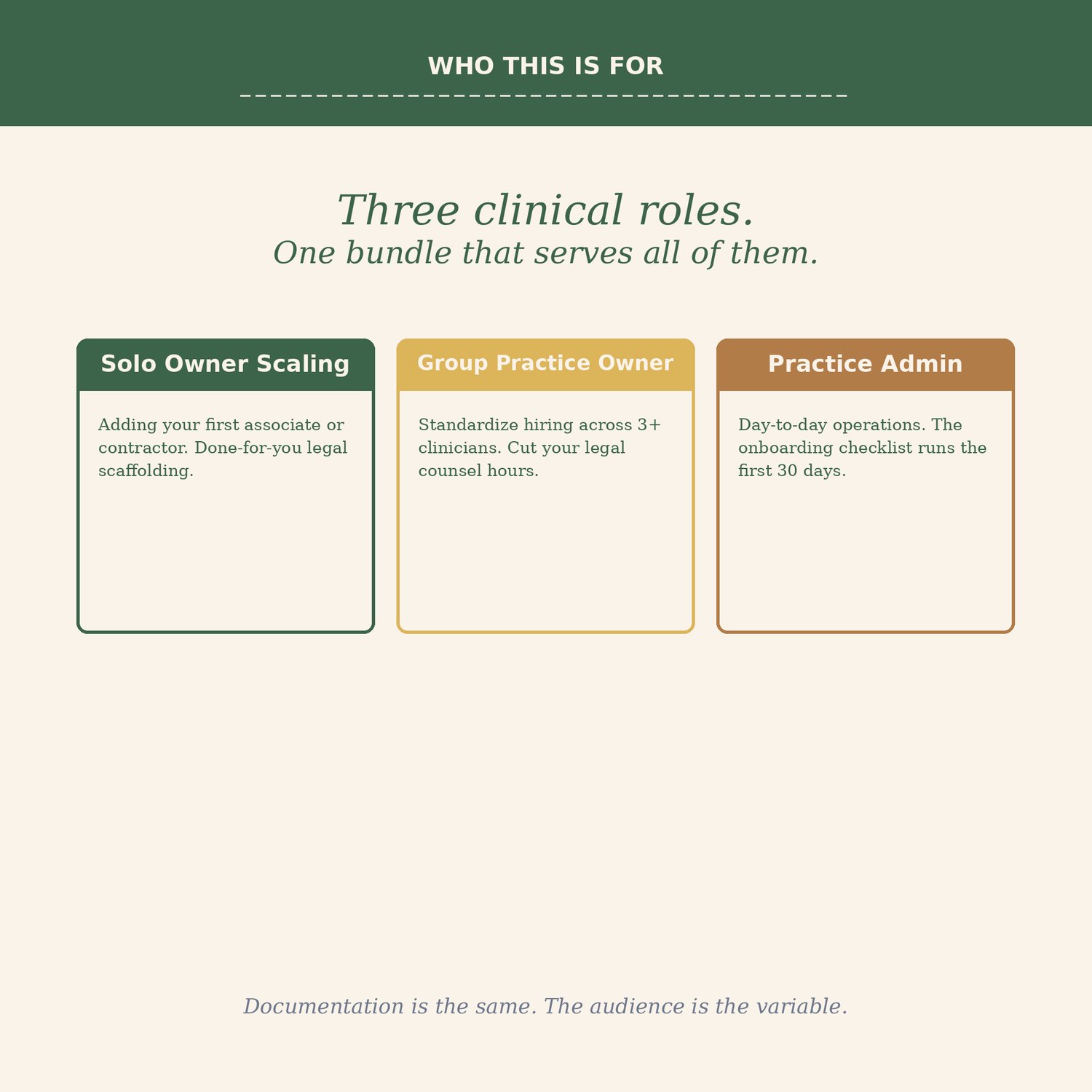
Solo owners adding a first associate. Group practice owners scaling from two or three clinicians to fifteen. Owners standardizing hiring across locations. Clinical directors and operations managers building HR infrastructure. Multi-state practices needing the state-specific classification and supervision requirements. Practice acquirers inheriting employment arrangements that need review. Pre-licensed clinicians and their supervisors documenting the relationship. Practice management consultants. Clinical supervisors managing and evaluating associate-level staff.
Why it exists
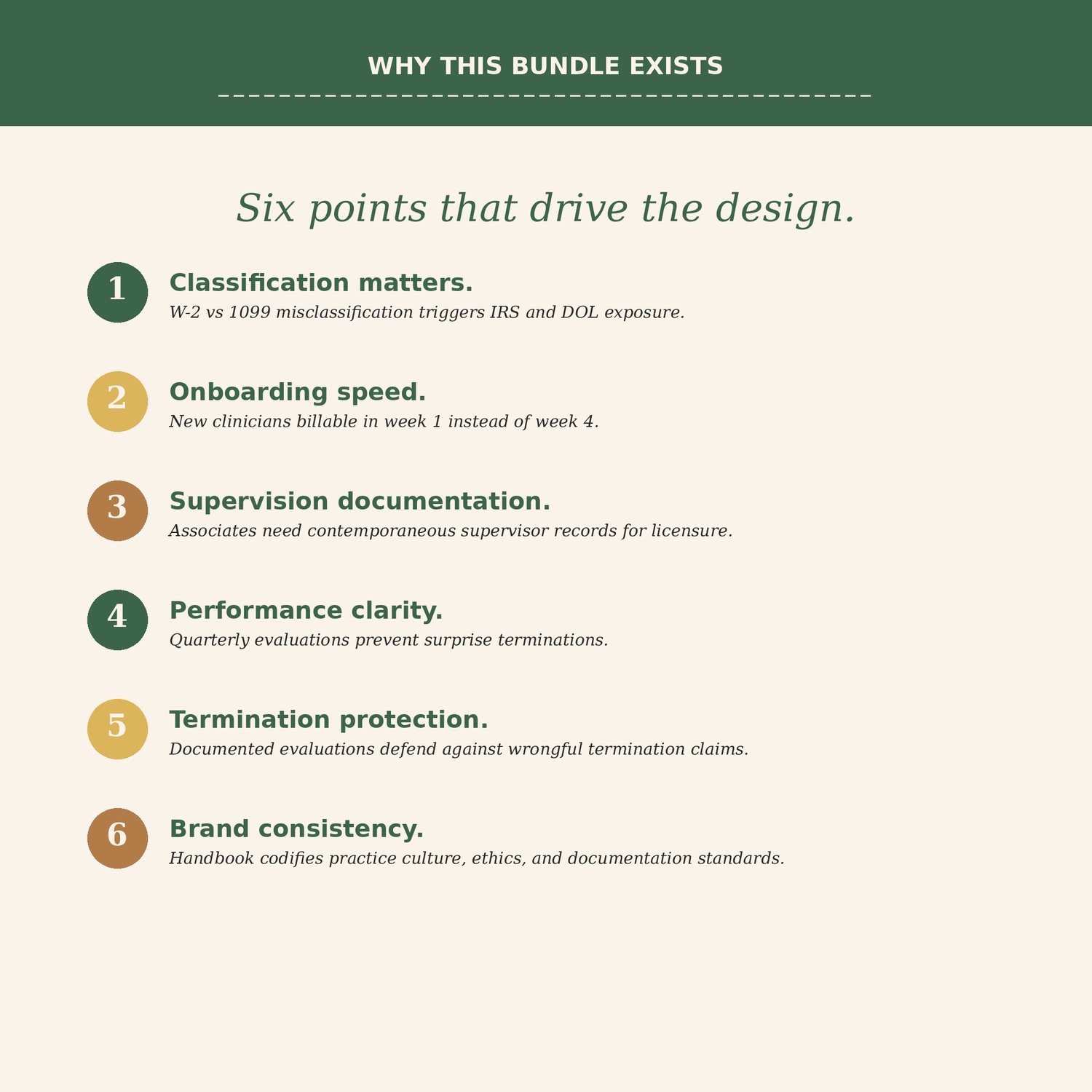
You are scaling past solo. Two associates this year, maybe a third by Q3. The accountant says 1099 to avoid payroll tax. The colleague at the mixer says W-2 because everyone they know got audited and lost. The DOL Final Rule took effect March 11, 2024, the IRS Publication 15-A test still applies, California uses the ABC test, and misclassifying one worker over three years can run $30,000 to $100,000.
The pre-licensed clinician you want to hire needs a supervision agreement that survives board review, an onboarding checklist that makes her billable in week one rather than week four, a handbook that satisfies state employment law, and an evaluation cadence that catches problems before they become terminations. The shortcut that skips all of that is the one that builds the lawsuit.
47 pages. Classification framework, both contract templates, the 30 day onboarding checklist, the employee handbook, the supervision agreement, evaluation and PIP templates, and the patient-protective offboarding workflow.
Aligned with IRS Publication 15-A (2026), the DOL Final Rule on Employee or Independent Contractor Classification (29 CFR Part 795), state employment law including California AB 5, the Massachusetts ABC test, and the Texas common-law test, plus HIPAA, COBRA, and AAMFT and APA supervision standards.
Why it is built this way
Most group practice hiring material is either an HR generalist's template with no clinical context or a clinician's blog post with no employment-law rigor. This is built for the mental health practice going from solo to multi-clinician.
Misclassification is the most common scaling mistake and the most expensive one. The three tests are walked side by side with worked examples, because the answer depends on which test the auditor applies.
Structured onboarding is the difference between a clinician billable in week one and week four. Pre-licensed clinicians need a supervision agreement separate from the employment agreement, because state boards require written documentation of the supervisory relationship.
Performance management is the duty practice owners neglect most, and without documented evaluation, terminations are exposed and strong clinicians go unrecognized. And abandonment claims come from rushed transitions, which is what the 30 day offboarding timeline is for.
Format
Editable, fillable PDF, 47 pages. Editable Microsoft Word (.docx), same length. Contracts, checklists, handbook sections and forms copy straight into your practice management workflow. US Letter (8.5 x 11) and A4 (8.3 x 11.7) both included. Works on Mac, Windows, iPad, GoodNotes, and Notability. Lifetime access, unlimited prints.
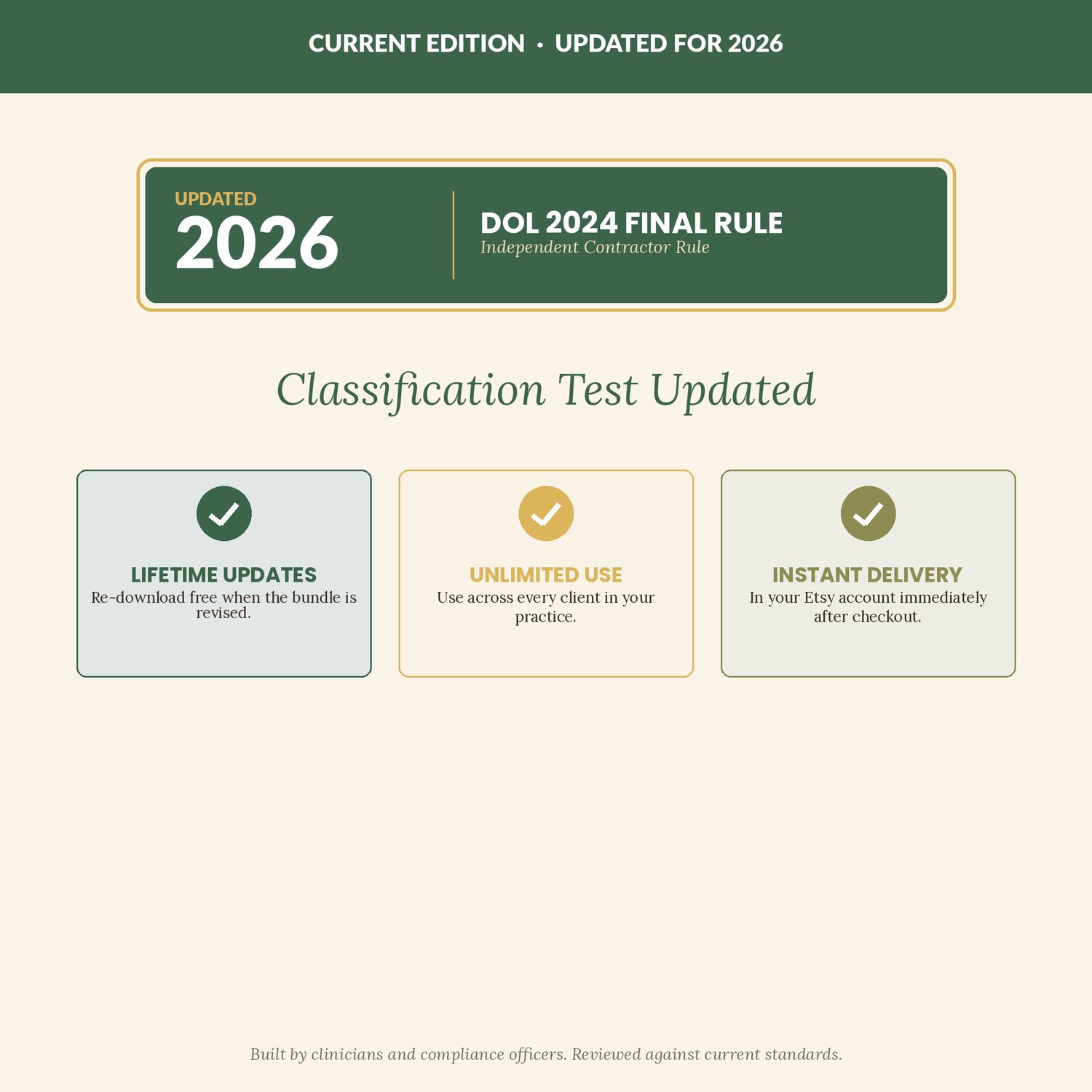
Updated 2026
IRS classification reflects Publication 15-A (2026) and Topic No. 762. DOL classification reflects the Final Rule (29 CFR Part 795, effective March 11, 2024). State tests reflect California AB 5 with the 2020 Prop 22 modifications, the Massachusetts ABC test under MGL c. 149 section 148B, plus New Jersey, Texas, Florida, and New York. Non-compete enforceability reflects current state law and the FTC's 2024 proposed federal ban, which is not in force. Supervision requirements reflect current California BBS, New York Office of the Professions, and Texas BHEC regulations. Final paycheck timing reflects current state rules. COBRA reflects 29 USC 1162.
How to use it
Before any hire, run the classification chapter across all three tests. W-2 for most cases, using the Chapter 3 agreement; the 1099 template only where the arrangement is narrowly defensible. Start the onboarding checklist on day one. Brand the handbook and deliver it at hire with the acknowledgment. For pre-licensed associates, the supervision agreement is separate from the employment agreement and required by the board. Run the quarterly evaluation on a fixed cadence, and reach for the PIP when concerns persist past routine supervision. When someone gives notice, work the offboarding chapter in order.
This is a practice management reference, not legal advice. For classification disputes, terminations, and multi-state arrangements, consult employment counsel licensed in your state.
Instant digital download. No physical product ships. Message us if anything does not work.