


PHQ-9, GAD-7 and PCL-5 Scoring Bundle (2026)
A measurement-based care scoring bundle with PHQ-9, GAD-7 and PCL-5 scoring guides, plus AUDIT, DAST-10 and EPDS.
What is in the bundle
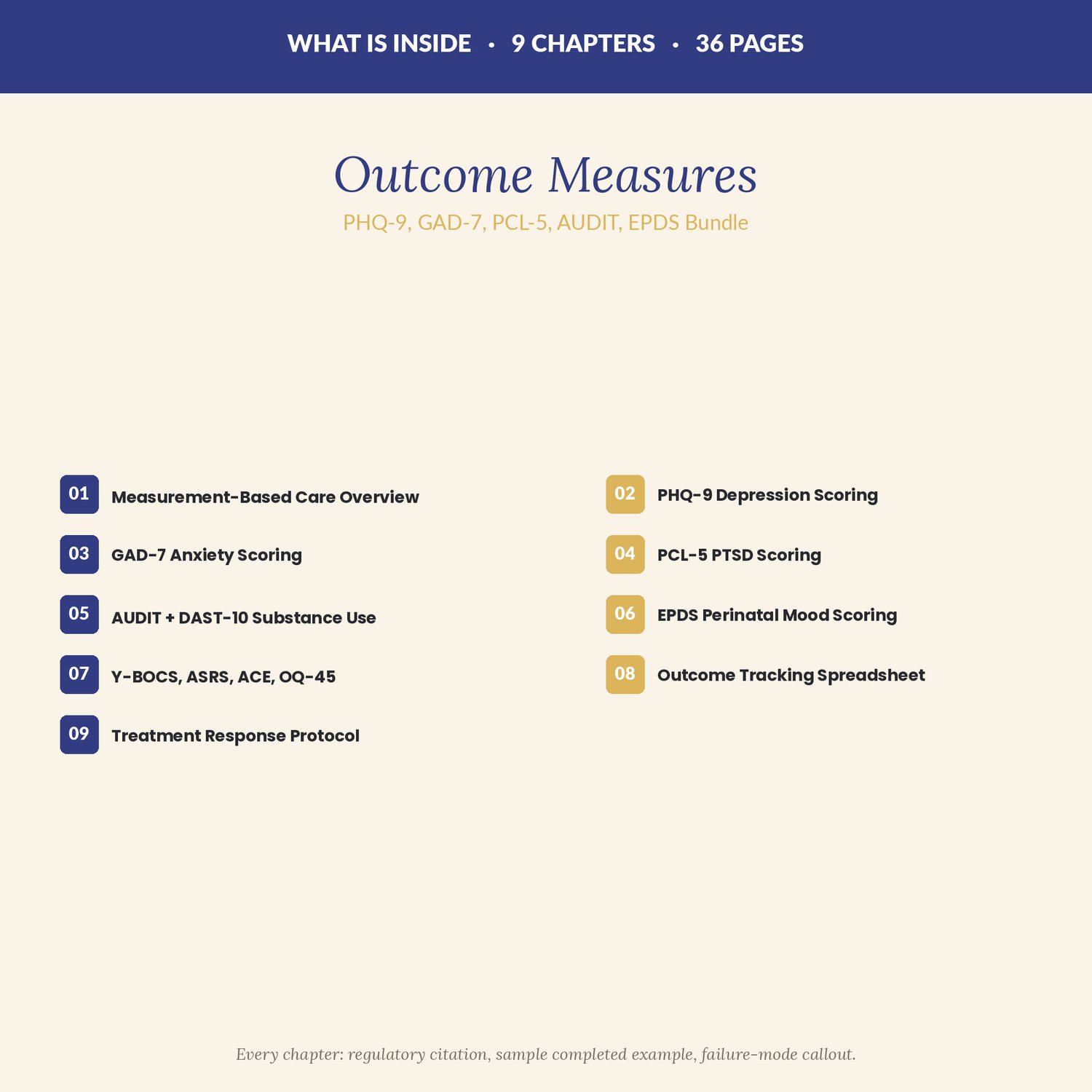
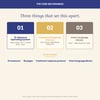
- Measurement-based care as a practice operating system, with the five components it actually requires: strategy, scoring, tracking, response protocol, and chart language. Plus the evidence base, including the Lambert (2018) meta-analysis showing 0.4 to 0.6 SD improvement over treatment as usual, SAMHSA endorsement, the APA 2018 Council Resolution, and current Aetna, UHC, BCBS, and Magellan value-based contracting requirements.
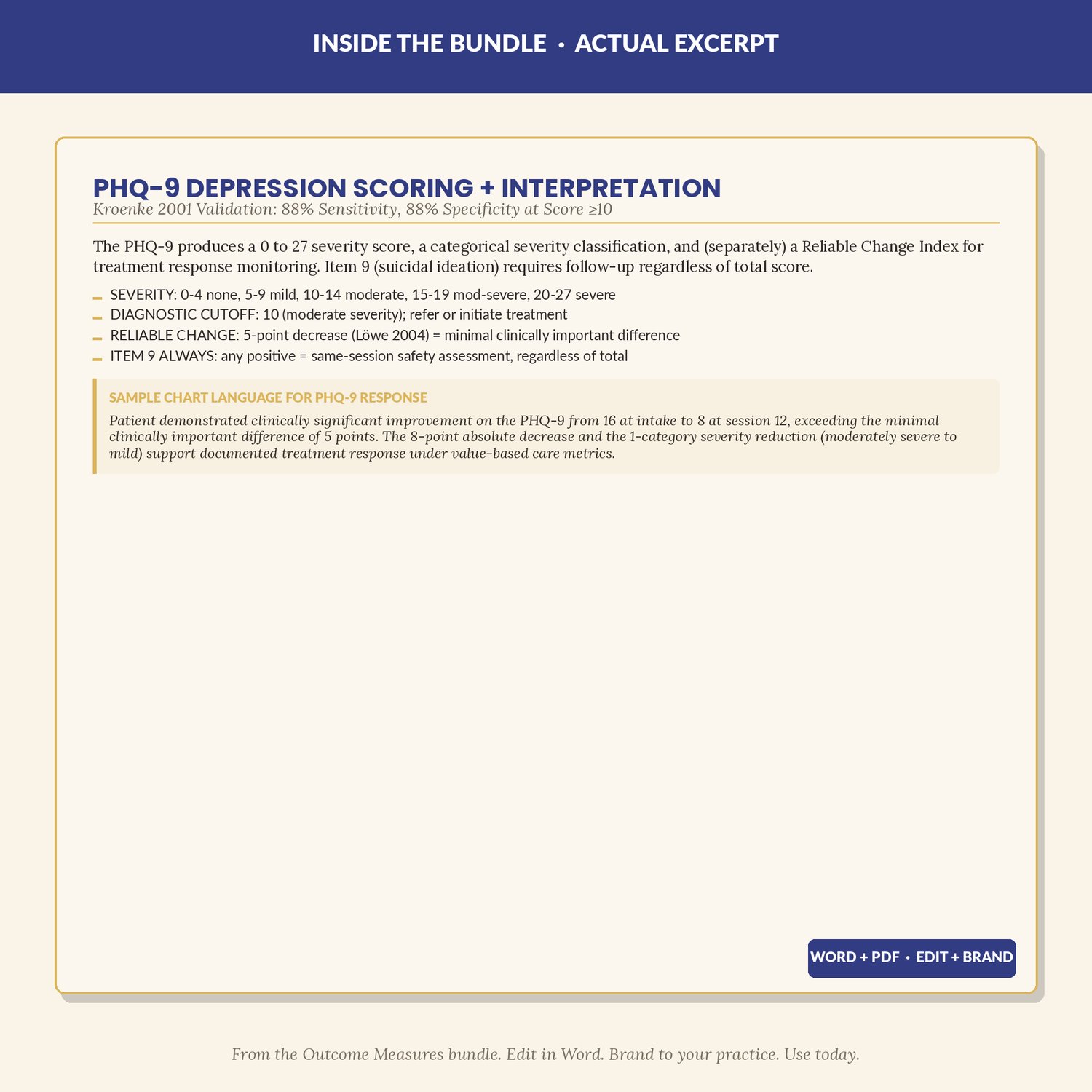
- PHQ-9: nine items, public domain, severity cutoffs per Kroenke (2001), sensitivity and specificity at the standard cutoff, item 9 suicide-risk handling, and a Reliable Change Index of 5 points per Löwe (2004). With chart language for baseline and treatment response, and the cases where the PHQ-9 is the wrong instrument: bipolar concerns, geriatric patients, somatic illness, and postpartum.
- GAD-7: seven items, public domain, severity cutoffs per Spitzer (2006), multi-anxiety screening utility across panic, social anxiety, and PTSD with the sensitivity and specificity for each, and an RCI of 4 to 5 points. Compared against BAI, STAI, LSAS, and PSWQ.
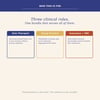
- PCL-5: twenty items mapped to DSM-5 criteria B through E, both scoring approaches (total score and the DSM-5 algorithm), severity bands, and an RCI of 10 to 20 points. Plus the cluster analysis, since the highest cluster informs treatment selection: Cluster D suggests Cognitive Processing Therapy, Cluster B suggests Prolonged Exposure, and the total score alone will not tell you that. Compared against the CAPS-5.
- AUDIT and DAST-10: the 10 item AUDIT with the AUDIT-C brief version and gender-specific cutoffs, and DAST-10 with its reverse-scored item. When to screen, the brief intervention thresholds, the referral thresholds, and chart language including referral documentation.
- EPDS: ten items with mixed-direction scoring, item 10 self-harm handling, prenatal and postnatal use, and why it is preferred over the PHQ-9 in perinatal populations. Plus screening intervals and the EPDS-Partner version, since roughly 10 percent of fathers experience postnatal depression.
- Y-BOCS: the symptom checklist plus ten severity items, severity bands, and the treatment response thresholds, 35 percent reduction for response and 50 percent for excellent response. ACE: ten categories with the dose-response relationship to adult depression, substance use, chronic illness, and early mortality, and risk elevation by score band. OQ-45: 45 items across three subscales, a licensed measure with an RCI of 14 points.
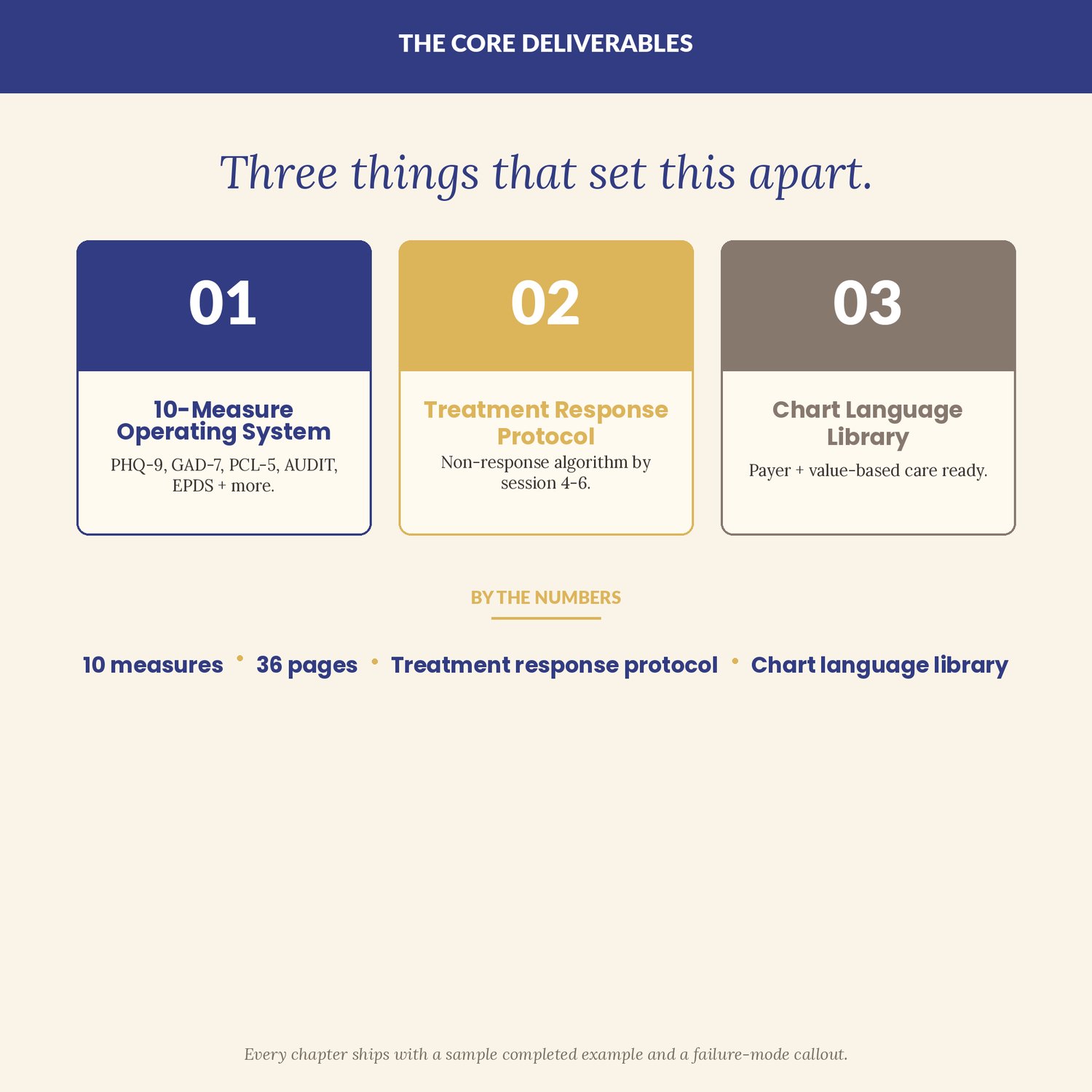
- An outcome tracking spreadsheet with sample longitudinal entries. A treatment response protocol with the decision algorithm for session 4 to 6 non-response, covering frequency increase, medication consultation, differential reassessment, alliance check, and stepped-care escalation. Chart language for payer review, and practice-level aggregation guidance for contracting negotiations.
- What-to-do-when callouts at every chapter: the PHQ-9 is not improving, the anxiety looks health-related, the PCL-5 is elevated without a clear trauma, the patient denied substance use and it later turns out otherwise, or the EPDS is negative but the clinical concern remains.
Who it is for
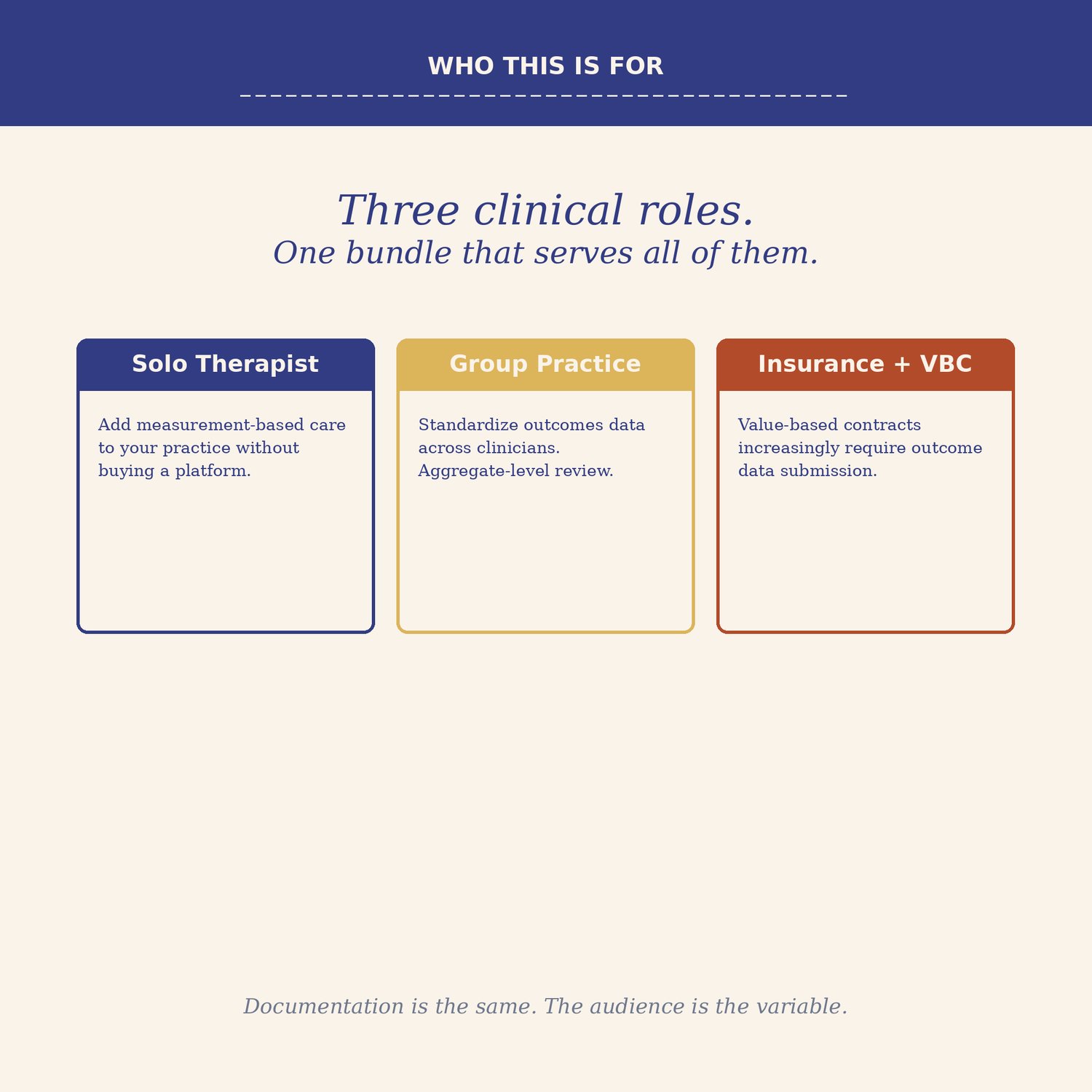
Solo clinicians implementing measurement-based care for the first time. Group practice owners standardizing outcomes across clinicians. Practice managers and clinical directors building infrastructure for value-based contracting. Integrated care clinics. Perinatal specialists using the EPDS as a primary screen. Trauma-focused practices using cluster-informed treatment selection. Substance use programs integrating AUDIT and DAST at intake. OCD specialists monitoring with the Y-BOCS. Practices preparing for contracting negotiations, and supervisors teaching this to associate-level clinicians.
Why it exists
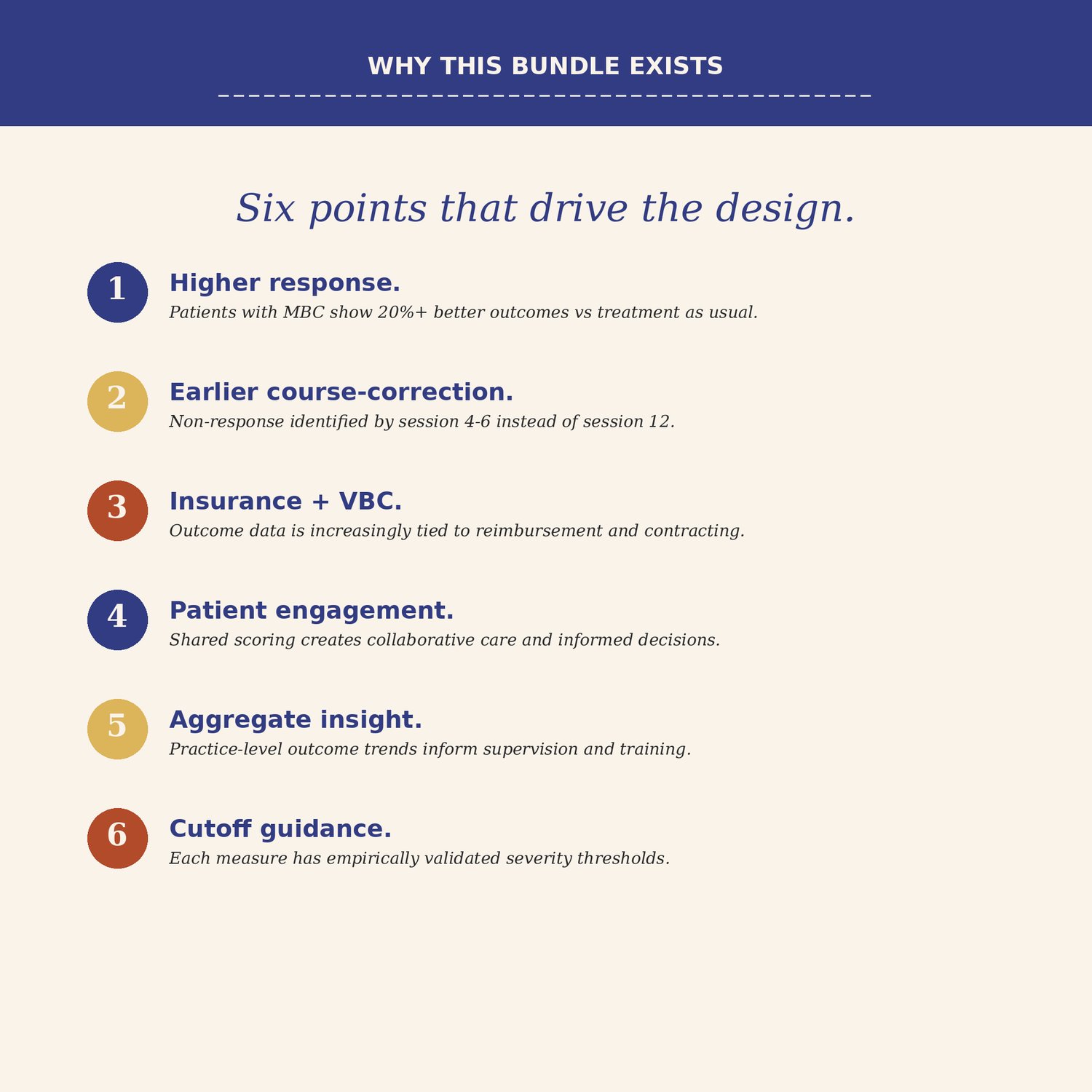
Your insurer rep mentions a value-based contract that requires outcomes data, with pay-for-performance up to 15 percent of contracted rate. The PHQ-9 you printed in residency has been on every chart for years, but you have never calculated a Reliable Change Index, never aggregated practice-level data, and never run the PCL-5 cluster analysis that would tell you whether this patient needs CPT or PE. The patient at week 8 who is not improving needs a different plan, and you have no algorithm for making that call.
Measurement-based care produces 15 to 20 percent better outcomes than treatment as usual. A practice without the infrastructure for it cannot actually do it.
45 pages. Eight outcome measures with administration, scoring, severity cutoffs and reliable change criteria for each; a tracking spreadsheet with sample longitudinal entries; a treatment response protocol with decision algorithms for session 4 to 6 non-response; and chart language built for payer review and value-based contracting.
This is the scoring and tracking layer. For fillable client-facing forms and the screener workflow, see the Measurement-Based Care Pack in the shop.
Why it is built this way
Most outcome measure resources are single instruments. Useful, and incomplete. A practice cannot run measurement-based care on one measure. This assembles all five components across eight measures.
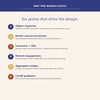
Cutoffs and reliable change are different questions and most clinicians treat them as one. The cutoff anchors diagnosis. The RCI tracks treatment. Both are walked here with the original citations.
The EPDS scoring is mixed-direction, which quietly breaks generic spreadsheets, and any positive on item 10 requires follow-up regardless of the total. AUDIT and DAST are the most under-used tools in mental health intake, and knowing the two thresholds tells you what to actually do with a positive screen.
Measurement-based care is only as good as the response to the data, which is what the decision algorithms are for. And outcomes data is increasingly required in payer documentation, which is what the chart language is for.
Format
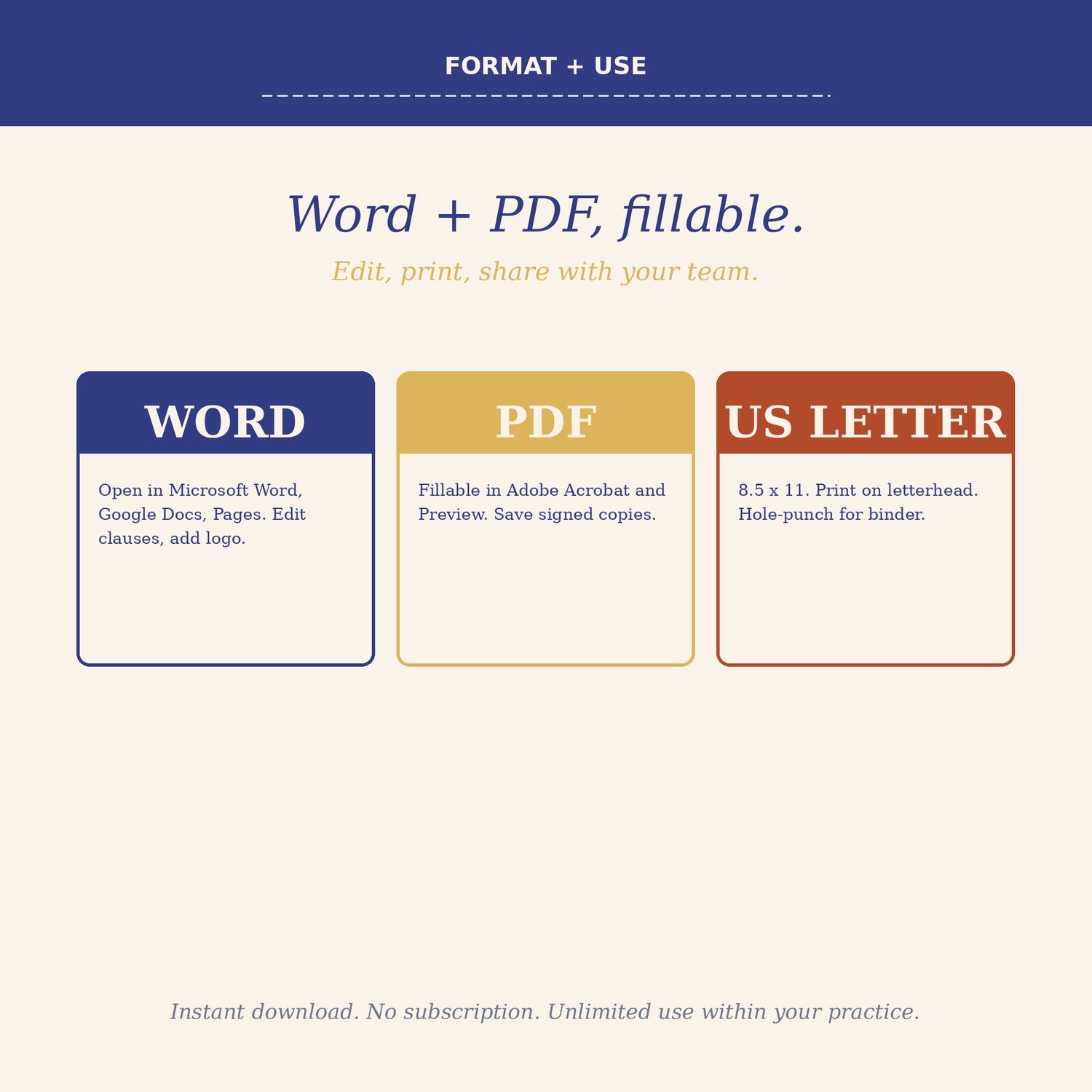
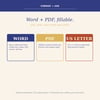
Editable, fillable PDF, 45 pages. Editable Microsoft Word (.docx), same length. Measures, tracking spreadsheet, and chart language copy straight into EHR text fields. US Letter (8.5 x 11) and A4 (8.3 x 11.7) both included. Works on Mac, Windows, iPad, GoodNotes, and Notability. Lifetime access, unlimited prints.
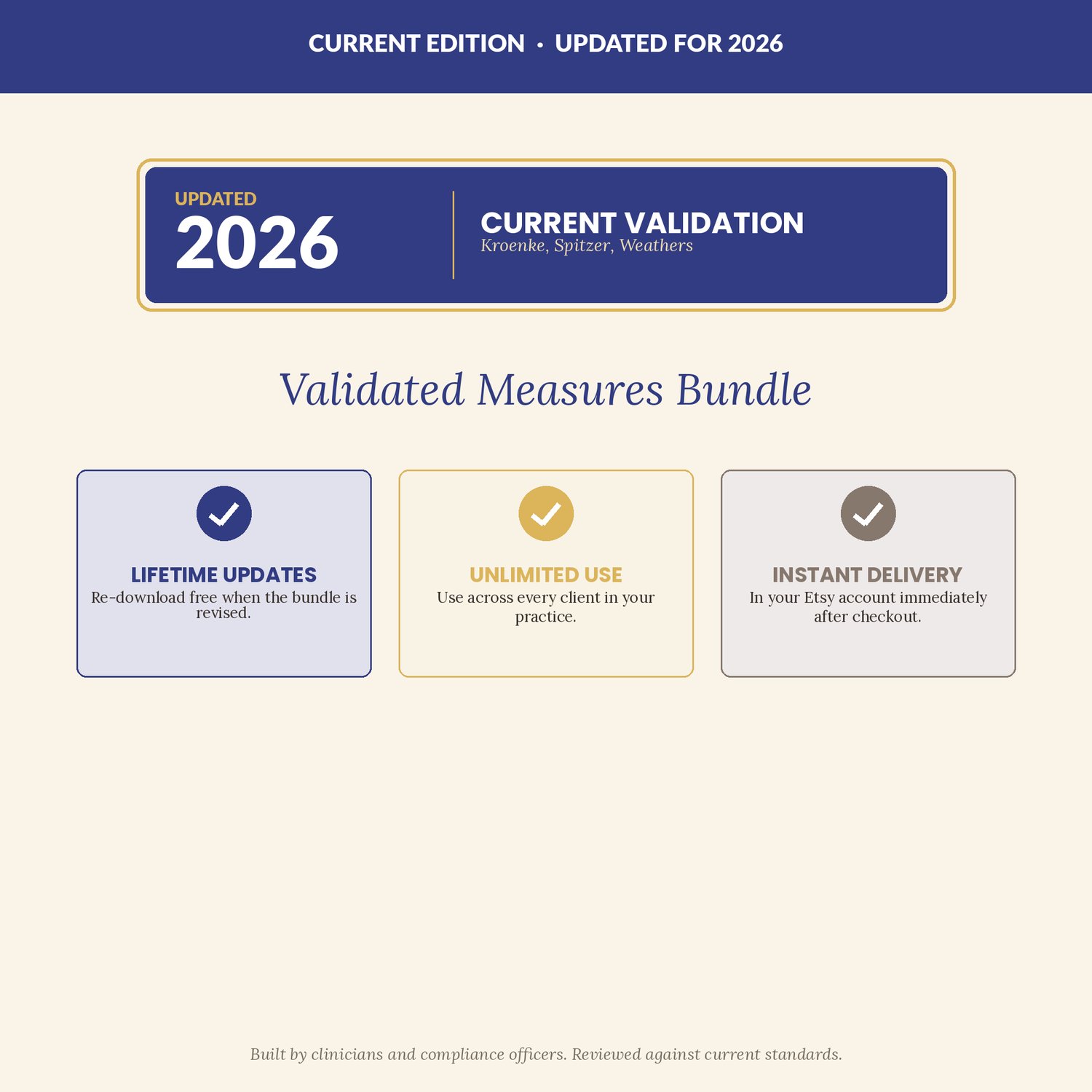
Updated 2026
PHQ-9 reflects Kroenke et al. (2001) and the Löwe et al. (2004) minimal clinically important difference. GAD-7 reflects Spitzer et al. (2006) and Kroenke et al. (2007). PCL-5 reflects Weathers et al. (2013) and Bovin et al. (2016). AUDIT reflects Saunders et al. (1993) and the Babor (2001) manual. DAST-10 reflects Skinner (1982) and the Yudko (2007) review. EPDS reflects Cox et al. (1987) and ACOG Committee Opinion 757. Y-BOCS reflects Goodman et al. (1989). ACE reflects Felitti et al. (1998). OQ-45 reflects Lambert et al. (1996) and current licensing. The MBC evidence base reflects Lambert et al. (2018) and the SAMHSA registry.
How to use it
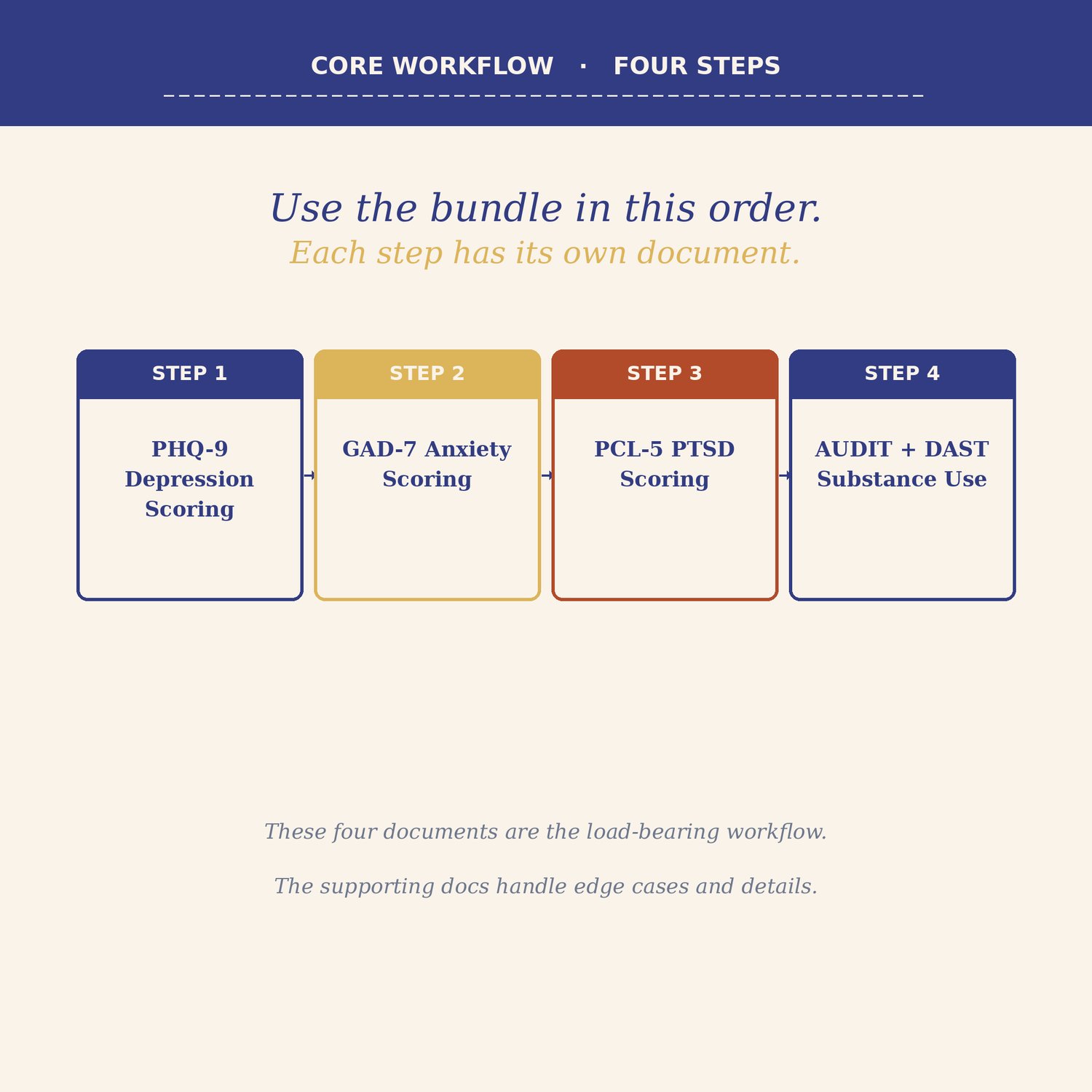
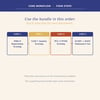
At intake, administer PHQ-9, GAD-7, and PCL-5, or the condition-specific measures, as part of the packet. Score per the protocols, log baselines in the tracking spreadsheet, and re-administer every visit or every second visit depending on your cadence. At session 4 to 6, apply the response protocol, where non-response triggers a specific algorithm rather than a vague plan change. Document with the chart language built into each scoring chapter. For contracting, aggregate practice-level data to show your outcomes profile.
This is a clinical and practice management reference, not training. The measures inform clinical judgment; they do not replace it.
Instant digital download. No physical product ships. Message us if anything does not work.
Watch free on YouTube: