
Psychology Master's Application Pack (2026)
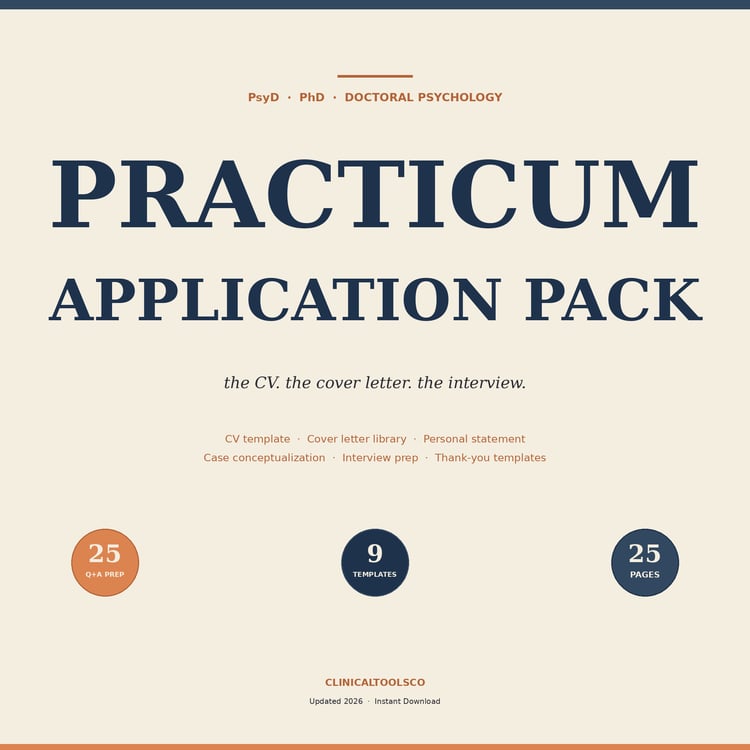
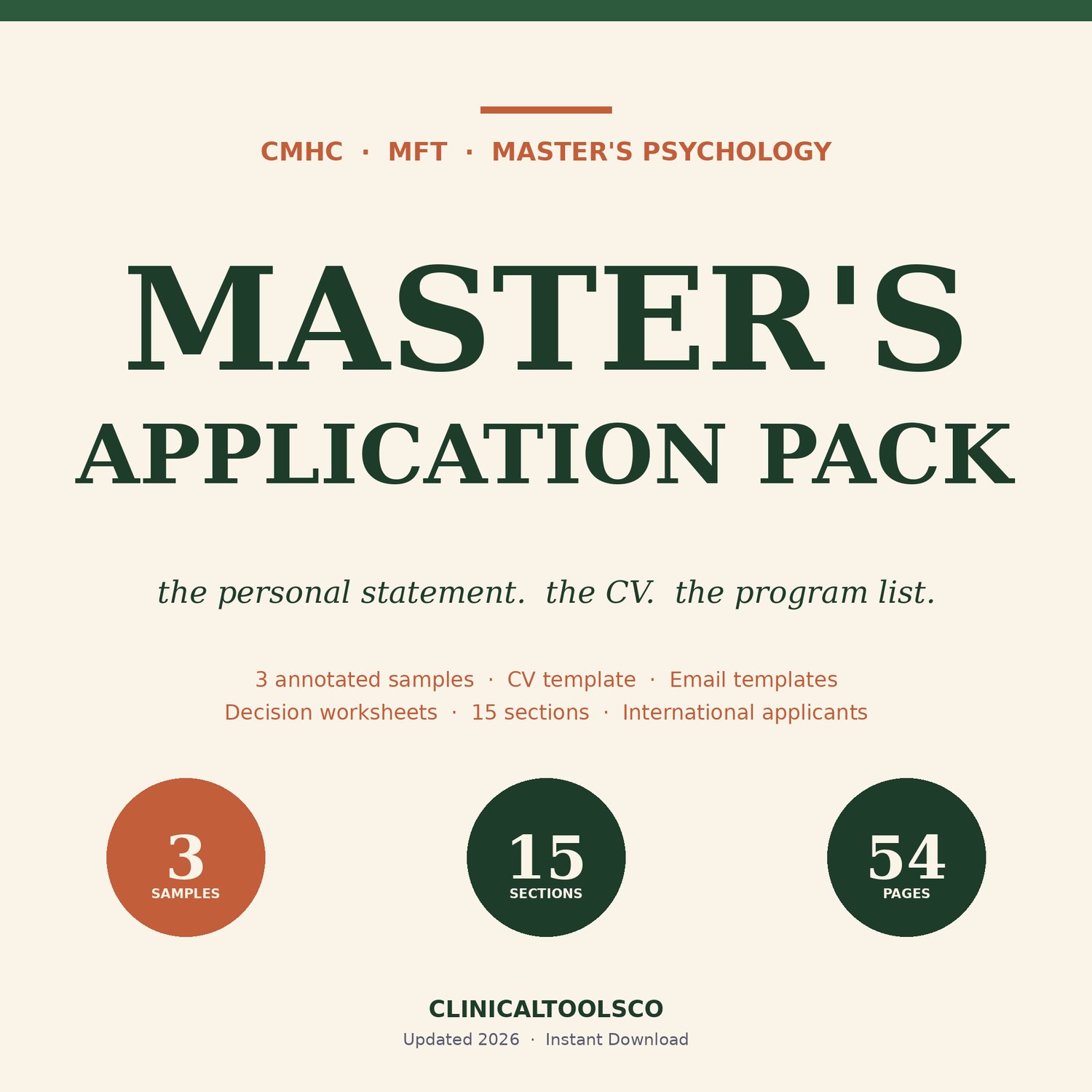
A psychology master’s application pack: program selection and fit, a twelve month timeline, personal statement anatomy, a CV for master’s applications and letters of recommendation.
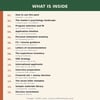
What is in the pack
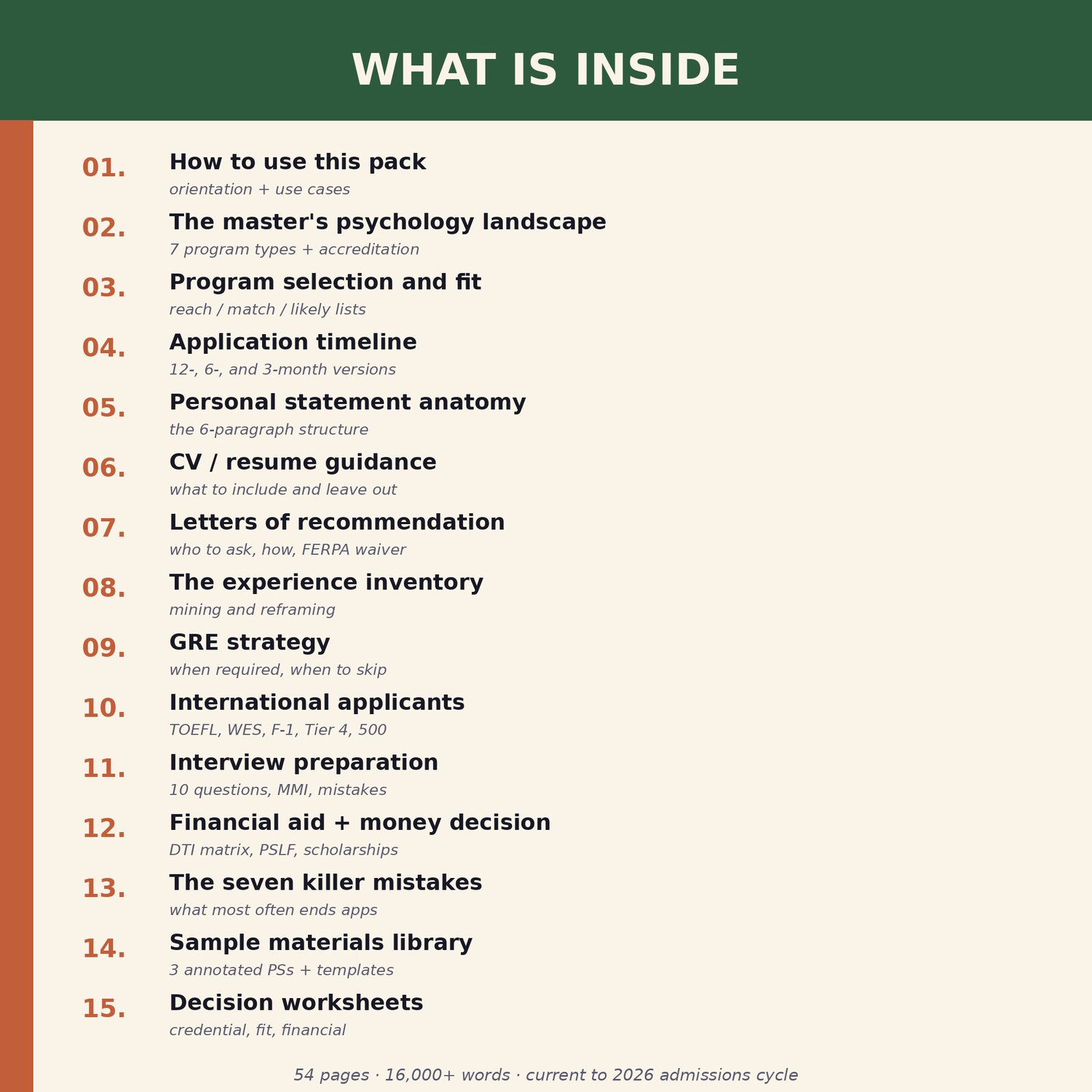
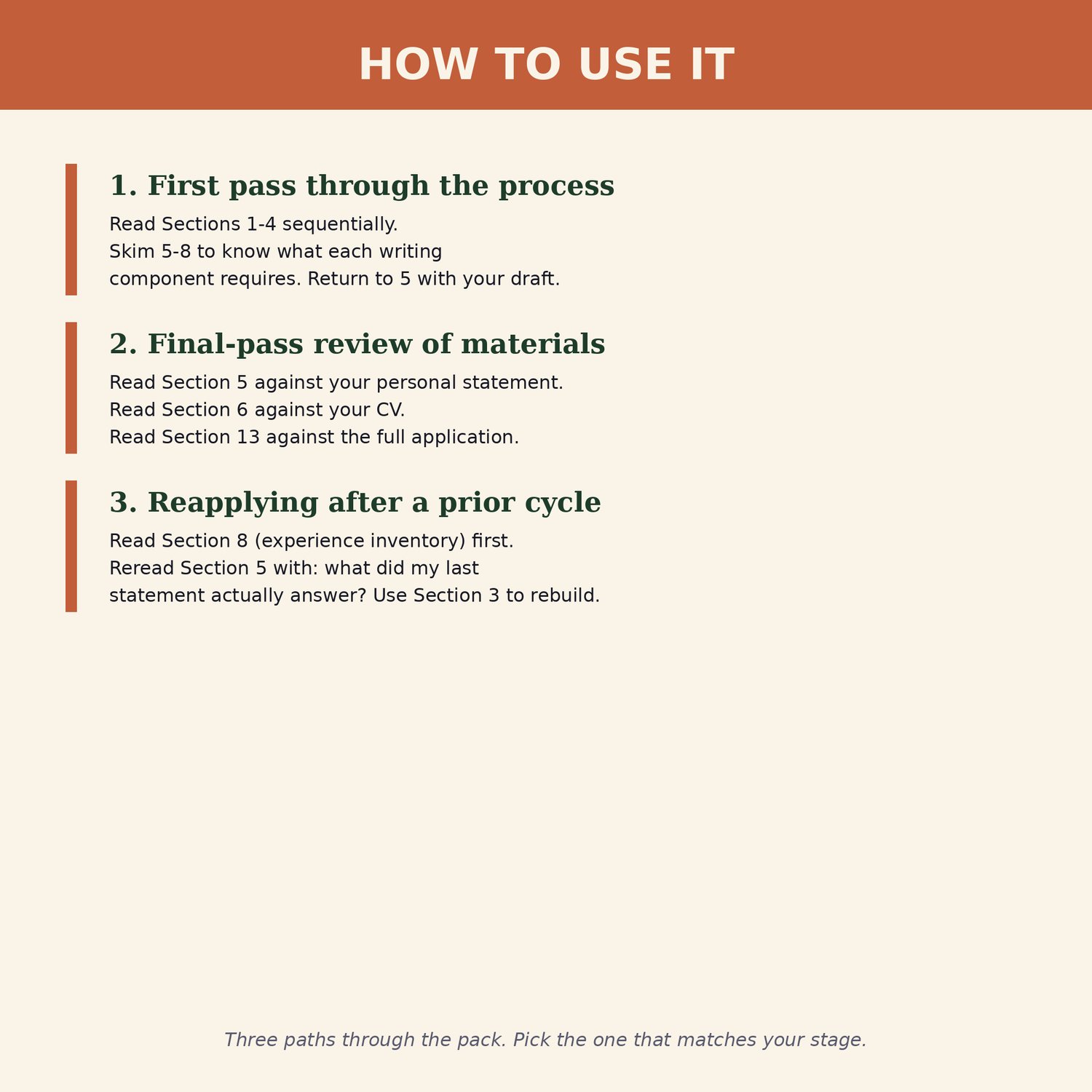
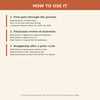
- Section 1: How to use this pack, with three use cases (first pass, final review, reapplying) and section priorities for each
- Section 2: The master's psychology landscape. The seven main paths with credits, credentials and notes, the accreditation answer, and the clinical social work clarification
- Section 3: Program selection and fit. The credential-backward filter, reach, match and likely tiering, what programs actually evaluate versus what applicants assume, the spreadsheet step by step, and the financial reality
- Section 4: Application timeline in twelve-month, six-month and three-month scenarios, with month-by-month or week-by-week tasks and the April 15 reply date
- Section 5: Personal statement anatomy. The four questions the statement must answer, the six-paragraph structure, voice and tone, and the common failure modes
- Section 6: CV for psychology master's applications, with required sections, a weak versus strong bullet comparison, what to leave out and gap explanation options
- Section 7: Letters of recommendation. A ranked list of who to ask, exact phrasing for the difficult ask, the FERPA waiver answer, and what to do when a letter falls through
- Section 8: The experience inventory, with a four-column exercise and reframing principles for teaching, hospitality, case management, healthcare-adjacent, military, parenting and immigrant experience
- Section 9: GRE strategy. Who still requires it, who has dropped it, score bands by program type, when to take it and when to skip
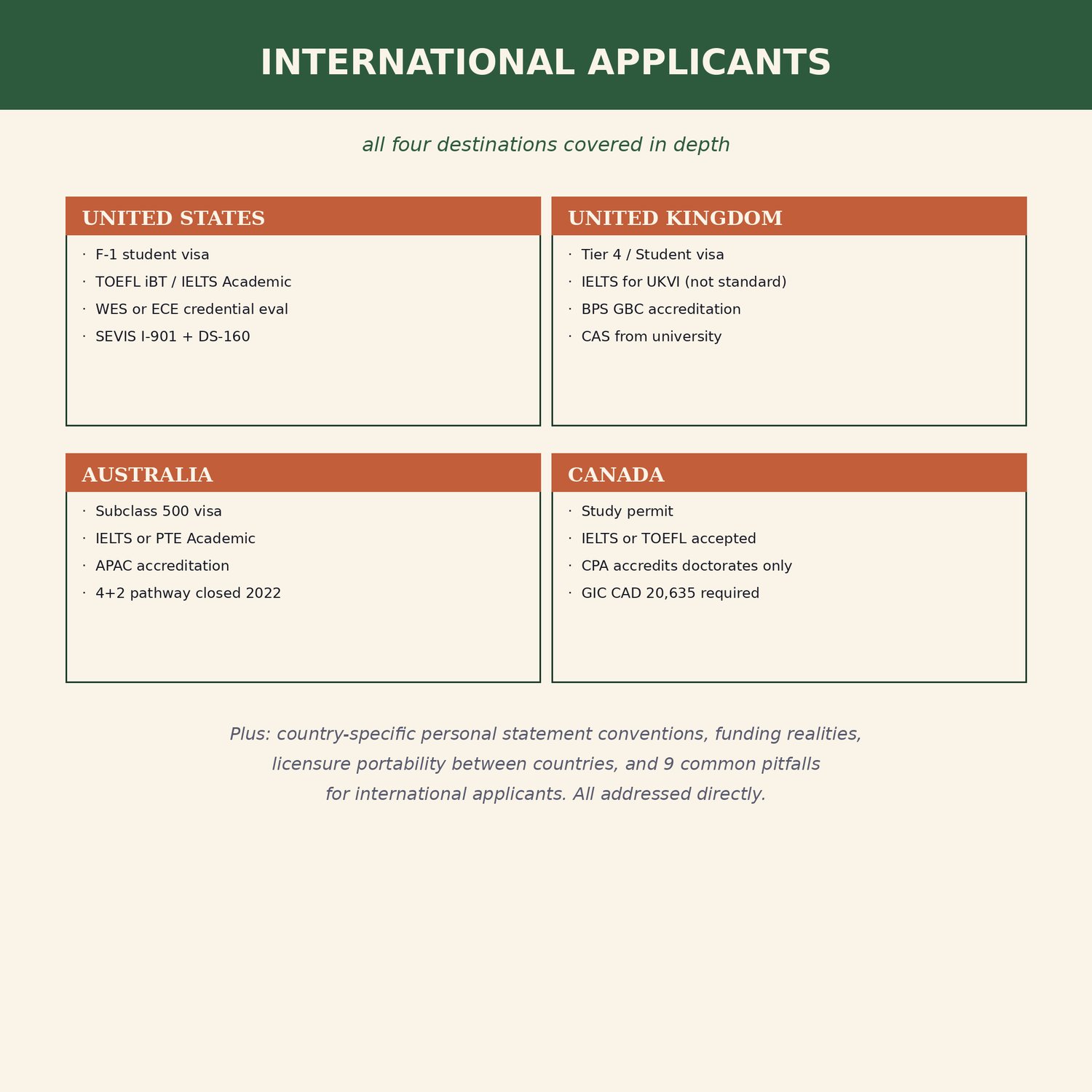
- Section 10: International applicants. English proficiency testing, credential evaluation timelines, the US, UK, Australia and Canada visa sequences, country-specific personal statement conventions, funding reality and the licensure portability conversation
- Section 11: Interview preparation. Formats, ten questions to prepare for with research and clinical additions, the three to five good questions to ask, the bad questions, and the after-interview thank-you
- Section 12: Financial aid and the money decision. Tuition ranges by program type, first-five-year earnings by setting, and a four-criterion decision matrix with debt-to-income anchors
- Section 13: The seven killer mistakes, each with why it kills applications and the specific fix
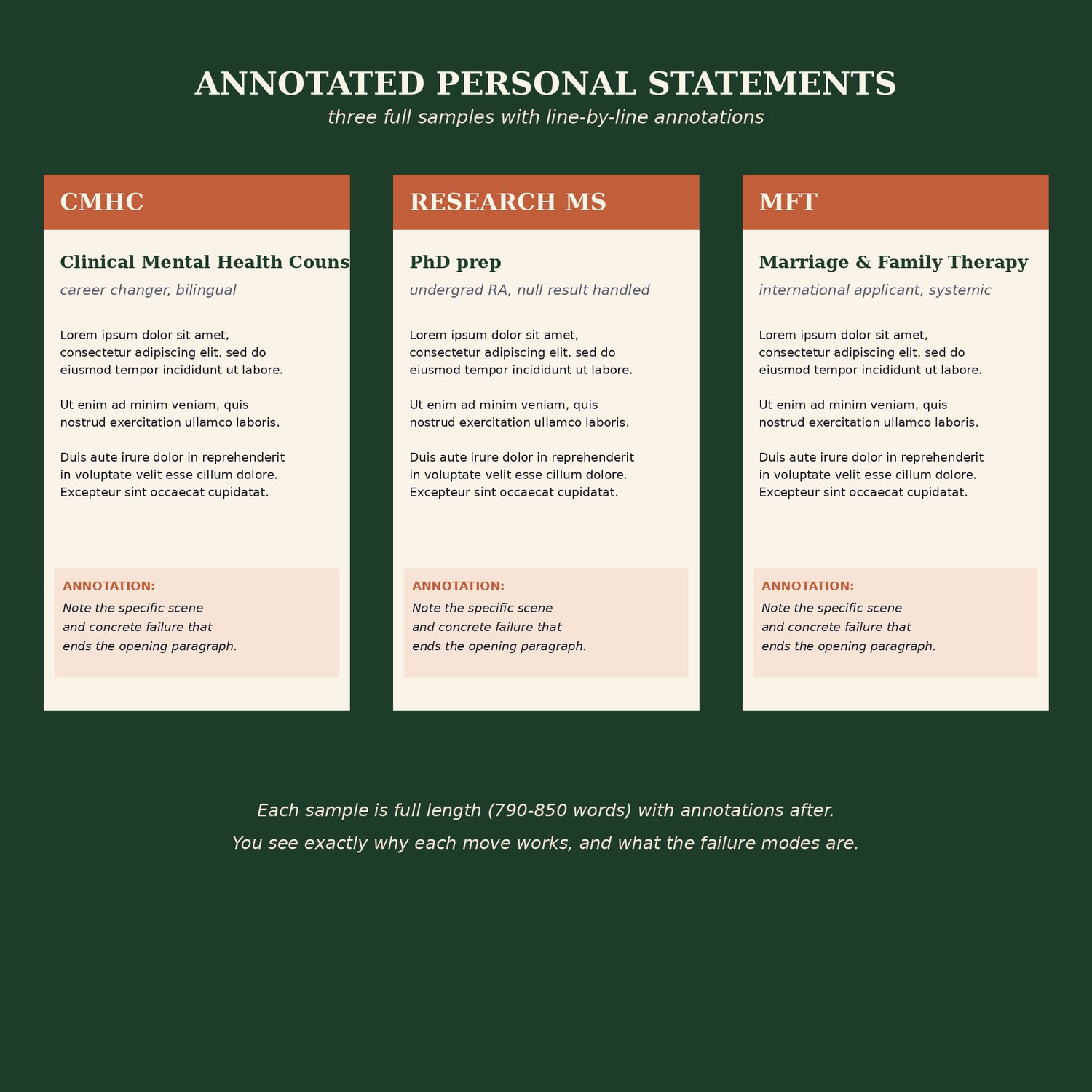
- Section 14: Sample materials library with three full annotated personal statements, a CV template and five recommendation email templates
- Section 15: Decision worksheets, including a credential decision flowchart, program fit audit, financial decision matrix, accept-or-decline framework and an application tracking column list
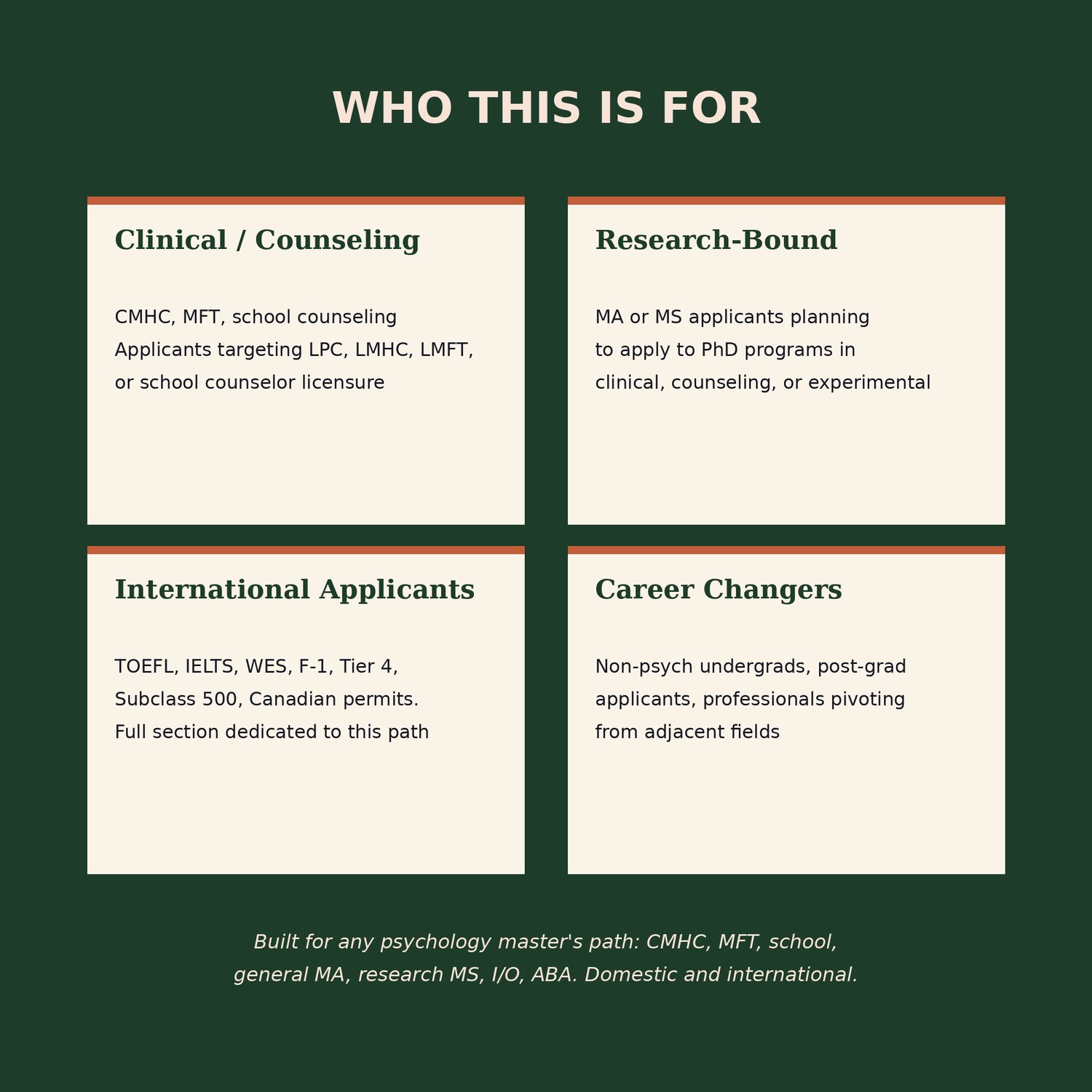
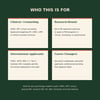
Who it is for
- Applicants to clinical mental health counseling master's programs
- Applicants to marriage and family therapy master's programs
- Applicants to school counseling master's programs
- Applicants to research-focused MS programs on a doctoral-prep track
- Applicants to industrial-organizational master's programs
- Applicants to applied behavior analysis master's programs preparing for certification
- Career changers entering psychology from teaching, social services, healthcare or other fields
- Applicants with non-psychology undergraduate backgrounds
- International applicants to US, UK, Australia or Canada programs
- Reapplicants whose first cycle did not yield offers, and the advisors supporting them
Why it exists
You have a 3.6 GPA, two years of crisis line work, an undergraduate degree in something other than psychology, no idea whether your target programs require the GRE, no draft of a personal statement, three potential letter writers and one definite weak link, and a deadline 14 weeks away. Most application guides tell you to write from the heart. That is not the job.
The job is to decide the credential you want to hold in five years, pick the accreditation filter that supports it, build a six to ten program list with reach, match and likely tiers, write the six-paragraph personal statement that answers the four questions in the reader's mind, request letters from people who can actually speak to your work, address the international or career-changer or non-psychology-undergrad reality directly instead of hoping it resolves itself, and respond to programs within 48 hours when offers arrive. This pack covers the whole process.
Includes an Admissions Interview Prep and Statement Annotation companion listing the questions counseling, CMHC and MFT programs ask, what each assesses, answer frameworks, and a section-by-section personal-statement annotation.
57 pages, 15 sections, written for the applicant to a clinical mental health counseling, marriage and family therapy, school counseling, industrial-organizational, applied behavior analysis, general MA or research-focused MS psychology program in the US, UK, Australia or Canada.
Why this is different
Most psychology master's application guides are generic graduate-school guides with a psychology label. This pack is field-specific: the credentials, the accreditation filters, the program-type differences, the international layer and the licensure-portability conversation are all written for the actual psychology applicant.
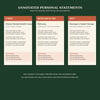
The three annotated sample personal statements matter because most applicants have never read a strong statement with the moves explained. Each is followed by paragraph-by-paragraph annotations explaining why the opening hook works, why the program-fit paragraph cites a specific paper, why the what-I-bring paragraph pairs strength with a named gap, and why the close returns to the opening figure without sentimentalizing.
The accreditation section matters because the single most expensive applicant mistake is choosing a counseling program without the accreditation the licensure state effectively requires.
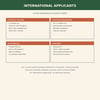
The international applicant section matters because international applicants face a separate layer of English proficiency, credential evaluation, visa, funding and licensure portability, and most guides treat it as an appendix.
The financial decision matrix matters because master's psychology programs are mostly self-funded and the wrong financial choice can shape earnings for a decade.
The seven killer mistakes section matters because the failure modes are concentrated. Most applications that fail do so for one of seven reasons.
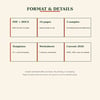
Format
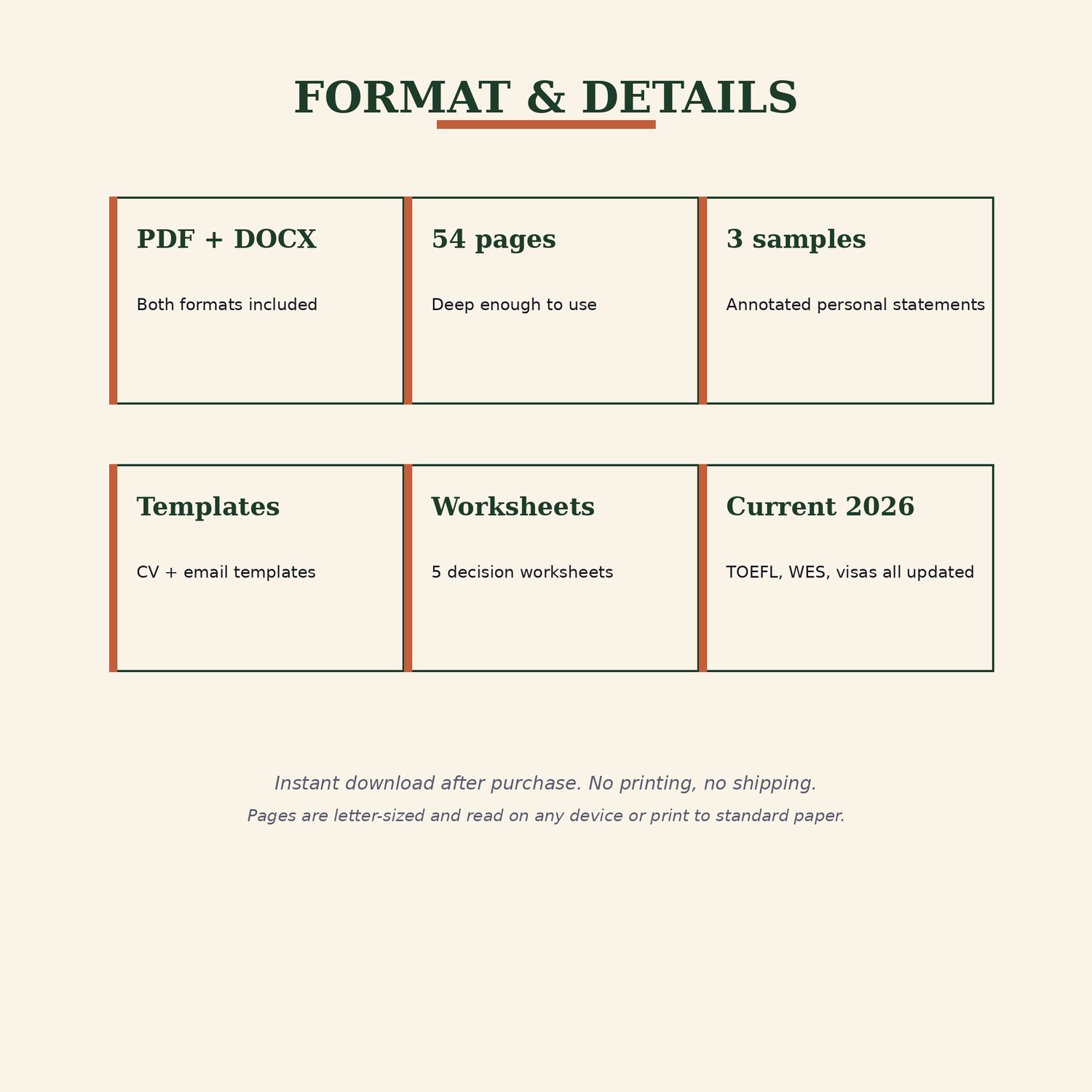
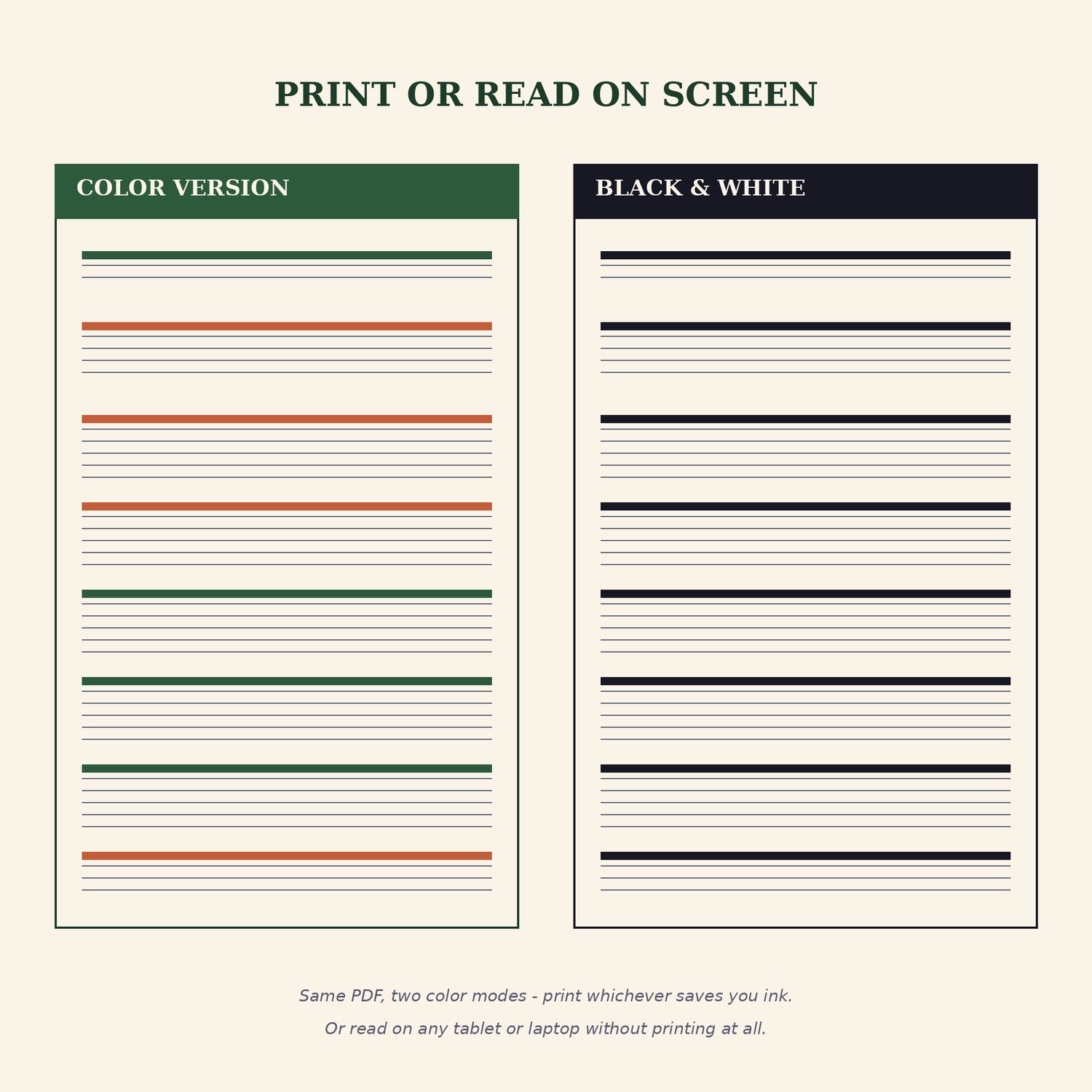
- Editable, fillable PDF (57 pages)
- Editable Microsoft Word (.docx, 57 pages)
- Interview prep and statement annotation companion in PDF and Word
- Five decision worksheets formatted to print and complete
- US Letter and A4 sizes both included
- Works on Mac, Windows, iPad, GoodNotes, Notability
- Lifetime access, unlimited prints
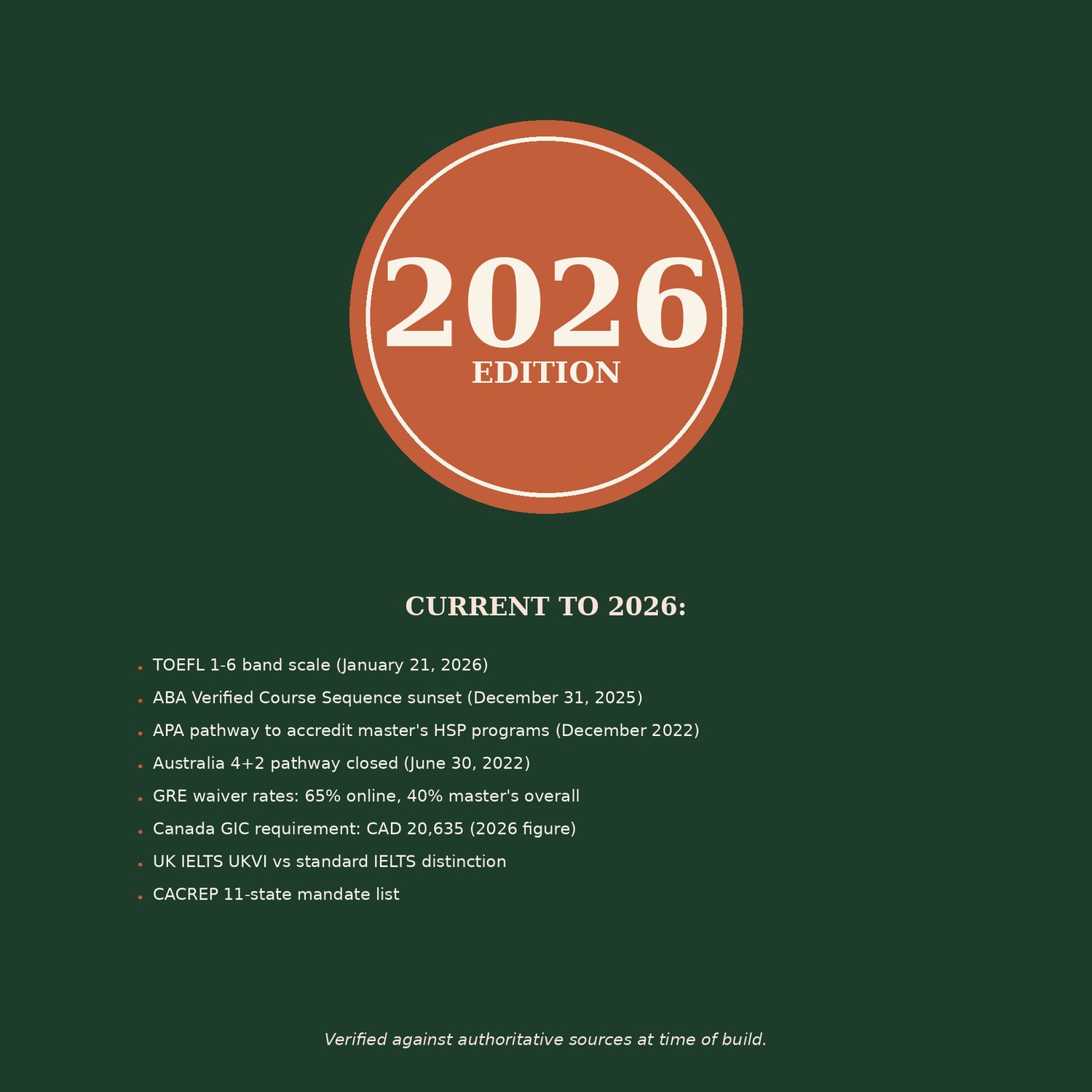
Updated 2026
Current to 2026, reflecting the TOEFL band scale transition, the Australia 4+2 pathway closure, the ABA verified course sequence sunset and the accreditation requirement that follows it, the 2023 APA pathway to accredit master's-level health service psychology programs, current GRE waiver patterns, the Council of Graduate Schools April 15 reply date, current federal graduate loan interest rates, and current visa fees and processing times for the US, UK, Australia and Canada. This pack is not legal advice, immigration advice or financial advice. Verify all program-specific information directly with the program admissions office before relying on it.
A note from the designer
I am a practicing clinician who has been on both sides of this process, as an applicant and as a peer reviewer of personal statement drafts across roughly 100 cycles. I built this pack after writing the same email reply 30 times explaining which accreditation filter to use. Section 5 is what I send to every applicant who emails me saying they do not know how to start. Section 14 is what I send when the real answer is that you need to see strong statements before you can write one.
This is a study and planning companion, not legal advice, immigration advice or financial advice. Verify all program-specific and visa-specific information with the relevant institutions before relying on it.
Digital download. No physical product ships. Reach out by email if anything does not work or if you have questions.