
Suicide Risk and Safety Planning Toolkit (2026)
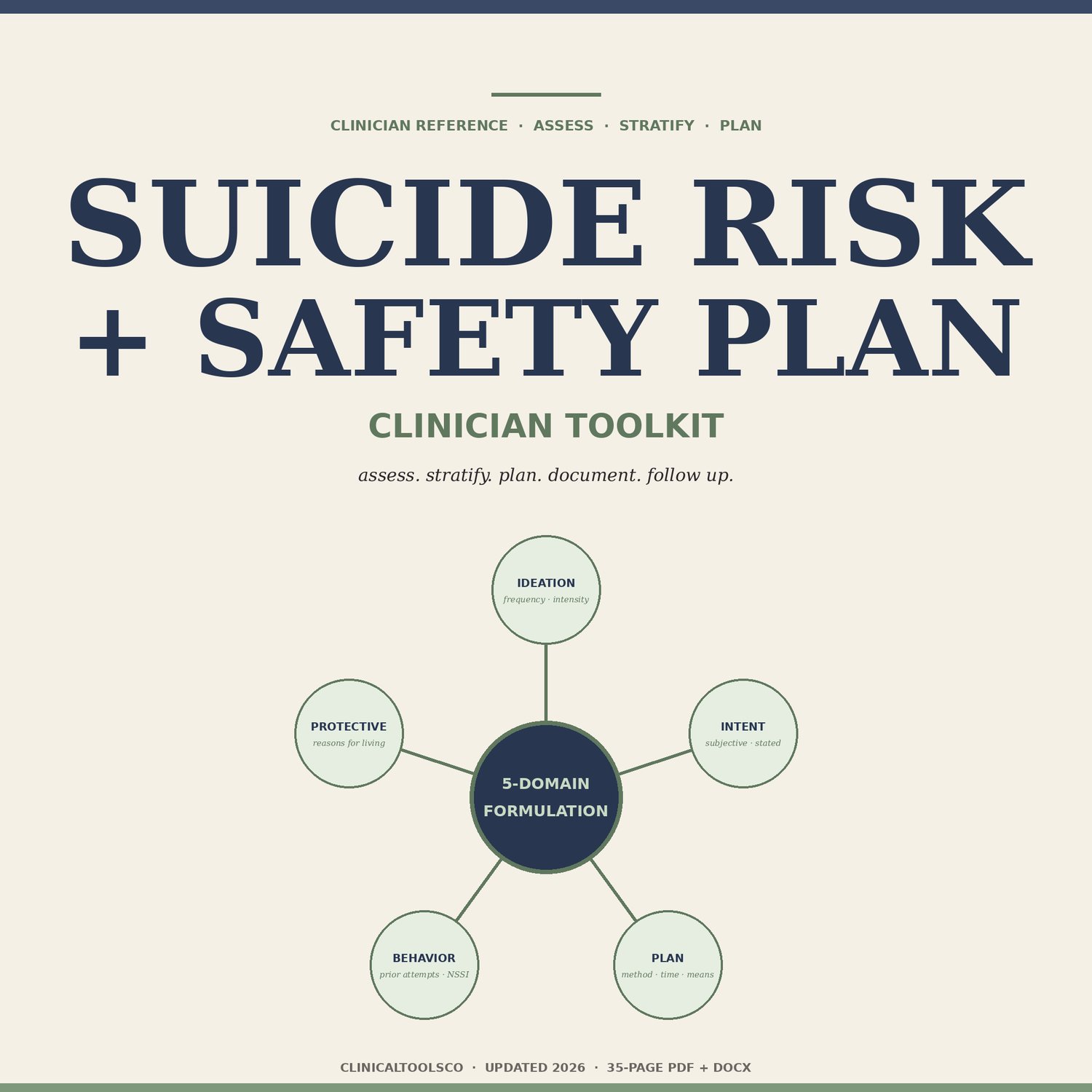
A suicide risk and safety planning toolkit: a five-domain risk formulation, a structured assessment protocol, risk stratification, a disposition matrix and the Stanley-Brown Safety Planning Intervention.
What is in the toolkit
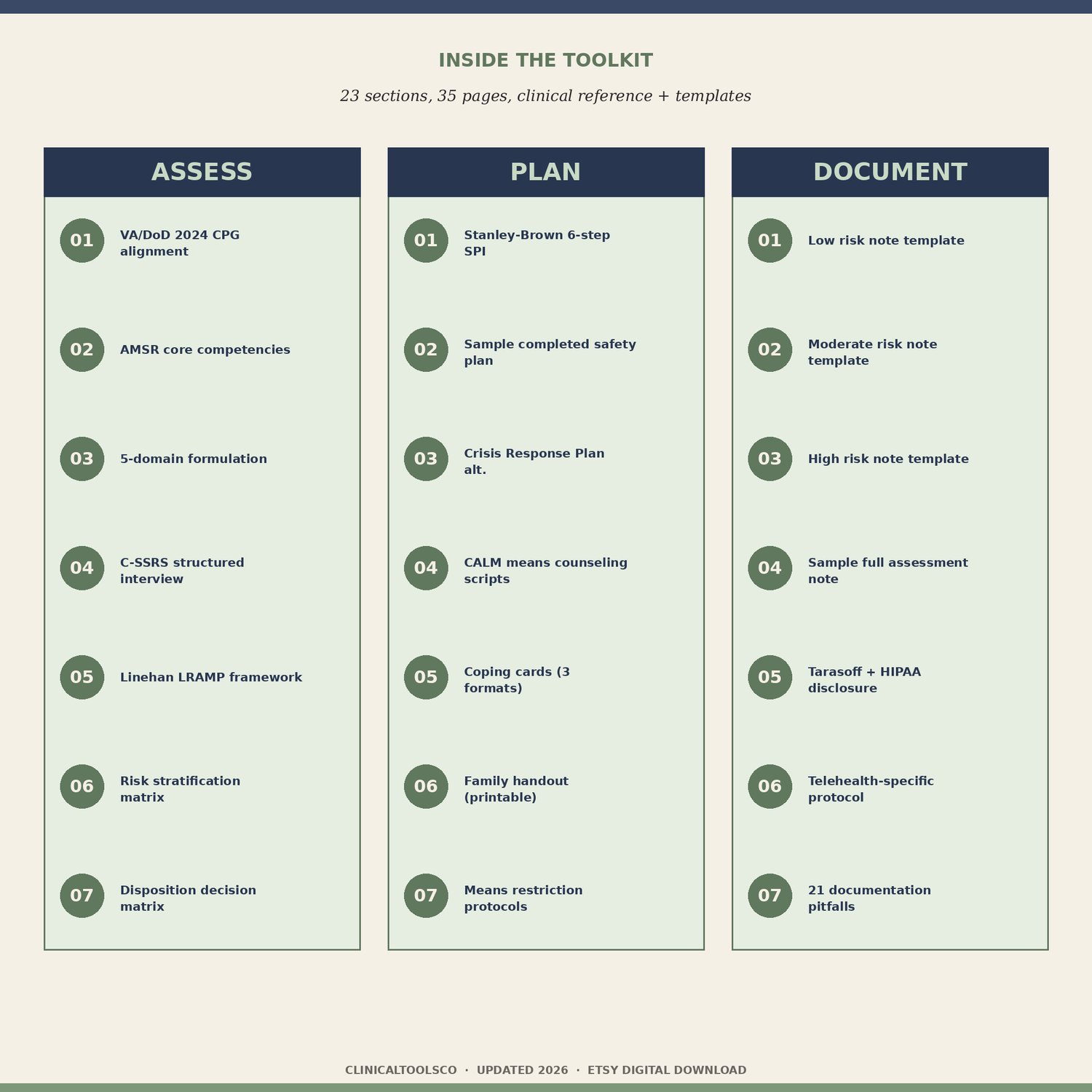
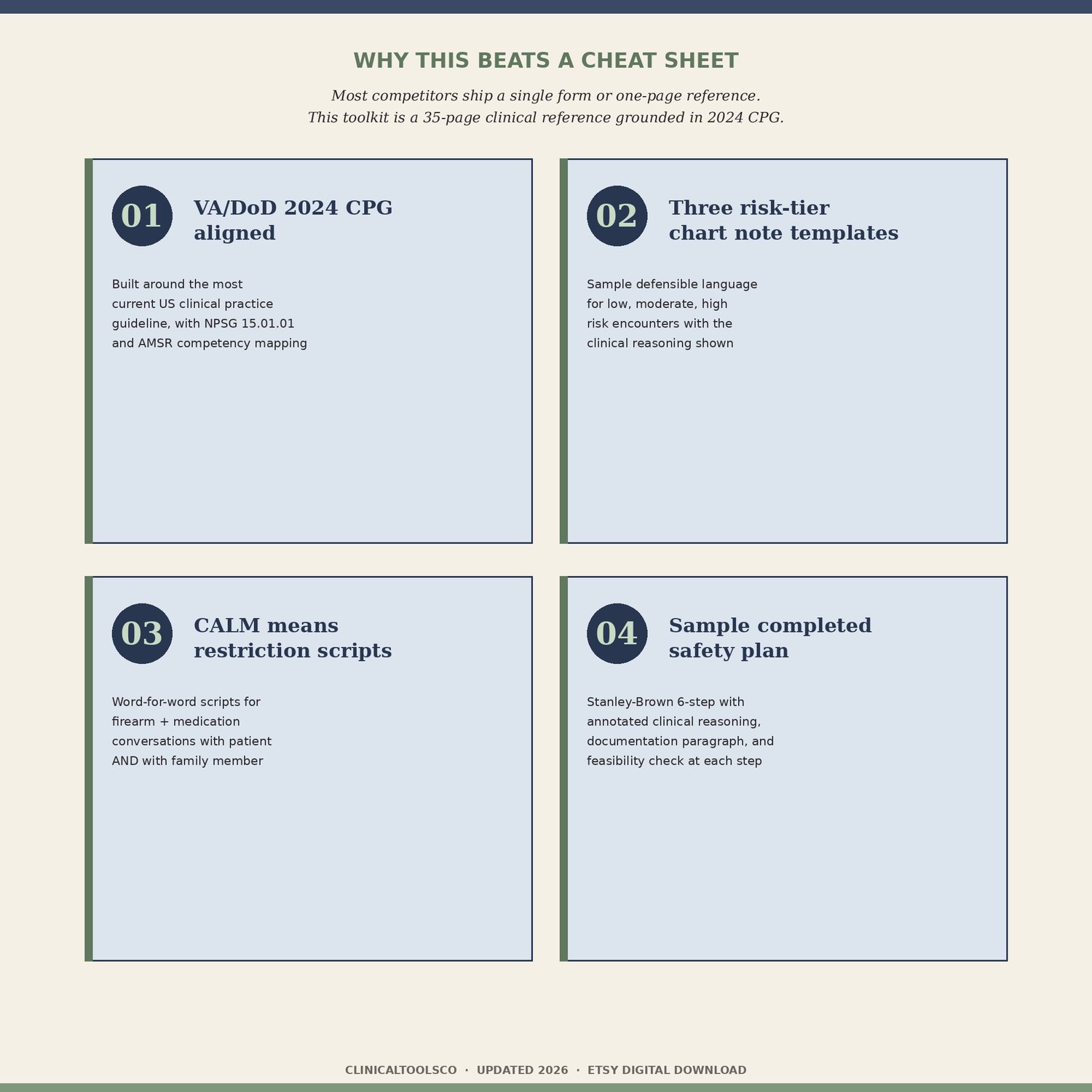
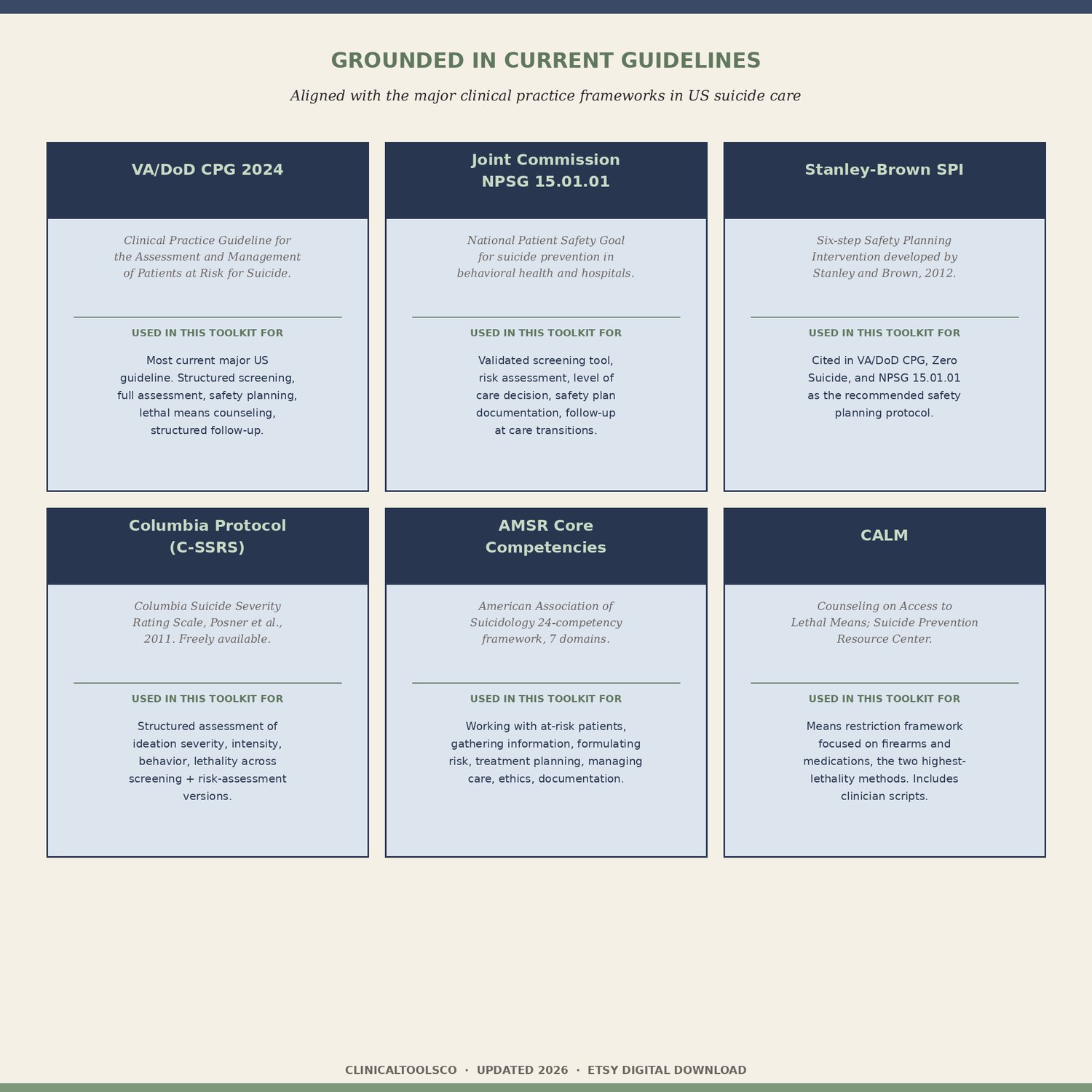
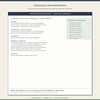
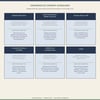
- Clinical guideline alignment across the VA and DoD 2024 CPG, Joint Commission NPSG 15.01.01, AMSR Core Competencies, the Zero Suicide framework, Stanley-Brown SPI, C-SSRS, Linehan LRAMP and CALM
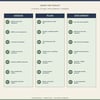
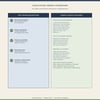
- Five-domain risk formulation covering ideation, intent, plan, behavior and protective factors, with verbatim interview prompts for each domain
- Structured assessment protocol: which instrument when (C-SSRS, ASQ, PSS-3, P4, BSS, LRAMP) plus a 14-step workflow from frame to disposition to documentation
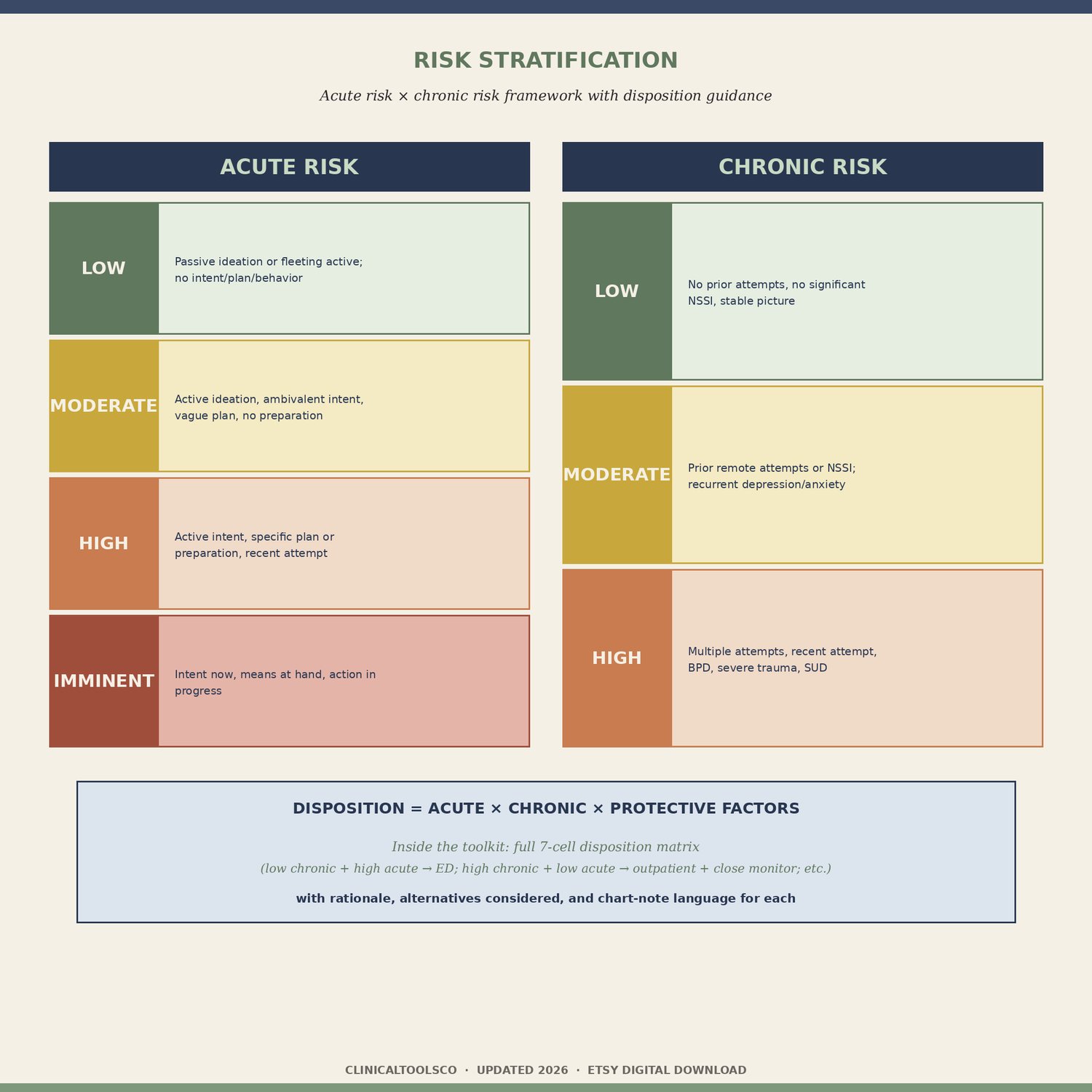
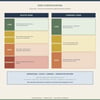
- Risk stratification framework with acute tiers (low, moderate, high, imminent), chronic tiers, and the acute-on-chronic combinations
- Disposition decision matrix from outpatient through emergency hospitalization with case-specific guidance for each combination
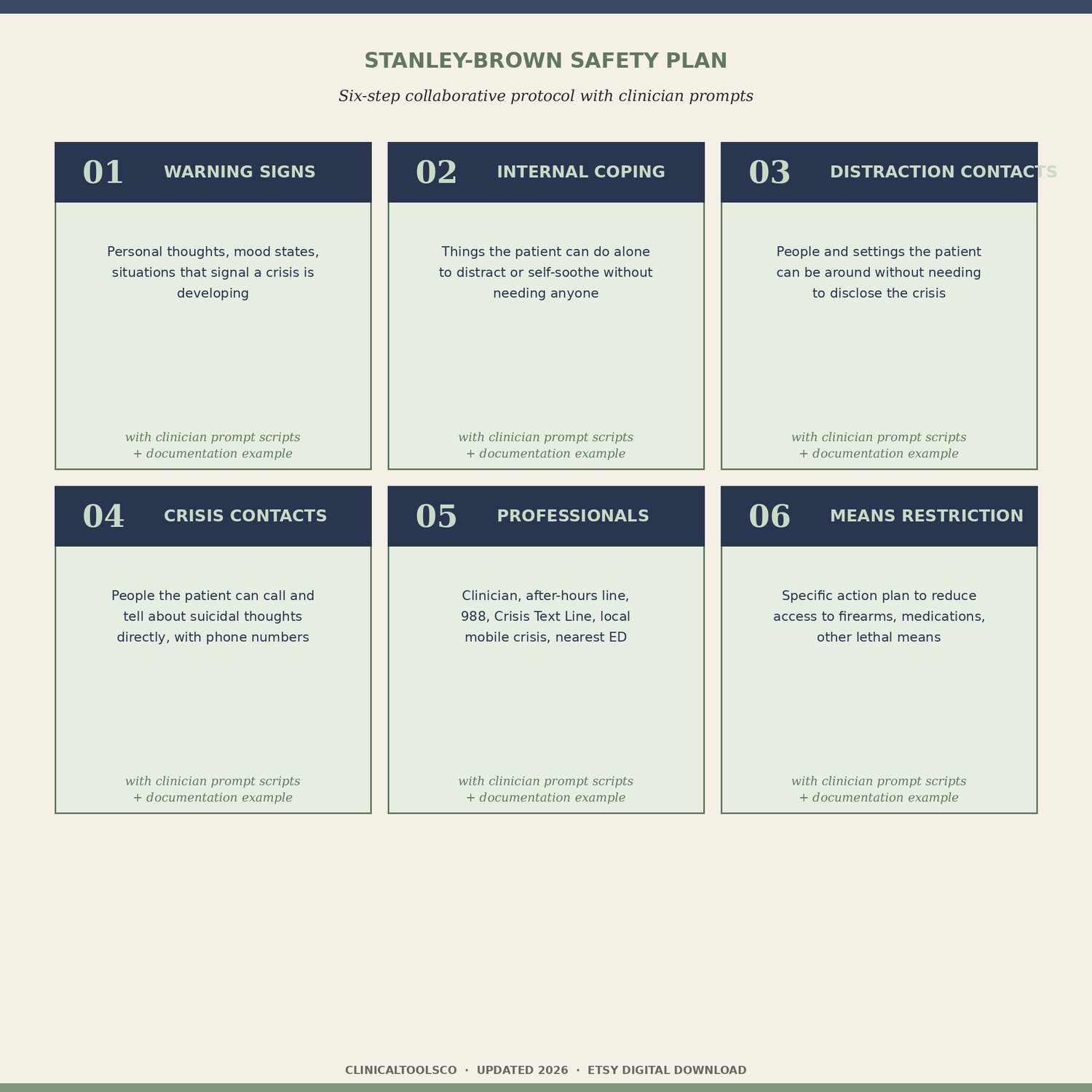
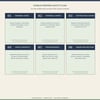
- Stanley-Brown Safety Planning Intervention: the full six-step protocol with clinician prompts and implementation principles
- Annotated sample completed safety plan with clinical reasoning notes for every step
- Crisis Response Plan (Bryan and Rudd) as an alternative protocol with comparison to Stanley-Brown
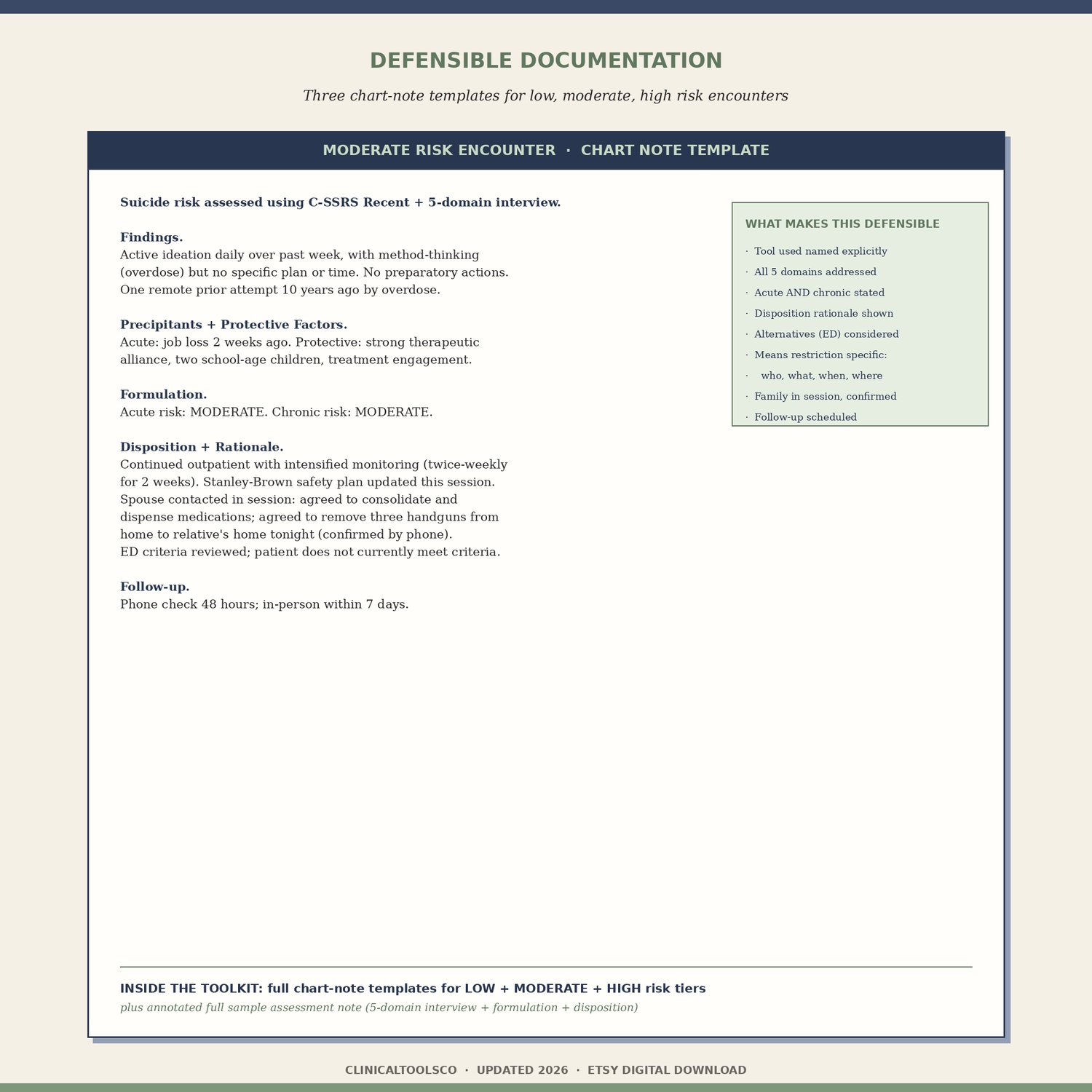
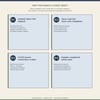
- Defensible documentation language for low, moderate and high risk with three sample formulation paragraphs
- Full annotated sample risk assessment note on a composite fictional case, with structural breakdown
- Three brief chart-note samples for shorter encounters at each risk tier
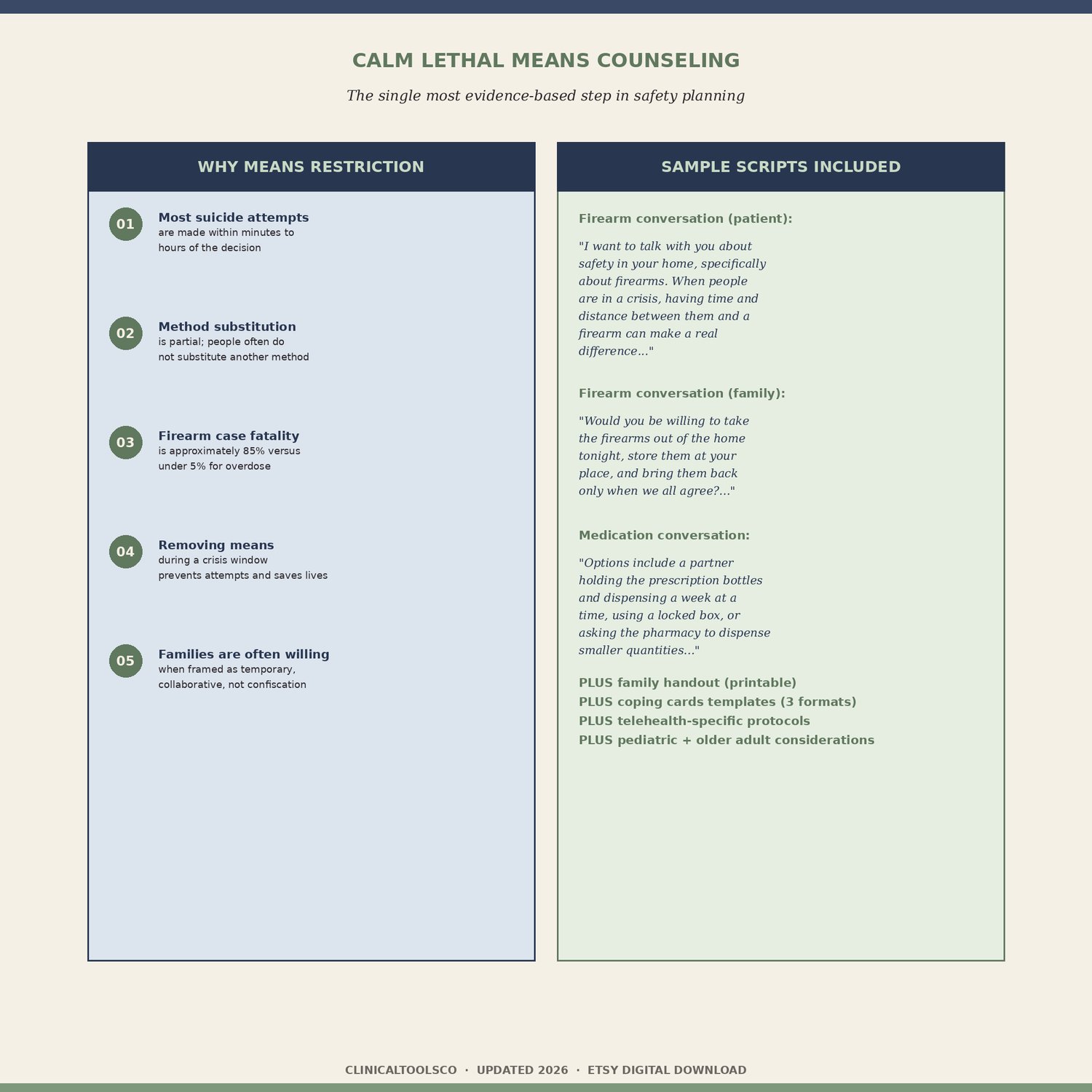
- CALM lethal means counseling: framework, evidence, and full scripts for the firearm and medication conversations with patient and family
- Tarasoff and HIPAA: duty to warn versus duty to protect, when and how to disclose, disclosure scripts, documentation
- Telehealth-specific protocol: address verification, emergency contact verification, what to do if risk emerges mid-session, CAMS-T adaptations
- Pediatric and adolescent considerations: ASQ screening, developmental adaptations, parental notification, family means restriction
- Older adult considerations: distinct risk profile, assessment adaptations, common clinical pitfalls
- Coping card templates in three formats, and a reproducible means restriction handout for families
- Follow-up and contingency planning workflow with cadence by risk tier and the caring contacts intervention
- Documentation pitfalls and malpractice considerations
- Crisis resources directory and continuing education pathways for AMSR, Stanley-Brown SPI, CALM, CAMS, CBT-SP and DBT
Who it is for
- Licensed clinical psychologists, psychiatrists, LPCs, LMHCs, LCSWs, MFTs, NPs and psychiatric nurses managing suicide risk in clinical practice
- Pre-licensed clinicians working under supervision
- Outpatient, inpatient, intensive outpatient, partial hospitalization and crisis service clinicians
- ED behavioral health clinicians and integrated primary care behavioral health providers
- Telehealth-only practices needing remote-specific risk protocols
- Doctoral and master's students preparing for clinical placements
- Clinical supervisors who want a structured teaching resource for risk assessment and safety planning
- Group practices and clinics establishing or updating internal risk protocols
Why it exists
When a patient discloses suicidal ideation, the clinical demands compress. You need to organize a five-domain assessment, stratify acute and chronic risk, make a defensible disposition decision, build a collaborative safety plan, conduct lethal means counseling, and write documentation that supports your clinical reasoning. Most clinicians were trained with a brief introduction to risk assessment and a sentence about no-harm contracts that current evidence does not support.
I built this toolkit as the single desk reference I wish I had when a patient discloses ideation in a session. It integrates the VA and DoD 2024 Clinical Practice Guideline, the Stanley-Brown Safety Planning Intervention, C-SSRS structure, AMSR Core Competencies, Joint Commission NPSG 15.01.01, CALM lethal means counseling, and Linehan LRAMP into one 35-page clinician workflow.
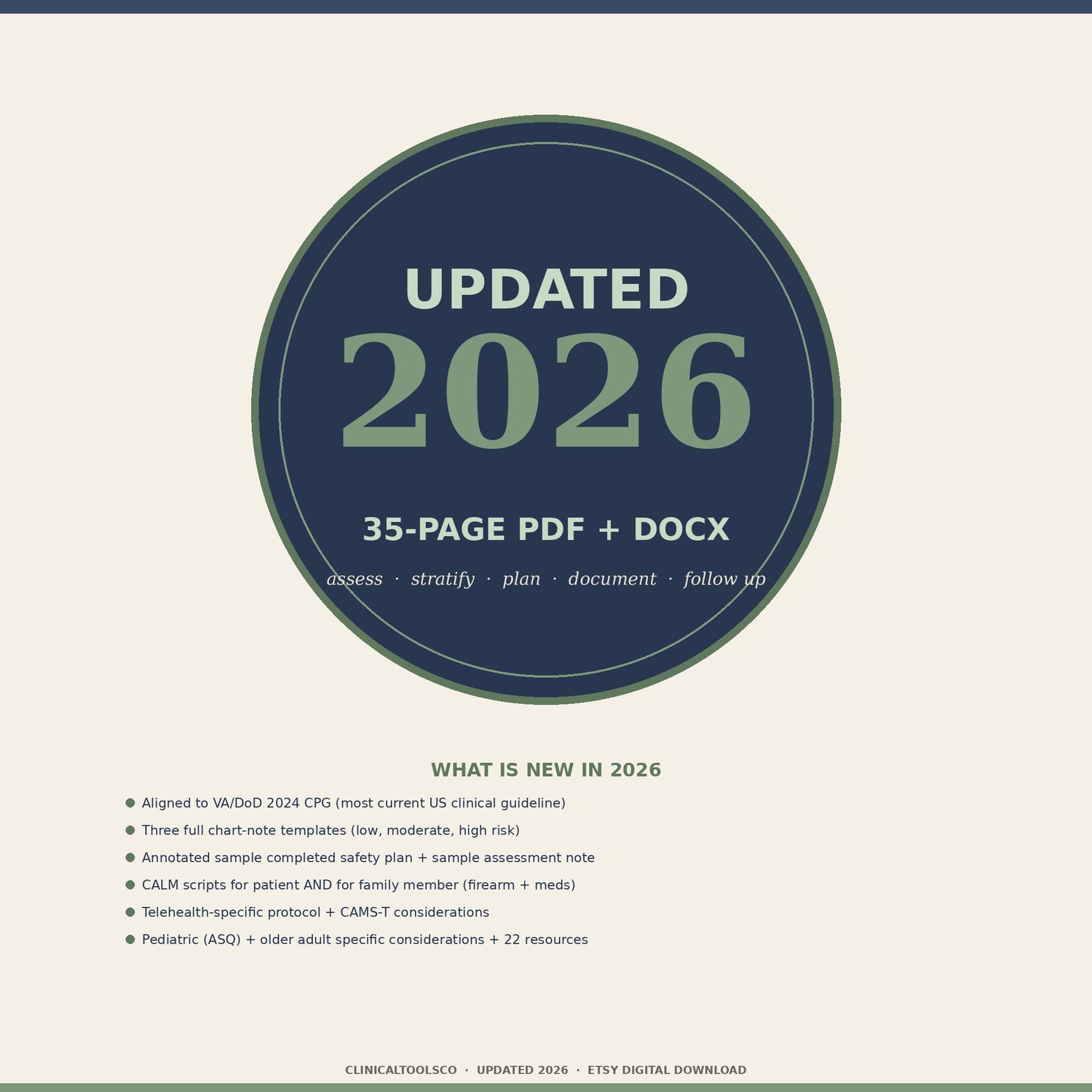
35 pages delivered as PDF and editable Word. Built for licensed mental health professionals and supervised pre-licensed clinicians who need an at-hand reference during and after a risk encounter. Sections move in the same order you move clinically: assess, stratify, plan, document, follow up.
Why this is different
Most safety plan resources give you the Stanley-Brown form alone. This toolkit gives you the full clinical workflow that surrounds the form: the five-domain assessment that justifies the plan, the disposition matrix that decides the level of care, the lethal means counseling scripts that operationalize the most evidence-based element, the documentation language that supports your clinical reasoning, and the follow-up cadence that addresses the highest-risk window.
The annotated sample safety plan matters because the Stanley-Brown form looks simple and is hard to fill out well. The sample shows what a clinically useful plan looks like at the bullet level: specific warning signs, internal coping strategies that take under 15 minutes, distraction contacts that work without disclosure, crisis contacts the patient has agreed to tell, and means restriction that is action-oriented and verifiable.
The defensible documentation section matters because chart notes after risk encounters carry real malpractice consequences. The three sample formulation paragraphs model the level of specificity that supports clinical reasoning without promising outcomes you cannot guarantee.
The CALM section matters because means restriction is the single most evidence-based element of suicide prevention and the step clinicians most often shortchange. Verbatim scripts give you exact language when the topic is hard to broach.
The telehealth section matters because risk encounters over video raise specific risk management considerations: address verification at every session, what to do if the patient becomes acutely at risk mid-session, and how to coordinate with emergency services remotely.
Format
- 35-page toolkit as PDF
- Same toolkit as editable Microsoft Word (.docx)
- US Letter and A4 sizes both included
- Works on Mac, Windows, iPad, Google Docs, Pages
- Lifetime access, unlimited prints
Updated 2026
Aligned with the VA and DoD Clinical Practice Guideline for the Assessment and Management of Patients at Risk for Suicide (2024), current Joint Commission NPSG 15.01.01 requirements, AMSR Core Competencies, the Zero Suicide framework, the Stanley-Brown Safety Planning Intervention (Stanley and Brown, 2012), the Columbia Suicide Severity Rating Scale (Posner et al., 2011), the Crisis Response Plan (Bryan and Rudd, 2018), CALM, and current 988 routing. Language conforms to current standards.
A note from the designer
I am a practicing clinician. This toolkit is the desk reference I built for my own practice and that my supervisees ask for. The sample safety plan is the level of detail I want every collaborative plan to reach. The defensible documentation section is the language I want every chart note after a risk encounter to use.
This is a clinical reference, not a substitute for graduate training, jurisdictional licensure, supervision or institutional protocols. Specific risk decisions require clinical judgment from a qualified clinician using the full context of the patient encounter.
Digital download. No physical product ships. Reach out by email if anything does not work or if you have questions.
Common questions
What should a suicide risk assessment include?
Five domains: ideation, intent, plan, past and current suicidal behavior, and protective factors. From there you stratify acute and chronic risk, decide on a level of care, build a safety plan with the patient and document the reasoning behind each step. The toolkit follows that sequence, with interview prompts for each domain.
What is the Stanley-Brown safety plan?
A written plan the clinician and patient complete together, built on six steps: warning signs, internal coping strategies, people and places that offer distraction, people the patient can ask for help, professionals and crisis services, and making the environment safer. The current version adds an optional step for reasons for living. The toolkit includes the protocol and an annotated completed sample.
Why use a safety plan instead of a no-harm contract?
A no-harm contract asks for a promise and gives the patient nothing to do when a crisis hits. A safety plan gives them concrete steps, people and numbers. The VA and DoD 2024 guideline describes safety planning as consistent with the standard of care, and lethal means counseling is built into the plan in this toolkit.
Does it include documentation examples?
Yes. Sample formulation paragraphs for low, moderate and high risk, a full annotated risk assessment note on a fictional case, and three brief chart notes for shorter encounters.