

Pre-Surgical Evaluation Templates (2026)
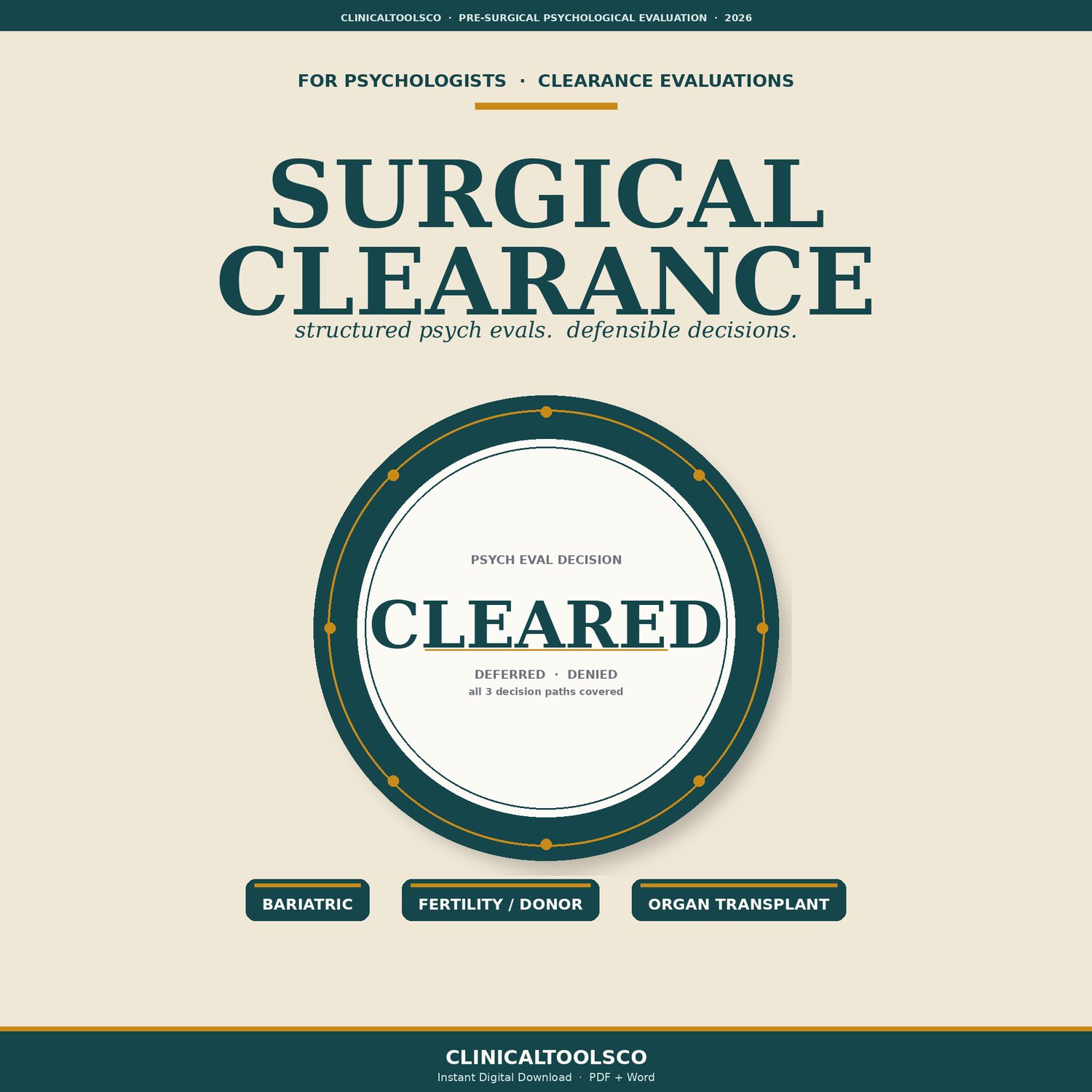
Pre-surgical psychological evaluation templates: a structured clinical interview plus bariatric, fertility, solid-organ transplant and spinal cord stimulator modules.
What is in the bundle
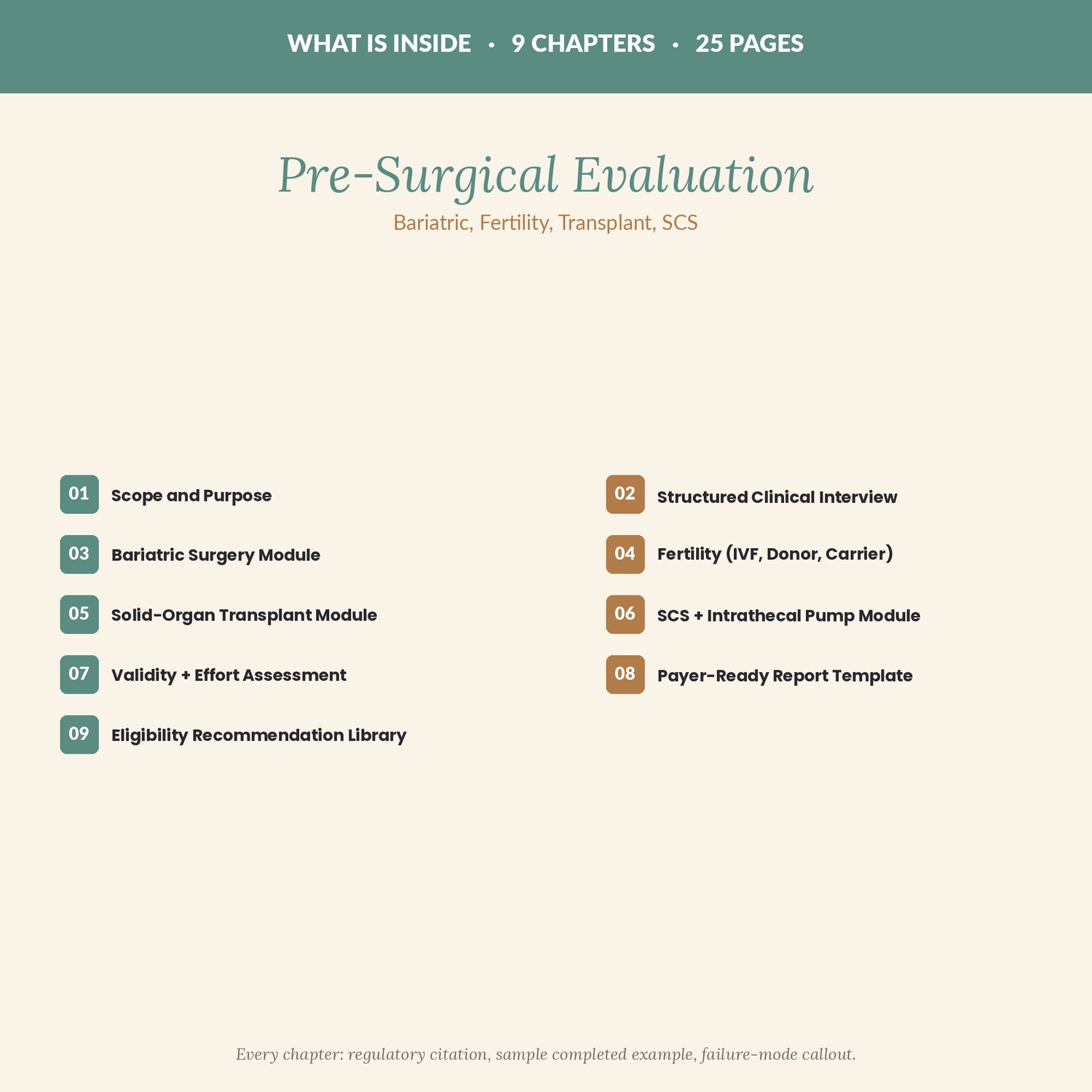
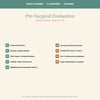
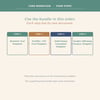
- Chapter 1, Scope and Purpose. The five surgery types behind most clearance referrals, what the payer is actually reading for, referral source patterns, and typical evaluator volume and revenue.
- Chapter 2, The Structured Clinical Interview. A five-section interview covering demographics and procedure context, mental health history, substance use history, medical and behavioral readiness, and the domain-specific module, with a worked time allocation for the standard 90 minute appointment.
- Chapter 3, Bariatric Module. The ASMBS Position Statement framework, the standard self-report battery (PHQ-9, GAD-7, AUDIT, BES, EAT-26) with all cutoffs, the findings that drive defer versus clear, the active binge eating disorder pathway, and a completed bariatric recommendation.
- Chapter 4, Fertility Module. Recipient parent, egg donor, sperm donor, and gestational carrier subcategories under ASRM 2021 standards, the spouse-of-carrier joint evaluation, the disclosure plan discussion, FertiQoL, and a completed gestational carrier recommendation.
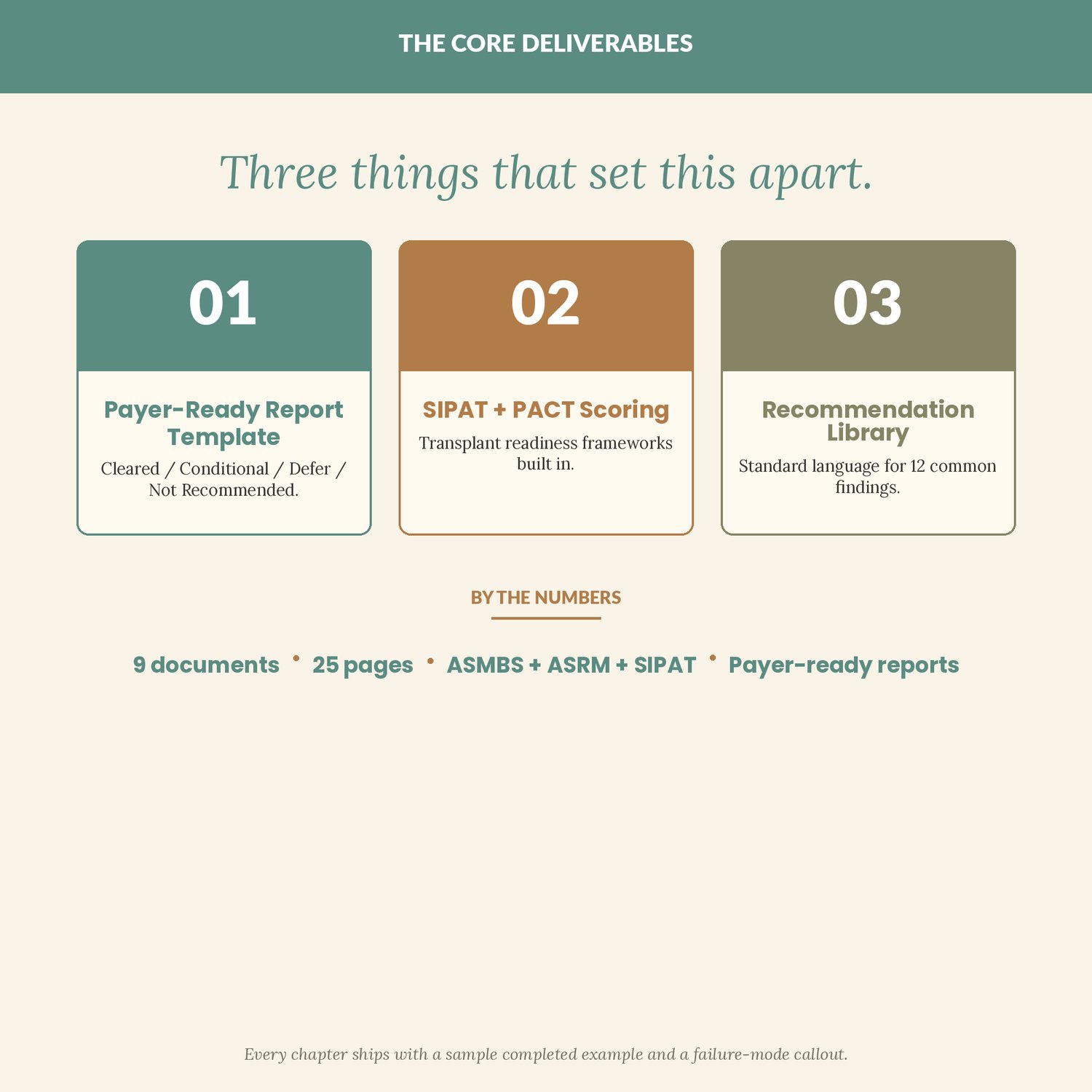
- Chapter 5, Solid-Organ Transplant Module. SIPAT and PACT scoring with cutoff bands, the etiology-of-organ-failure discussion across alcohol-related liver disease, NASH and hepatitis C, the caregiver and financial resources assessment, and a completed kidney transplant recommendation.
- Chapter 6, Spinal Cord Stimulator and Intrathecal Pump Module. Pain catastrophizing (PCS), opioid risk (ORT), kinesiophobia (TSK-11), the CBT-CP conditional clearance pattern, and a completed cleared-with-conditions recommendation.
- Chapter 7, Validity and Effort. The underreporting pattern that dominates this work, MMPI-2-RF and PAI validity scale interpretation, collateral data sources, the discrepancy detection workflow, and the validity statement language every report needs.
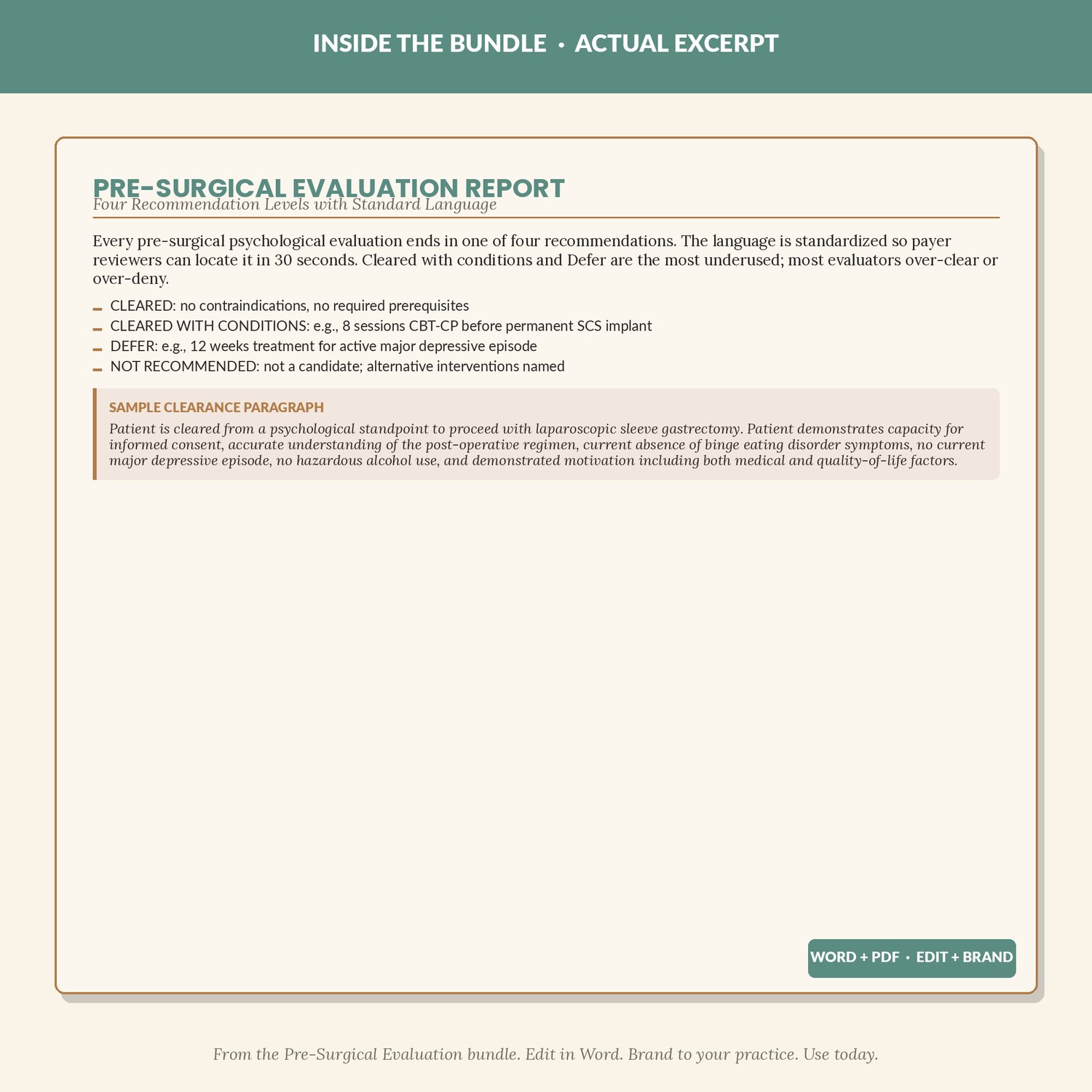
- Chapter 8, The Report Template. Required sections, writing style for the payer audience, a recommendation language library covering all four outcomes (cleared, cleared with conditions, defer, not recommended), and a full sample completed bariatric report from header to signature.
- Chapter 9, Recommendation Library and Programmatic Practice. Patterns for 12 common findings with time-to-re-evaluation guidance, fee structures, billing codes (96130, 96131, 90791), handling disputed outcomes, and a programmatic feedback loop example.
- Plus a citation index for every chapter referencing ASMBS, ASRM, IPPS, AST, AASLD, CMS NCDs, and the underlying validation studies.
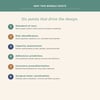
Who it is for
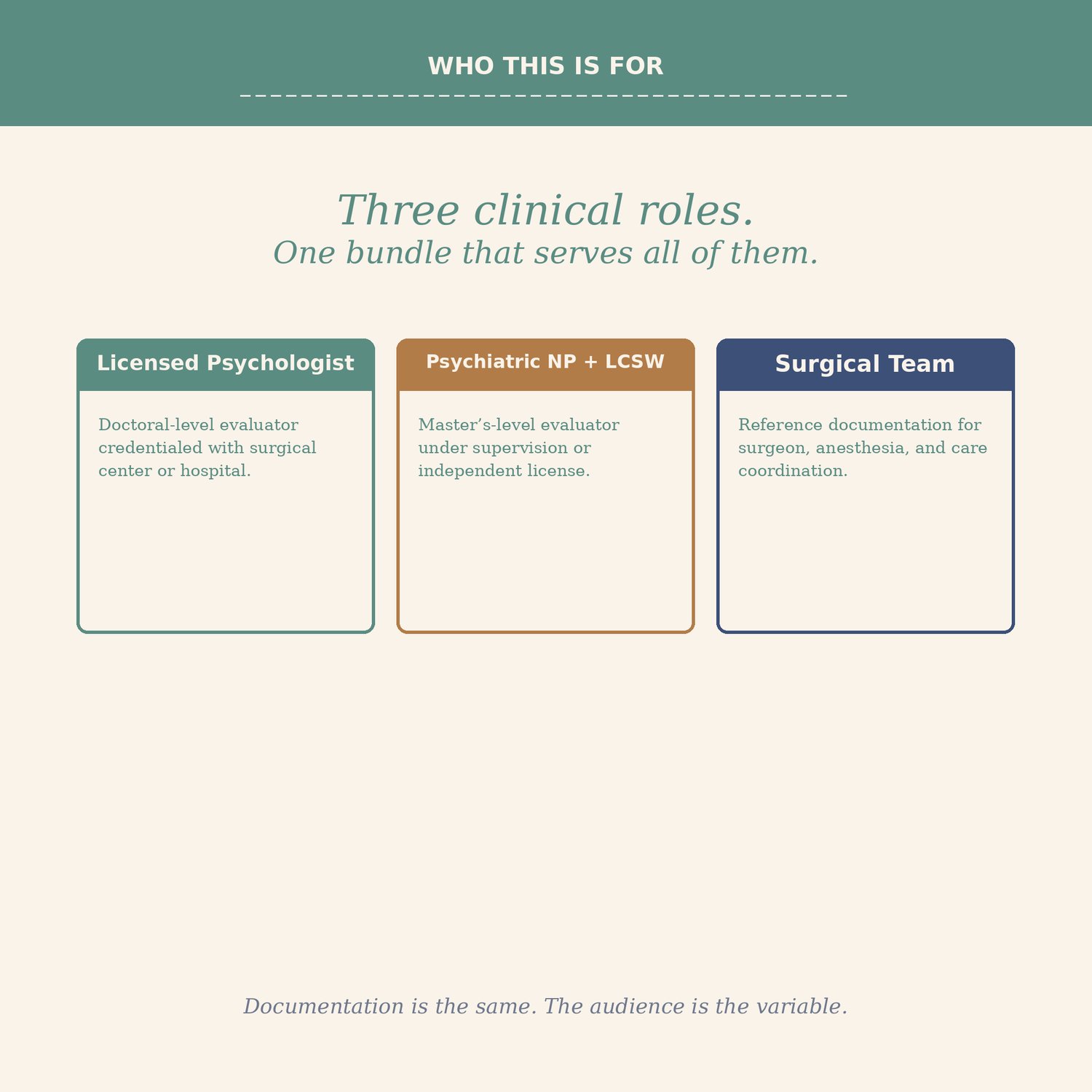
Psychologists (PhD, PsyD) on bariatric, fertility, transplant, or interventional pain panels. LCSWs and LICSWs conducting pre-operative behavioral health assessments. Health psychologists building a pre-surgical practice or specialty clinic. Group practice owners assigning clearance work to credentialed clinicians. Hospital-employed clinicians embedded in surgical teams. Postdoctoral fellows and early-career psychologists learning the structure. Supervisors teaching the methodology. Assessment-focused clinicians adding pre-surgical work to the referral mix.
Why it exists
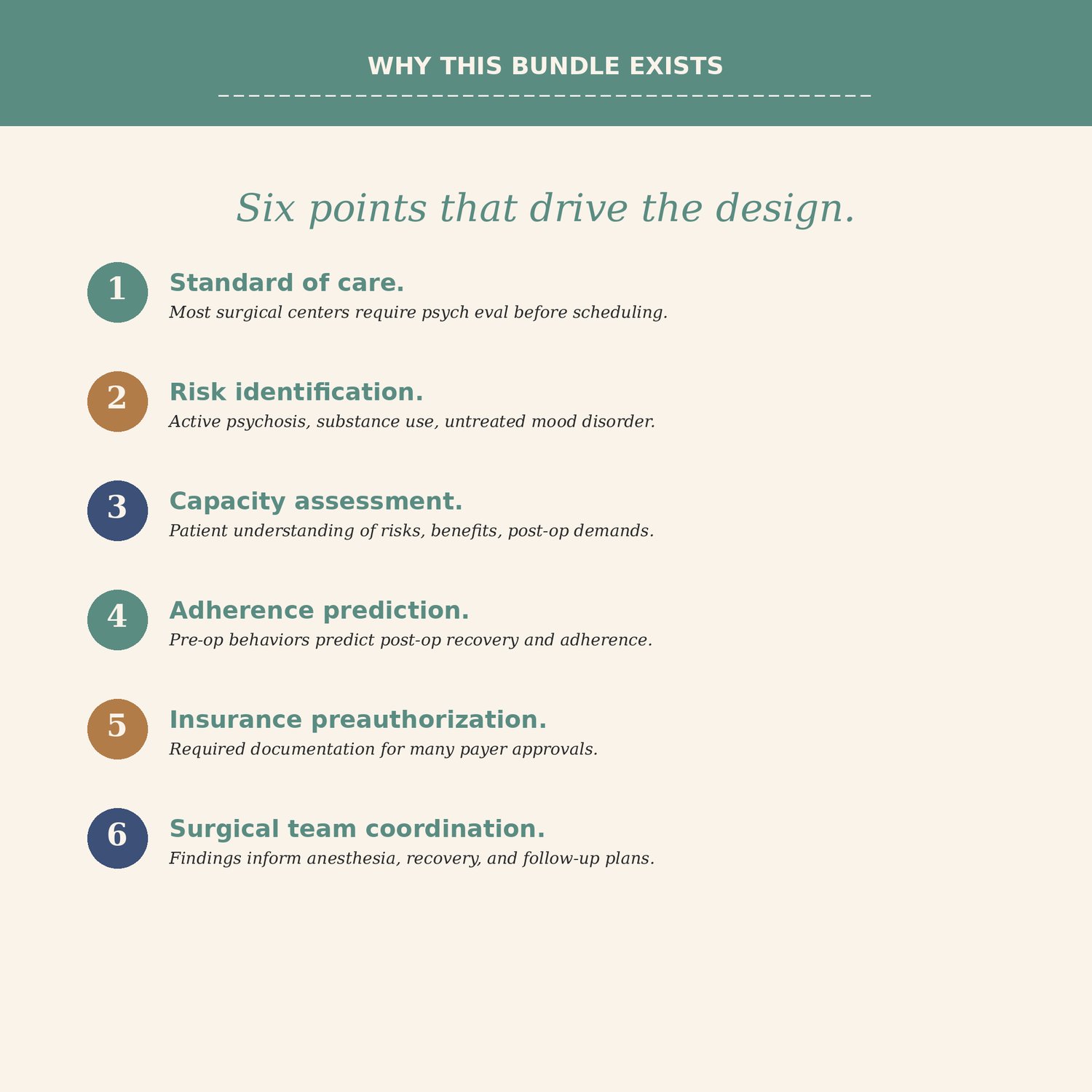
The bariatric coordinator emails on a Tuesday. Can you see Mrs. Doe by Friday, surgery is in three weeks, the carrier wants the clearance letter. You have a 90 minute slot, four standardized measures to administer, a primary care record to review, a SIPAT to score, and a defer-versus-clear call to make on a candidate with a 24 month sobriety claim and an active GAD diagnosis.
A one-page clearance letter with the candidate name as a fillable field is a billing instrument, not an evaluation. The work needs a structured interview, a procedure-specific module, a validity protocol, a scored battery, a payer-ready report, and recommendation language you can defend to a program selection committee.
29 pages, 9 chapters, for the psychologist or LCSW doing clearance evaluations across bariatric, fertility (IVF, donor egg, gestational carrier), solid-organ transplant, and spinal cord stimulator candidates.
Why it is built this way
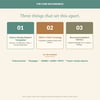
Each procedure has a different evidence base, different payer expectations, and different validated measures. A bariatric module that asks about pain catastrophizing is the wrong module. A transplant module without SIPAT is the wrong module. These are aligned to the standards of each surgical specialty rather than blended into one generic form.
Underreporting is the dominant validity problem here, because candidates know that disclosure can delay surgery. Chapter 7 is the part most pre-surgical clinicians were never formally taught and the part that most often decides whether a report holds up.
The report's strength is in the rationale, not the conclusion. Cleared, cleared with conditions, defer, and not recommended each have their own defensible language patterns, and a defer written well reads as a path forward rather than a denial. Chapter 9 collapses the twelve most common findings into a one-page desk reference for the pattern and the re-evaluation window.
Format
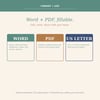
Editable, fillable PDF, 29 pages. Editable Microsoft Word (.docx), same length. Use the report template directly or move it onto your own letterhead. US Letter (8.5 x 11) and A4 (8.3 x 11.7) both included. Works on Mac, Windows, iPad, GoodNotes, and Notability. Lifetime access, unlimited prints.
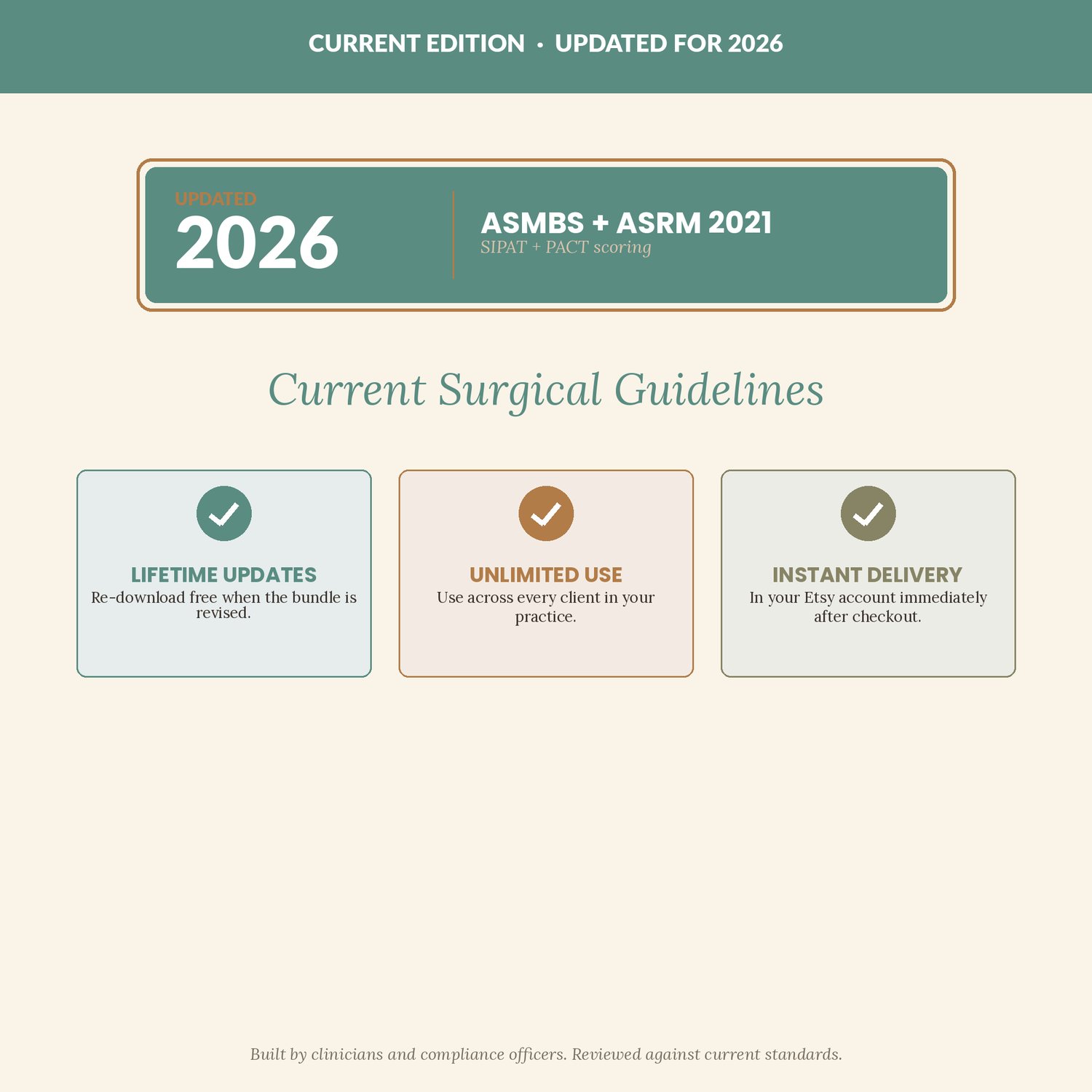
Updated 2026
Reflects the ASMBS Position Statement on Preoperative Psychosocial Evaluation (Mechanick et al., 2020), the ASRM Practice Committee Documents on Psychological Assessment of Gamete Donors and Gestational Carriers (2021), the IPPS Best Practices Statement on Psychological Screening for Spinal Cord Stimulator Implantation (Beletsky et al., 2022), the AASLD Practice Guidelines on Evaluation for Liver Transplantation (2023 update), CMS NCD 100.1 for bariatric and 280.4 for SCS, DSM-5-TR criteria, and the APA Specialty Guidelines for Forensic Psychology (2013) on collateral data and validity. SIPAT and PACT overviews follow the Maldonado validation series. The sample report follows current NCQA UM Standards for the payer reader.
How to use it
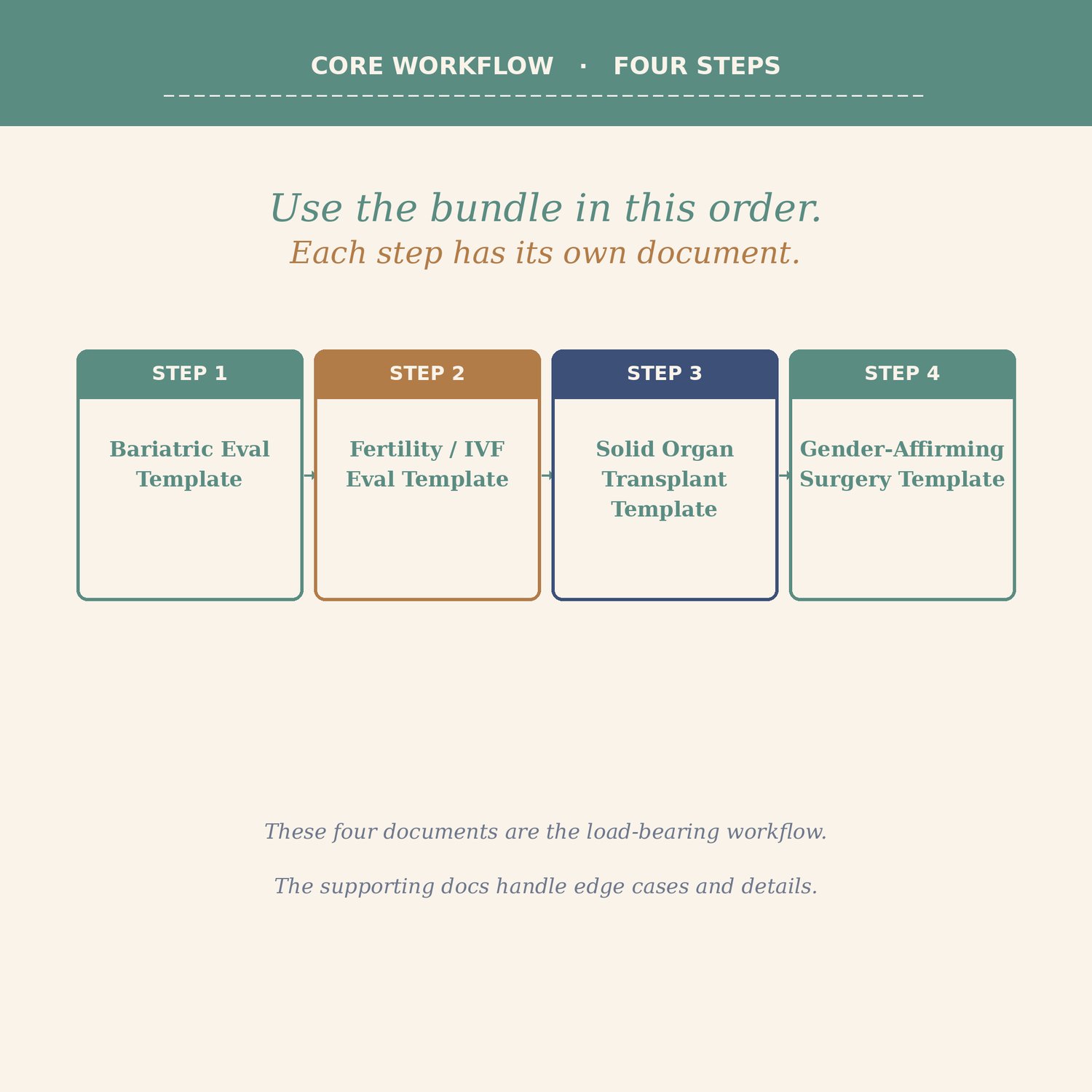
Set scope and pricing from Chapter 1. Anchor every appointment on the Chapter 2 interview, then add the module that matches the referral. Run the self-report battery in the waiting room so scores are in hand when the interview starts. Apply Chapter 7 throughout, corroborating explicitly against the primary care record, the prescribing psychiatrist's note, and the surgeon's history and physical. Write from Chapter 8, anchor the defer-versus-clear call in the Chapter 9 library, and keep the Chapter 9 table at your desk between appointments.
Instant digital download. No physical product ships. Message us if anything does not work.