





Telehealth Practice Setup Bundle (2026)
A telehealth practice setup bundle: telehealth informed consent, an intake addendum, a technology failure and disconnection protocol, a video session note adapter and population-specific sections.
What is in the bundle
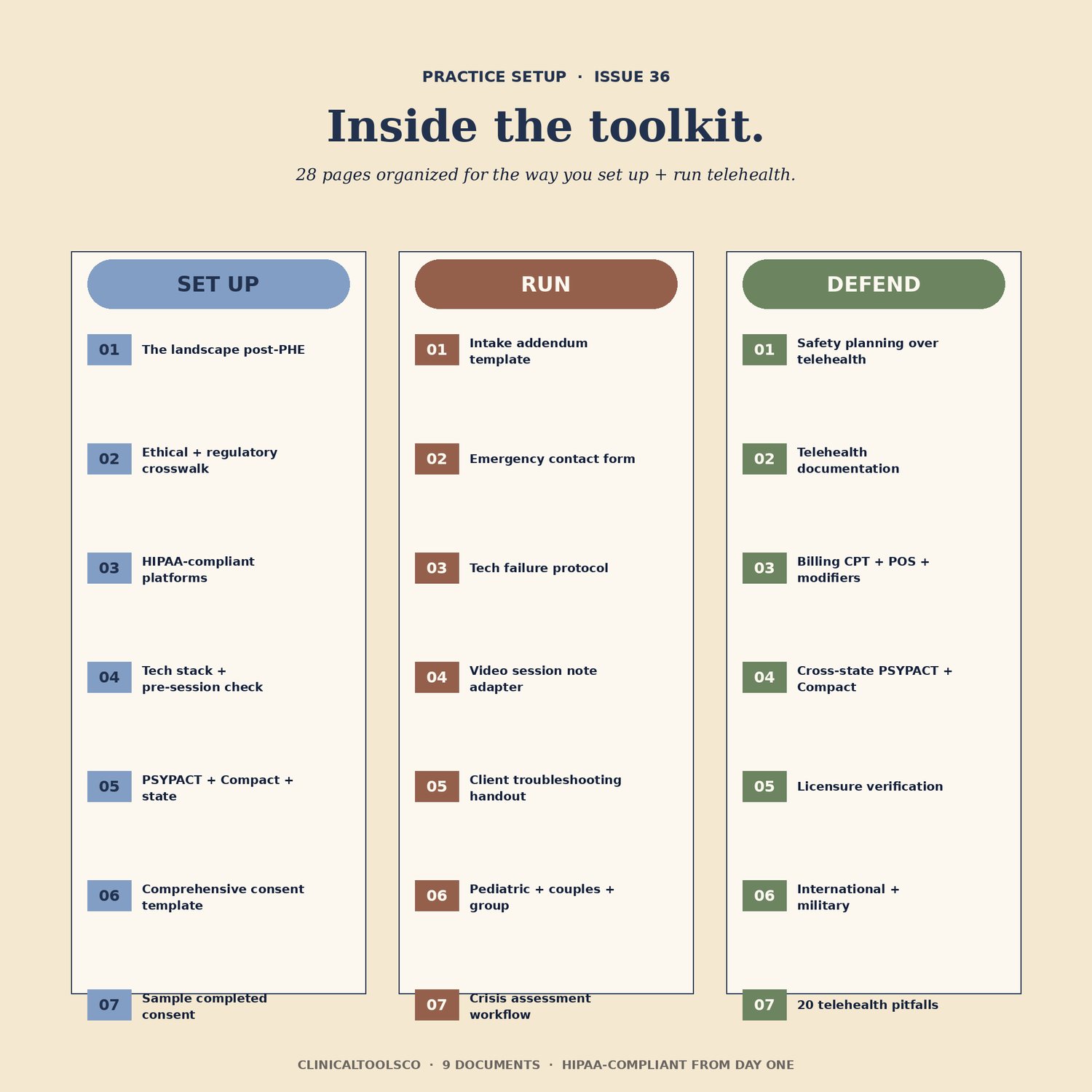
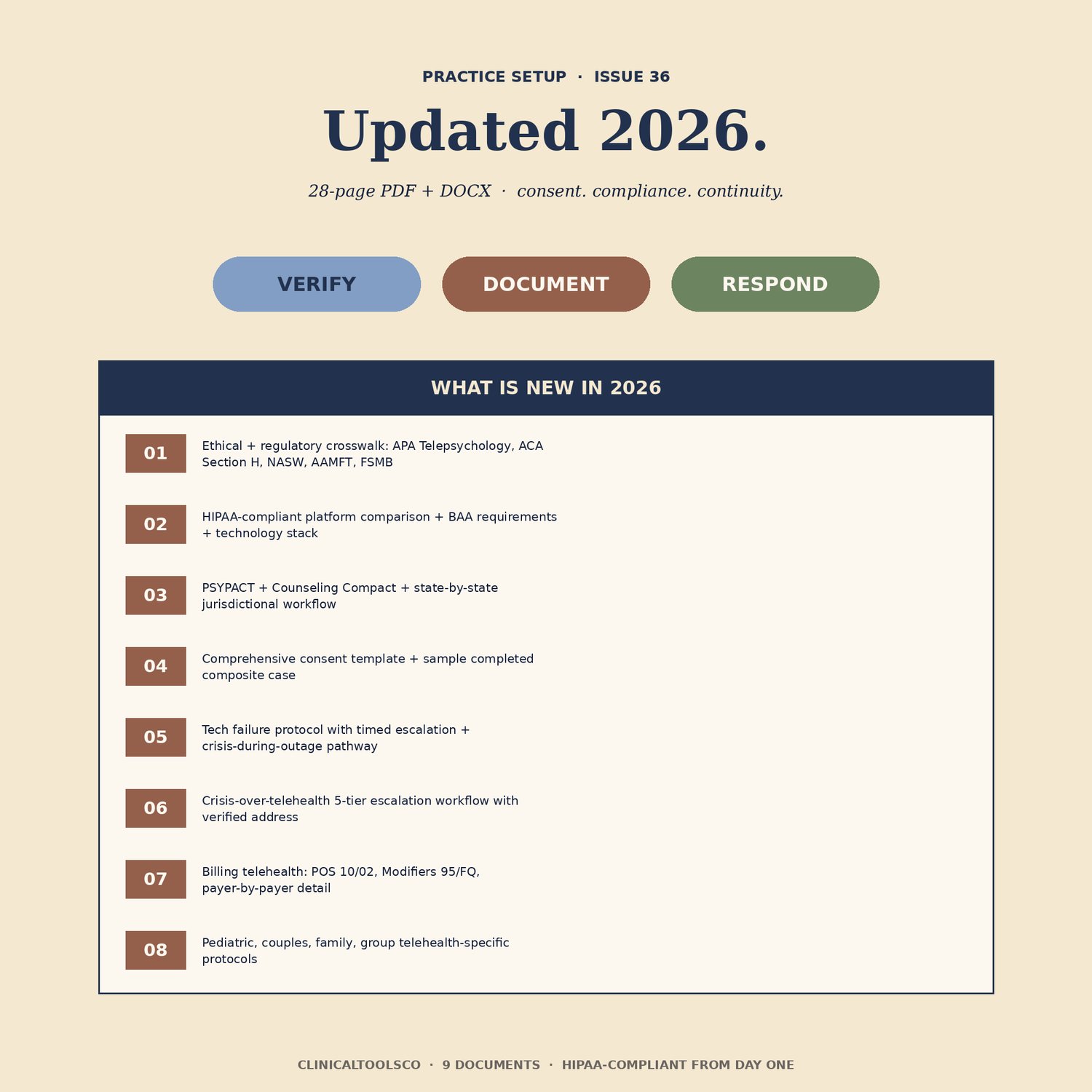
- Setup foundation (Sections 1 to 5): what is permanent versus temporary in US telehealth after the PHE, an ethics and regulatory crosswalk (APA Telepsychology, ACA Section H, NASW Standards for Technology, AAMFT Code 6, FSMB Model Policy, HHS OCR, CMS, state boards), HIPAA-compliant platform requirements, and jurisdictional rules.
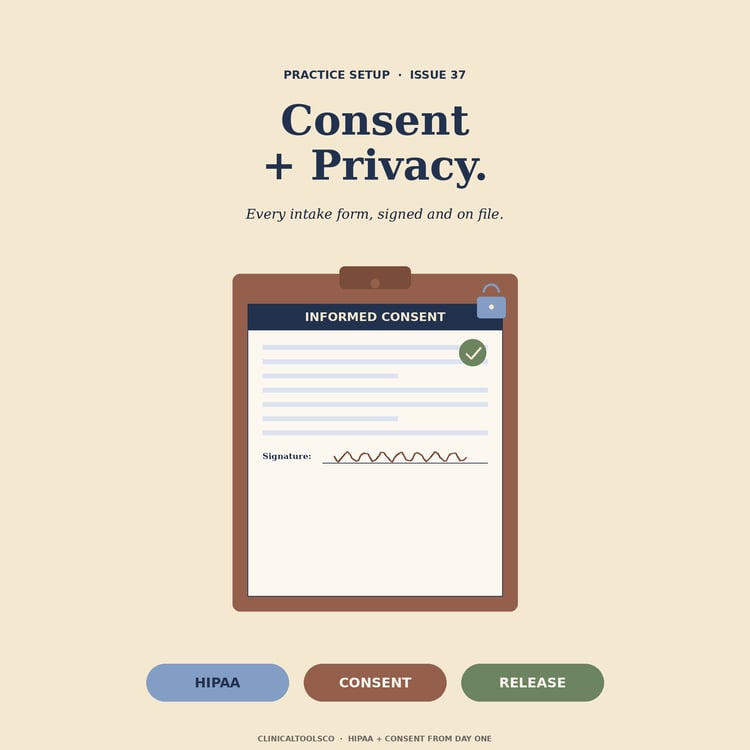
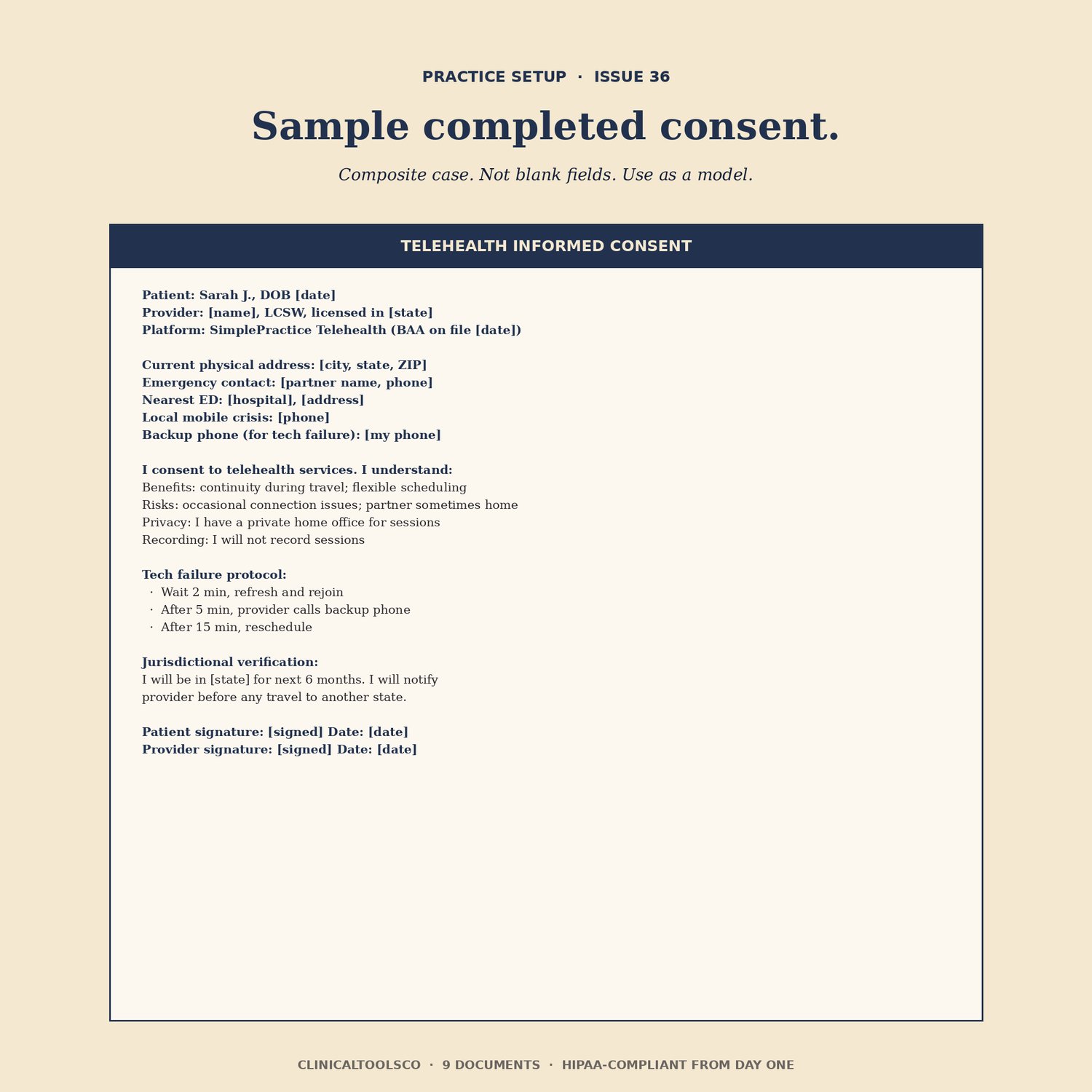
- Full telehealth informed consent template (Section 6) with sample language for identification, the nature of telehealth, benefits, telehealth-specific risks, confidentiality and security, emergency protocols, the technology failure plan, jurisdictional verification, recording rules, and the in-person-may-be-necessary clause. Section 7 is a completed composite example at the level of detail boards and auditors expect.
- Telehealth intake addendum (Section 8): primary physical address, backup phone, emergency contacts, nearest ED, mobile crisis, others potentially in the home, tech setup. Section 9 is a fillable one-page emergency contact and local resources form with a per-session verification block.
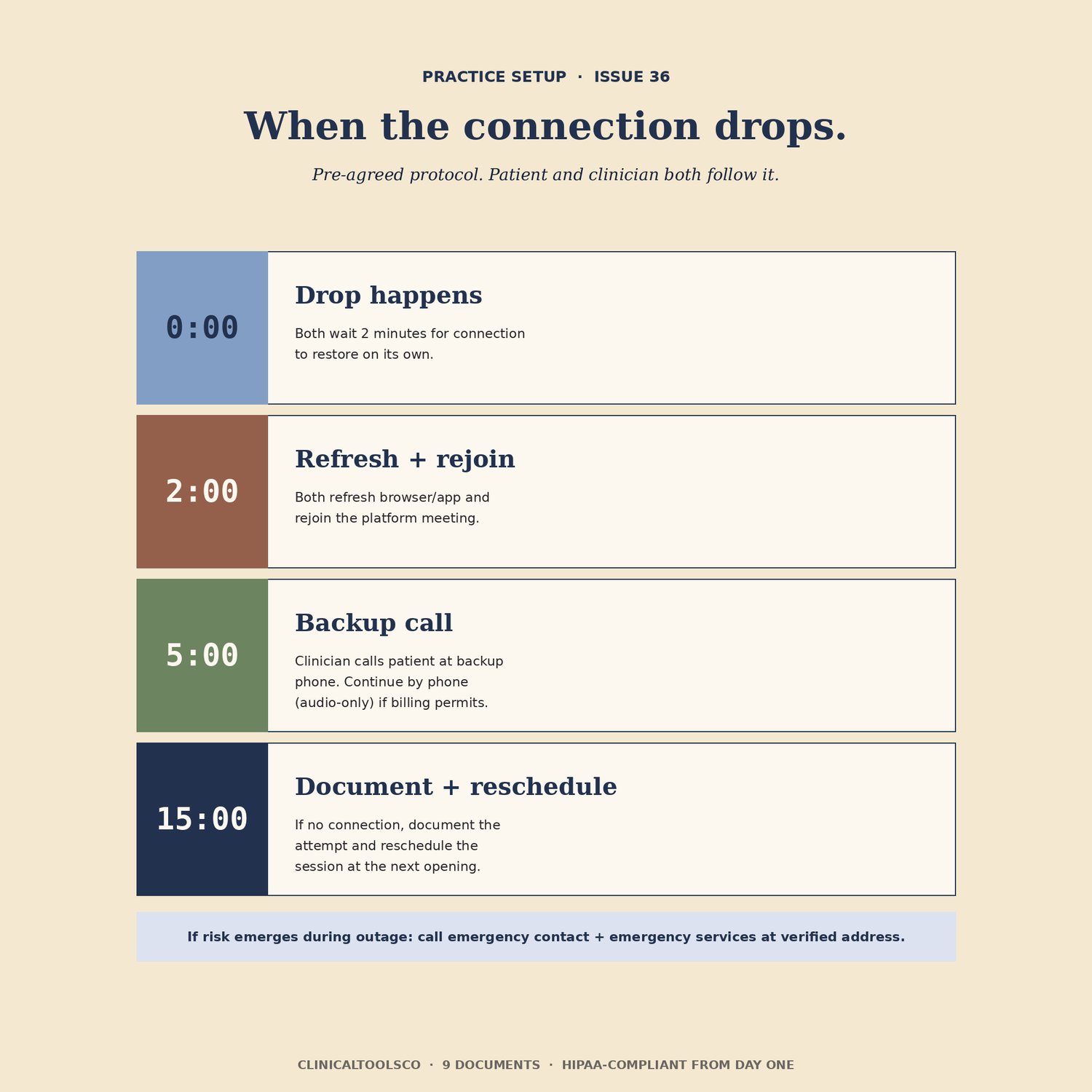
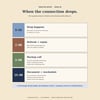
- Technology failure and disconnection plan (Section 10): the default protocol (two-minute wait, five-minute backup phone, fifteen-minute reschedule), a separate pathway for failure during a clinical crisis, prevention practices, and when to move the case to in-person.
- Video session note adapter (Section 11): every telehealth-specific field to add to your existing note, with sample phrasing for a stable connection, a brief drop, and a mid-treatment address change. Section 12 is a patient-facing troubleshooting handout to send before the first session.
- Population-specific sections. Pediatric telehealth (Section 13): minor consent variability by state, developmental considerations, home privacy with adolescents, school coordination, IEP and 504 supports. Couples and family (Section 14): joint consent, multi-screen setup when partners are in different locations, and when telehealth is not appropriate, including active intimate partner violence and custody disputes. Group (Section 15): consent, confidentiality among members, facilitation, documentation.
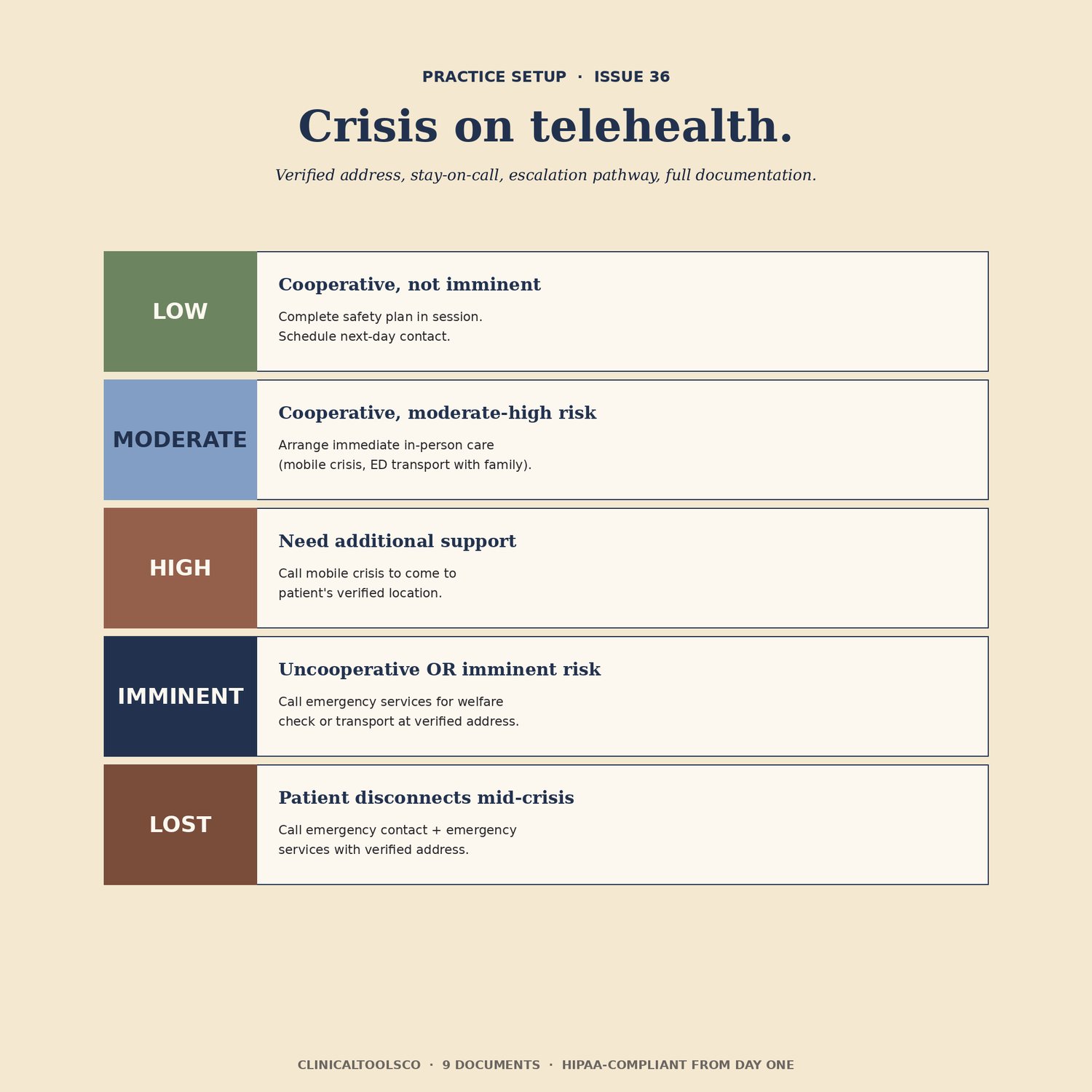
- Crisis assessment over telehealth (Section 16): a five-step escalation pathway running from cooperative low-risk through patient disconnected mid-crisis, with the documentation list for each step. Section 17 adapts the Stanley-Brown six-step safety plan to video, including means restriction in the patient's actual current location.
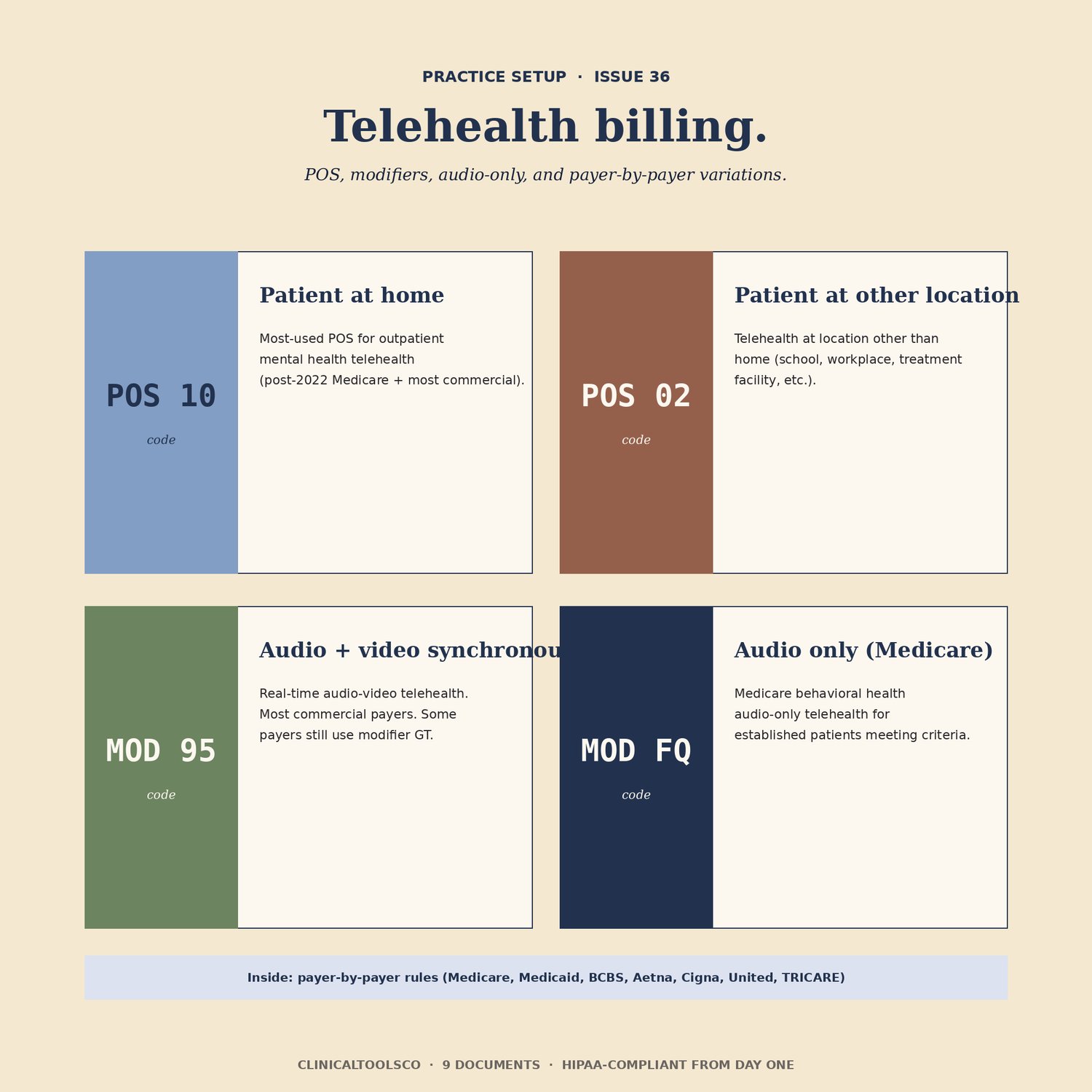
- Billing telehealth (Section 19): POS 10 versus POS 02, modifier 95 versus GT versus FQ versus 93, and a payer-by-payer summary covering Medicare, state Medicaid, and the major commercial payers (BCBS, Aetna, Cigna, United, Anthem, Humana, TRICARE). Section 18 lists the telehealth-specific fields every session note needs.
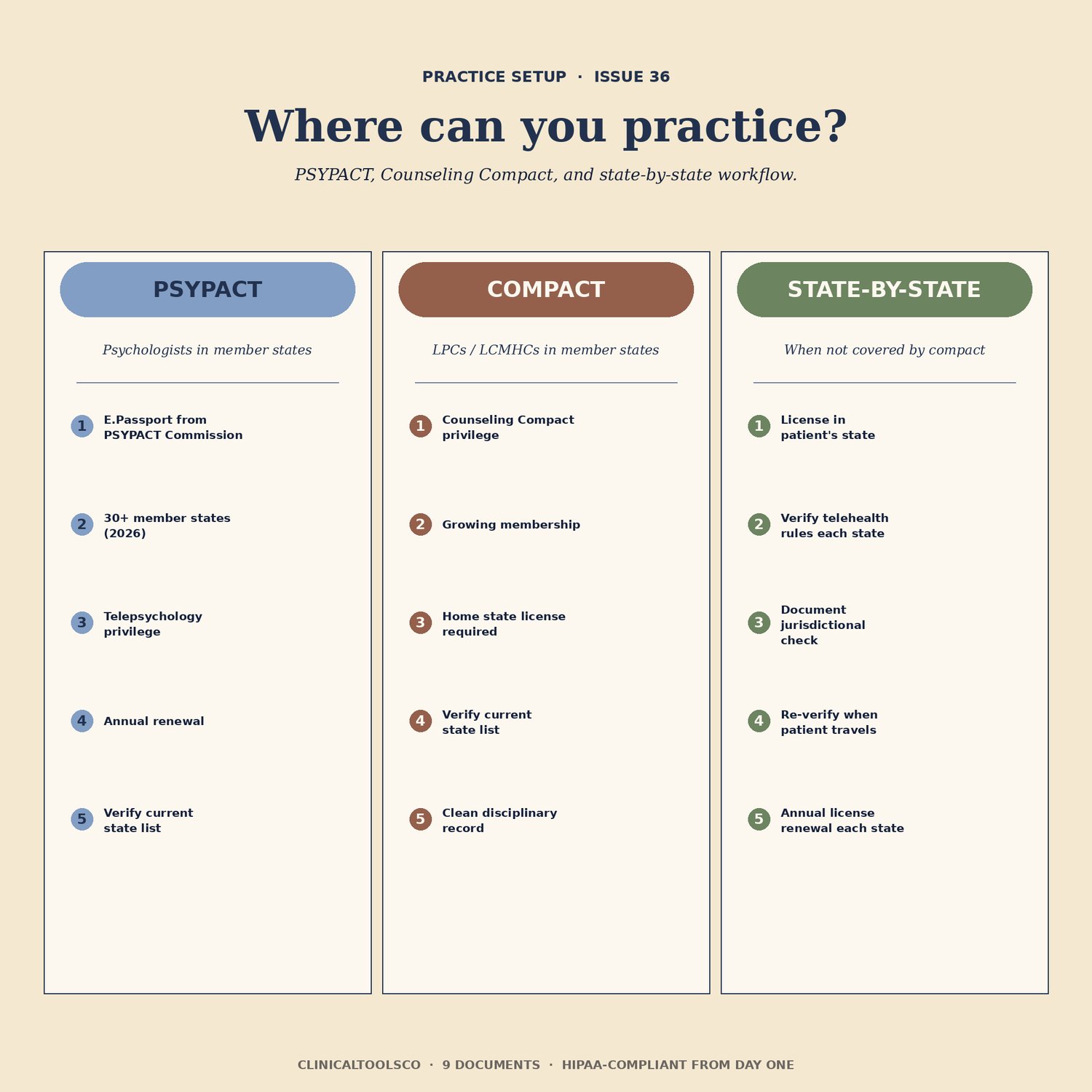
- Cross-state practice (Section 20): PSYPACT for psychologists, the Counseling Compact for LPCs and LCMHCs, IMLC for physicians, the Nurse Licensure Compact, and where the Social Work and MFT compacts currently stand. Section 21 is the licensure verification workflow at intake, at each session, when a patient relocates or travels, plus an annual self-audit.
- International, military, and traveler considerations (Section 22): patient temporarily outside the US, active duty with PCS moves, college students out of state, and permanent relocation handoff. Section 23 is twenty telehealth pitfalls plus a print-and-keep quick-reference card.
Who it is for
Solo practitioners setting up telehealth or upgrading an existing setup. Group practices standardizing policy across associates. Pre-licensed clinicians building a first telehealth caseload under supervision. PSYPACT psychologists and Counseling Compact LPCs and LCMHCs working across member states. Psychiatrists and psychiatric NPs, including those working under DEA controlled-substance rules. Supervisors training supervisees on setup and crisis management. Agency clinicians expanding services. Anyone working with relocating, traveling, military, or college-student patients.
Why it exists
The patient logs in from a hotel room in Nevada. You hold a license in Colorado. The connection drops twice and the tech failure plan is somewhere on your hard drive. The note template still has POS 11 hardcoded from 2019 because nobody ever updated it.
41 pages, 23 sections. The operational paperwork telehealth actually runs on: informed consent, intake addendum, emergency contact form, tech failure protocol, note adapter, crisis pathway, billing reference, and the jurisdictional verification workflow, with the regulatory citation behind each one.
Why it is built this way
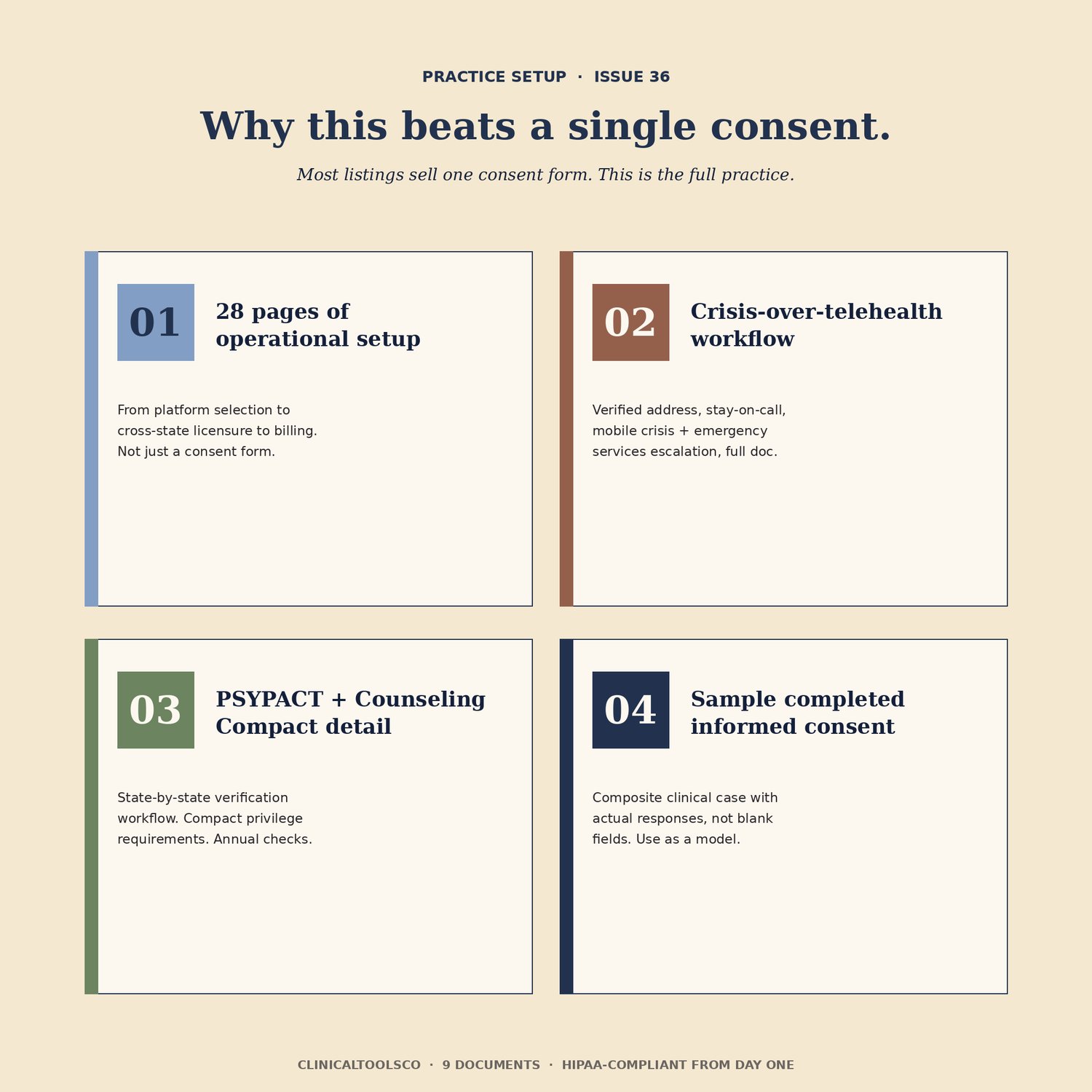
Most telehealth material online is a two-page association summary or a platform vendor's marketing PDF. Neither gives you a consent form you can send tomorrow.
A generic in-person consent does not satisfy state telehealth consent requirements. The template here covers what APA, ACA, HIPAA, and state board guidance converge on, in language you can paste and adapt.
Nobody writes a tech failure protocol until they need one, and then they are improvising mid-session with a high-risk patient. This one is agreed to in writing, by both parties, before the connection ever drops.
A crisis over video is a different clinical situation than a crisis in your office. You do not have the room and you do not have physical access. Section 16 is built for that reality, including the case where the patient disconnects in the middle of a risk encounter.
Cross-state licensure is the single largest legal exposure in telehealth and the rules are still moving. The verification workflow here matches the address-verification cadence boards expect. On the billing side, POS 10, modifier 95, modifier FQ, and payer-specific variations drive most telehealth denials, which is what the payer table is for.
Format
Editable, fillable PDF, 41 pages. Editable Microsoft Word (.docx) with the same content for in-house customization. Consent and intake forms ready to drop onto letterhead or load into your EHR. US Letter (8.5 x 11) and A4 (8.3 x 11.7) both included. Works on Mac, Windows, iPad, GoodNotes, and Notability. Lifetime access, unlimited prints.
Updated 2026
References current APA Guidelines for the Practice of Telepsychology, ACA Code of Ethics Section H, NASW Standards for Technology and Social Work Practice, AAMFT Code 6, FSMB Model Policy, HHS OCR HIPAA telehealth guidance, and CMS post-PHE permanent rules for behavioral health telehealth. Cites POS 10 as the post-2022 standard for patient home and Medicare's permanent audio-only allowance for established behavioral health patients in qualifying circumstances. PSYPACT membership is currently above 30 states, with the Counseling Compact still growing. Crisis language uses the 988 Suicide and Crisis Lifeline and Crisis Text Line at 741741.
How to use it
Setting up or overhauling: read Sections 1 to 5, draft consent from Section 6, check your platform against Section 4, confirm jurisdictional standing with Sections 5 and 21, and write your tech failure protocol from Section 10. Every new patient after that: Section 6 consent, Section 8 addendum, and Section 9 emergency form at intake, with the Section 12 handout sent ahead of the first session. Print Section 23 and tape it near the desk. Section 16 is the page to know cold before you need it.
Instant digital download. No physical product ships. Message us if anything does not work.