
The CPLEE is 100 questions in two and a half hours.
How many questions are on the CPLEE?
100 multiple choice questions. 75 are scored and 25 are non-scored items the California Board of Psychology is trialing for future forms. The non-scored items are not identified, so you answer all 100 as though each one counts.
How long do you get for the CPLEE?
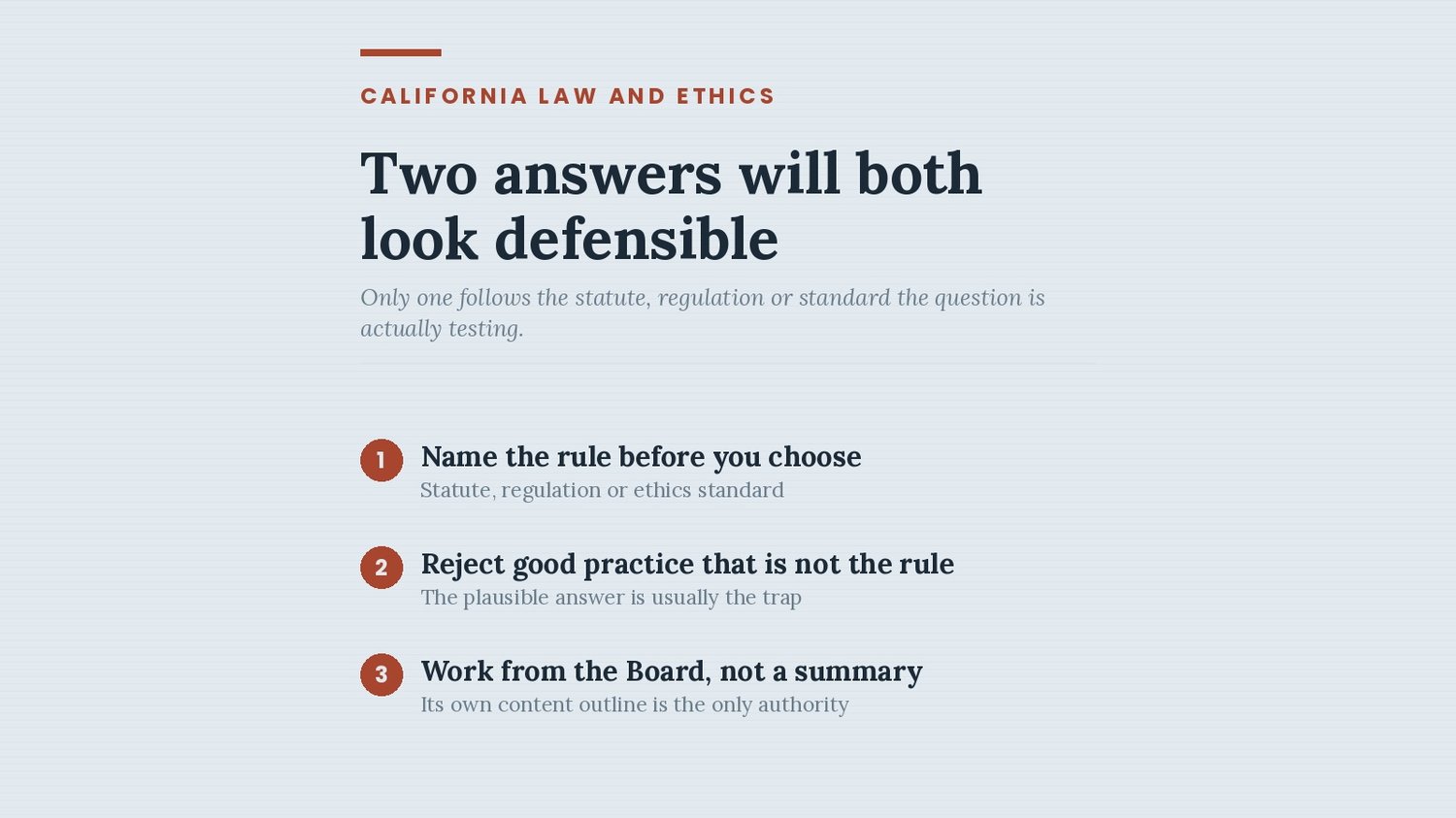
Two and a half hours for 100 questions, which is 90 seconds an item. Time is rarely the problem on this exam. The problem is that two of the four options usually describe defensible practice and only one follows the specific statute, regulation or ethics standard the question is testing.
What is the CPLEE and who has to take it?
The California Psychology Law and Ethics Examination is the state exam for initial licensure as a psychologist in California, taken alongside the EPPP. It is not a renewal requirement. It is written and administered by the California Board of Psychology.
What are the eight CPLEE content areas and how are they weighted?
Two areas tie for largest at 20 percent each: Informed Consent, Confidentiality, and Privilege, and Assessments, Evaluation, and Intervention. Professional Competence is 16 percent. Psychotherapeutic Relationships is 13 percent. Records is 11 percent. Teaching, Training, Supervision, and Research is 9 percent. Professional Issues is 6 percent. Administrative is 5 percent.
Those weights are from the Board's Examination Outline effective January 1, 2022, which is the outline in force.
What is a passing score on the CPLEE?
The Board does not publish a cut score, and it does not say whether the result is scaled. Results are reported as pass or fail. No practice percentage translates into a prediction on this exam.
Is the CPLEE changing?
A replacement outline is in progress. The Board's 2025 subject matter expert recruitment placed the third occupational analysis workshop, where the new outline was to be finalized, in March 2026. As of this writing nothing new has been posted and the 2022 outline is still the live document. If your test date is more than a few months out, re-check the Board's site for a new outline before you build a schedule around the old one.
Is the CPLEE the same as the BBS law and ethics exam?
No. The Board of Behavioral Sciences runs a separate California law and ethics exam for LMFT, LCSW and LPCC candidates. Different board, different statutes emphasized, different exam. Prep material for one is not prep material for the other.
What should you study first for the CPLEE?
Confidentiality and privilege, because it is one of the two largest areas and because it is where California law is most specific and most different from what the APA Ethics Code alone would tell you. Mandated reporting thresholds, the limits of privilege, and the specific record access rules in the Health and Safety Code are the material candidates most often answer from general ethics instinct rather than from the statute, and the exam is written to catch exactly that.
Our California Law and Ethics Exam Prep bundle is built to the Board's 2022 outline, with practice questions weighted across the eight content areas in the same proportions as the exam.
Score yourself by section
The free CPLEE mini exam is 40 questions across the eight content areas of the Board outline, with a written rationale for every answer. The spread between the largest area and the smallest is four to one, so score it by area and let that decide where your next hours go. No card and no code.
Watch the walkthrough
How the CPLEE works in 2026. About 8 minutes, chaptered so you can jump to the part you need.
Related guides
An independent study aid. Not affiliated with, endorsed by, or sponsored by the California Board of Psychology.