

The MFT National Examination is 180 questions, and the score you get back is a raw count.
How many questions are on the MFT National Examination?
180 multiple choice questions. The AMFTRB candidate handbook says nothing about pretest or unscored items, so unlike most licensing exams there is no published unscored block to plan around. Treat every question as scored.
How long do you get for the MFT exam?
Four hours for 180 questions, which is 80 seconds an item. That is more room than the counseling and social work exams give, and the candidates who run short are usually the ones re-reading long vignettes rather than the ones who did not know the material.
How is the MFT exam scored?
Differently from most licensing exams. AMFTRB reports a raw score, the number of correct responses, equated across forms so that a harder form and an easier form require different raw counts to pass. AMFTRB does not publish the passing number. It is set by a modified Angoff standard setting process, and the figure that applies to your form is not something you can look up in advance.
What are the six MFT exam domains and how are they weighted?
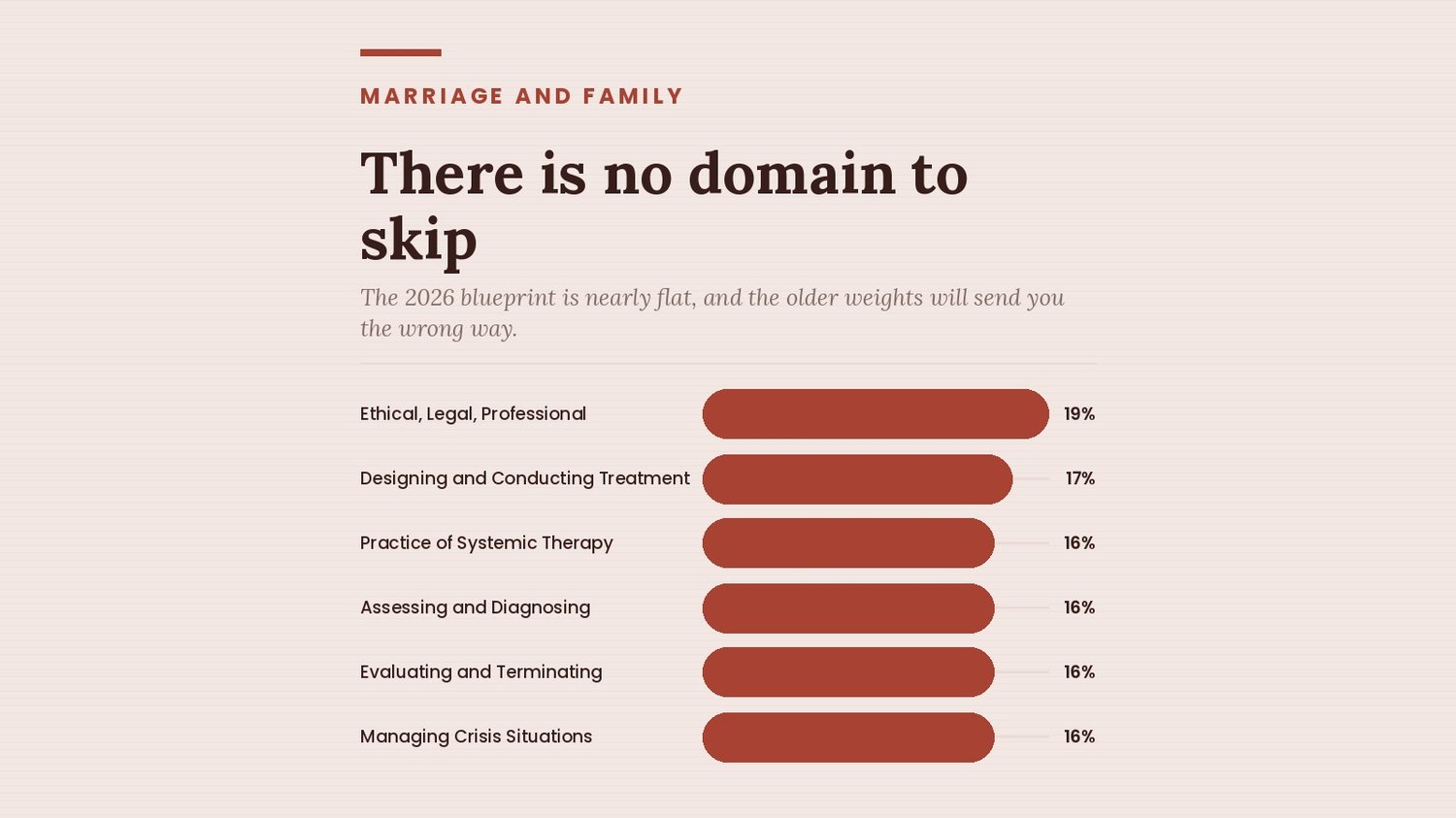
The 2026 blueprint is nearly flat. The Practice of Systemic Therapy is 16 percent, 29 questions. Assessing, Hypothesizing, and Diagnosing is 16 percent, 29 questions. Designing and Conducting Treatment is 17 percent, 30 questions. Evaluating Ongoing Process and Terminating Treatment is 16 percent, 29 questions. Managing Crisis Situations is 16 percent, 29 questions. Maintaining Ethical, Legal, and Professional Standards is 19 percent, 34 questions.
Ethics is the largest domain by a small margin. Nothing else is far enough ahead of the pack to justify skewing a study plan toward it.
Did the MFT exam blueprint change in 2026?
Yes. The domains were rebalanced for 2026 examinations off a 2024 to 2025 role delineation study, and the candidate handbook says so on its face. Older prep material tends to carry weights of roughly 23, 14, 20, 10, 14 and 19 percent, which describe a different distribution. AMFTRB does not publish a change log, and the handbook PDF has been replaced more than once during 2026, so the revision date printed on the document, currently April 30, 2026, is the only marker of which version is in force.
Which states use the MFT National Examination?
Most, but not all, and California in particular uses its own clinical exam through the Board of Behavioral Sciences. Whether you take the AMFTRB exam, a state exam, or both, and at which stage of licensure, is decided by your state board, not by AMFTRB.
How many times can you take the MFT exam?
The waiting period between attempts and any cap on total attempts come from your state board, and they vary. Confirm your board's rule before your first attempt rather than after, because a cap changes how you should treat the first attempt.
What should you study first for the MFT exam?
Because the blueprint is nearly flat, the useful first move is a diagnostic rather than a domain. Find out where you actually stand across all six before building a schedule, then give the weeks to whichever two domains are weakest, with ethics kept in the rotation throughout because it is the largest.
Our MFT National Exam Prep bundle was rebuilt to the 2026 blueprint proportions, with the practice set weighted 16, 16, 17, 16, 16 and 19 percent across the six domains.
Score yourself by section
The free MFT mini exam is 40 questions across the six practice domains, with a written rationale for every answer. The blueprint is nearly flat, so score it by domain and put your next study hours into whichever one you actually did worst in. No card and no code.
If you want the arithmetic for turning those weights into weeks, it is in how to turn your exam blueprint into a study plan.
Watch the walkthrough
How the MFT National Exam works in 2026. About 8 minutes, chaptered so you can jump to the part you need.
An independent study aid. Not affiliated with, endorsed by, or sponsored by AMFTRB. AMFTRB is a trademark of the Association of Marital and Family Therapy Regulatory Boards.